Search by topic
- archaeology
- Building of Local Interest
- chapel
- charity
- church
- crime
- dressmaker
- Great Eastern Railway
- Listed building
- Mapping Relief
- medieval
- oral history
- poverty
- Public House
- railway worker
- Religious House
- Roman
- scholar
- school
- Then and Now
- tudor
- women
- work
- world war one
- world war two
Search by text


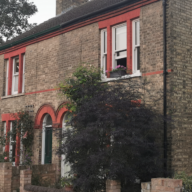
99 Hemingford Road, Cambridge
History of 99 Hemingford Road
1898 gardens
In 1901 and 1911 the Clark family were living in Hemingford Road. The 1899 inquest took place while they were living at Gwydir Street, address unknown.
1899 CDN 9.3.1899: Another Infant’s Death. Overlaying in Cambridge. At the Gwydir Arms, Gwydir-street, on Wednesday, an inquest was held by Mr Coroner French, concerning the death of Dorothy Olive Clark, the two months old daughter of Arthur Edward Clark, tailor, of Gwydir-street, and Eliza Clark (both of whom are deaf mutes).
The evidence of the mother was interpreted by her sister. Mrs Crawshaw. She stated that the deceased was two months old, and had been healthy since birth. On Monday she went to bed with the deceased as usual, and gave it the breast at 11 p.m. About half past five she woke and found the deceased had slipped off her arm. and was partly covered with the clothes. She aroused her husband. and they sent for her sister. The deceased was sleeping on the outside of the bed.
Mrs Crawshaw, sister of the last witness, said she was called to the deceased about 5.45 on Tuesday. She went and found her sister sitting in bed, nursing the child, which was quite dead.
Mr Edwin Stanley Wood, physician and surgeon, of Gwydir House, Gwydir street, deposed to being called to the deceased on Tuesday morning He had since made a post-mortem examination and found that death was due suffocation, undoubtedly caused having been overlaid by the mother. The Jury returned a verdict in accordance with the medical evidence.
1901
Arthur E Clark, 29, tailor, b Cambridge, deaf and dumb
Eliza, 26, b Hatley, deaf and dumb
1911
Arthur Clark, 39, b Cambridge
Eliza, 36, b Tadlow
Arthur, 2, b Cambridge
1913
Arthur E Clark, tailor
1951
Arthur Edward Clark
1960 James Wilsher
1970 Alan Fraser
Alan Fraser’s reminiscences of life in Romsey Town can be found in “Hemingford Road 1878-2012” and cover the period of 1963 to 2006.
“The only people that I can recollect having baths when we were young in the 1940s, they obviously had a lot more money. I found that there was a big gap between the lower class and the upper class, and the upper class had a lot better things.
Romsey itself was called Railway Town; Red Russia was another name it got.”
‘We were neighbourly. I didn’t do John’s for money, I helped him do it. I helped Keith Wadham. We put windows in John’s place, we put fences up. My mates all lived round here, if one was a plumber, I’d go round and do their brickwork and they’d come round to do my plumbing. You never mentioned money. Everyone kept to their promise, they didn’t let you help them and then not turn up at yours. That’s how it was.’
Projects
Contribute
Do you have any information about the people or places in this article? If so, then please let us know using the Contact page or by emailing capturingcambridge@
Licence
This work is licensed under CC BY-NC-SA 4.0