Search by topic
- archaeology
- Building of Local Interest
- chapel
- charity
- church
- crime
- dressmaker
- Great Eastern Railway
- Listed building
- Mapping Relief
- medieval
- oral history
- poverty
- Public House
- railway worker
- Religious House
- Roman
- scholar
- school
- Then and Now
- tudor
- women
- work
- world war one
- world war two
Search by text


Malting Lane, Litlington
History of Malting Lane, Litlington
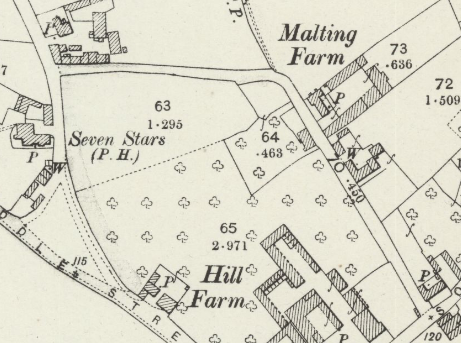
Litlington OS 1901
Malting Lane ran west and south east from Malting Farm, unnamed in 1901.
1861
James Covington, 24, ag lab, b Litlington
Jeremiah Willmott, 23, bricklayer, b Litlington
Augusta Monis, 32, dressmaker, b Litlington
John Ball, 34, ag lab, b Litlington
Abraham Pack, 34, blacksmith, b Ashwell
Elizabeth, 34, b Herts
Abraham, 12, b Beds
Elizabeth, 10, b Beds
George, 8, b Herts
Thomas, 2, b Litlington
James, 5ms, b Litlington
In 1881 the Pack family are living in the Blacksmith’s Shop on Royston Road, Litlington. According to the Ancestry genealogy on this family, Abraham Burr Pack (1827-1901) married Elizabeth Phillips (1826-1902). Ten children are recorded (in the Johnson Family Tree). One of these is Elizabeth (1850-1927) who was born in Stotfold Beds and died in Bassingbourn. She married Walter C Wedd. The family history of their granddaughter, Doris Roisseter, paints a vivid account of family life at the end of the 19th century.
Mary Dickerson, 60, formerly farmers wife, b Litlington
Susan Cockerill, 65, b Bassingbourn
John Sharp, 29, ag lab., b Litlington
Joseph Pateman, 26, bootmaker, b Bassingbourn
1871
James Gardner
Henry Jarman
Simon Willmott
John Ball
Abraham Pack, 44, blacksmith
Elizabeth,
George, 17, bricklayers apprentice
Thomas, 12, labourer
Fanny, 7, b Litlington
William, 5, b Litlington
Alfred, 3, b Litlington
Frederick, 9ms, b Litlington
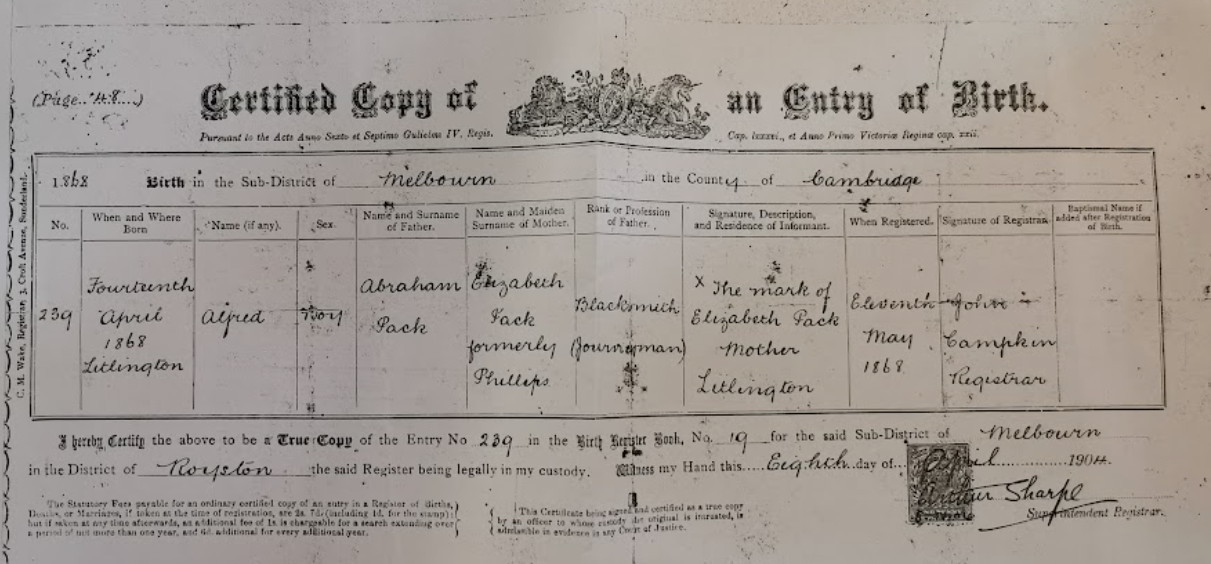
Alfred Pack birth certificate 1868
Projects
Contribute
Do you have any information about the people or places in this article? If so, then please let us know using the Contact page or by emailing capturingcambridge@
Licence
This work is licensed under CC BY-NC-SA 4.0