Search by topic
- archaeology
- Building of Local Interest
- chapel
- charity
- church
- crime
- dressmaker
- Great Eastern Railway
- Listed building
- Mapping Relief
- medieval
- oral history
- poverty
- Public House
- railway worker
- Religious House
- Roman
- scholar
- school
- Then and Now
- tudor
- women
- work
- world war one
- world war two
Search by text


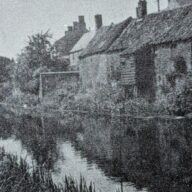
Fence Bank, Walpole Highway, Norfolk
History of Fence bank
Reminiscences of a Fenman by James W Taylor was published in 1980. The author was born in Fence Bank in c.1910.
The Taylor family is that of William Lester Taylor listed in the 1911 census at Walpole Highway, the nearest village to Fence Bank.
William Lester Taylor, 31, butcher, b Holt Norfolk
Charlotte Elizabeth, 25, b Walpole St Peters
Rose Ward, 6, b Walpole St Peters
Francis Agnes, daughter, 3, b Walpole St Peters
Annie Elizabeth, 2, b Walpole St Peters
Olive May, 1, b Walpole St Peters
1921
William Taylor, 41, b Norfolk, postman
Charlotte, 35,
Agnes, 13,
Annie, 12,
Olive, 11,
James, 8, b Walpole St Peters
The autobiography starts with an account of the family, – James was the youngest of six, the others being sisters, – being so poor that James’s father was unable to afford the £6 needed for his daughter, Doris’s, funeral. She died of double pneumonia before her second birthday. Fence Bank was a very isolated community and in the winter very difficult to reach because of the mud.
In 1913 the family moved to Walpole Highway, a cottage on Mill Road. His father joined the army and was sent to Gallipoli.
The autobiography contains several poems which James says he wrote throughout his life.
After WWI the family moved to No. 4 Council House, West Drove North. His father rented 5 acres and had a post round. James attended Curtons Endowed School at Walpole St Peter.
One acquaintance was the dairy farmer, William Pratt who lived at West Drove South. He had a daughter, Mary.
William and his sister Olive attended Walpole Highway church on Sundays.
James’s father opened a fish and chip shop in Walpole Highway, next to the Bell Inn.
In 1934 James married and started building a house in Terrington St John. The book ends in 1939 with a promised that there will be another volume.
Projects
Contribute
Do you have any information about the people or places in this article? If so, then please let us know using the Contact page or by emailing capturingcambridge@
Licence
This work is licensed under CC BY-NC-SA 4.0