Search by topic
- archaeology
- Building of Local Interest
- chapel
- charity
- church
- crime
- dressmaker
- fire
- Great Eastern Railway
- Listed building
- Mapping Relief
- medieval
- oral history
- poverty
- Public House
- Religious House
- Roman
- scholar
- school
- Then and Now
- tudor
- women
- work
- world war one
- world war two
Search by text
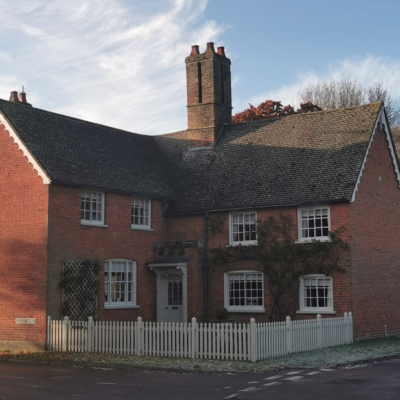
The Chequers, Impington
History of the Chequers
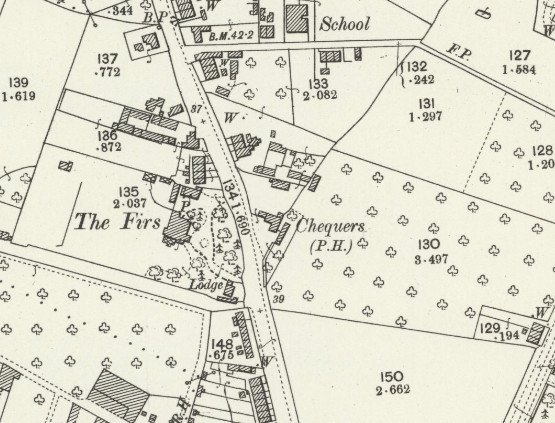
OS 1901, Impington
(History of the Inns and Public Houses, Histon and Impington, 1990)
1765 William Gilbert granted a licnse. It was a brick abndn thatched building of three low rooms, cellar and three bedrooms.
1772 Mary Gilbert, possibly widow, became licensee
1778 Thomas Brand licensee
1806 part of the Pepys Estate, inherited by Rev John Pine Coffin.
1807 William Peyton licensee
1818 Sarah Peyton licensee. The property was as some point sold to the brewers Steward and Cotton of Trumpington Street.
1821 – 1822 John Pettit licensee
1822 – 1828 Thomas Dye licensee
1837 Steward and Cotton declared bankrupt and purchased by Nutter & Elliston
1842 Nutter and Elliston bankrupt
1851 Chequers Public House
William Bird, 48, publican employing 1 boy, b Milton
Charlotte, 44, b Hilton
Peter, 5, b Impington
In 1861 William Bird is a gardener living with his family on the High Street
1861 Chequers lane
Robert Mansfield, 48, publican and ag. lab., b Histon
Elizabeth, 47, b Willingham
John, 20, ag. lab., b Histon
William, 17, ag. lab., b Histon
Eliza, 14, b Histon
Emma, 10, b Histon
Elizabeth, 6, b Histon
1871 Chequers
Robert Mansfield, 57, publican and farmer of 13 acres employing 1 man and 1 boy, b Histon
Elizabeth, 56, b Willingham
James, widower, 35, coprolite digger, b Histon
Sarah, 22, b Histon
Elizabeth, 17, dressmaker, b Hiton
Naomi Emily Nash, 1, granddaughter, basket makers daughter, b Middlesex
1881
Robert Mansfield, 67, publican and farmer 12 acres employing 1 man, b Histon
Elizabeth, 66, b Willingham
Emma, 28, b Histon
1882 Robert Mansfield, Owner of Chequers
1896 Lacons bought freehold. William Pegg licensee
1904 Fred Norman, licensee
1912 Property sold to James Mowlam and delicensed.
Ethel James, granddaughter of James Mowlam, has added her memories to the account in ‘History of Inns and Public Houses …’
Projects
Contribute
Do you have any information about the people or places in this article? If so, then please let us know using the Contact page or by emailing capturingcambridge@
Licence
This work is licensed under CC BY-NC-SA 4.0