Search by topic
- archaeology
- Building of Local Interest
- chapel
- charity
- church
- crime
- dressmaker
- fire
- Great Eastern Railway
- Listed building
- Mapping Relief
- medieval
- oral history
- poverty
- Public House
- Religious House
- Roman
- scholar
- school
- Then and Now
- tudor
- women
- work
- world war one
- world war two
Search by text
Typhoid, Cholera, Plague and water supply in Cambridgeshire
History of Typhoid and Cholera in Cambridgeshire
1327 The Grey Friars first piped water from springs at Gravel Hill yo thir Friary on Sidney Street. (Massie 2024)
1349 Plague in Cambridge – Black Death. According to Alasdair Massie (2024) the Black Death in Cambridge completely depopulated the Castle side of the river and halved the population on the east. In 1366 the parishes of All saints and St Giles merged as ‘the parishioners of All Saints are for the most part dead by pestilence, and those that are alive have gone to other parishes, the name of All Saints in ruinous and the bones of dead bodies are exposed to beasts.’
1389 Plague
1513 Plague in Cambridge: Erasmus leaves Cambridge to escape
1574 Plague killed 11 people in Cambridge. Believed by Dr Andrew Perne, Vice Chancellor, to be because of corruption of King’s Ditch. he organised tenders for a ‘new river’, later known as Hobson’s Brook, to flush the ditch.
1577-1578 Plague in Cambridge
1584 Plague in Wisbech
1587 Plague in Wisbech
1610 New River built in Cambridge. It was realised that as well as scouring the King’s Ditch it could also provide clean drinking water.
1630 347 deaths in Cambridge from plague (Massie 2025)
1665-66 Plague in Cambridge: killed 920
1815 Outbreak of ‘Cambridge Fever January. This was probably typhoid and caused the University to close at Easter. The outbreak killed 8 possibly 9 students and an unknown number of townspeople. By May Dr Thomas Okes, senior surgeon at Addenbrookes concluded that up to 54 might have died aross the Borough.
In the same year Benjamin Bevan was approached for advice on Cambridge’s sewers. He would go on to recommend that sewers were enclosed, city streets flushed, meadow drains scoured and old flat bottomed drains replaced with cylindrical pipes.But there was no suggestion of removing sewage from the river.
1832 Cholera in Ely
23/3/1832 Cambridge Chronicle
In 1832, 32 inhabitants of Nordelph died of cholera. Reepham medicine was claimed to work. At time of report 19 deaths.
20/4/1832 Cambridge Chronicle
Cholera at Ely: 49 dead.
Cholera in Wisbech: 20-30 died.
That Alarming Malady by Reginald Holmes, 1974, is a detailed account of the cholera epidemic in Ely in 1832.
A poem of gratitude to Dr Stevens was published as a broadsheet after the Ely cholera outbreak.
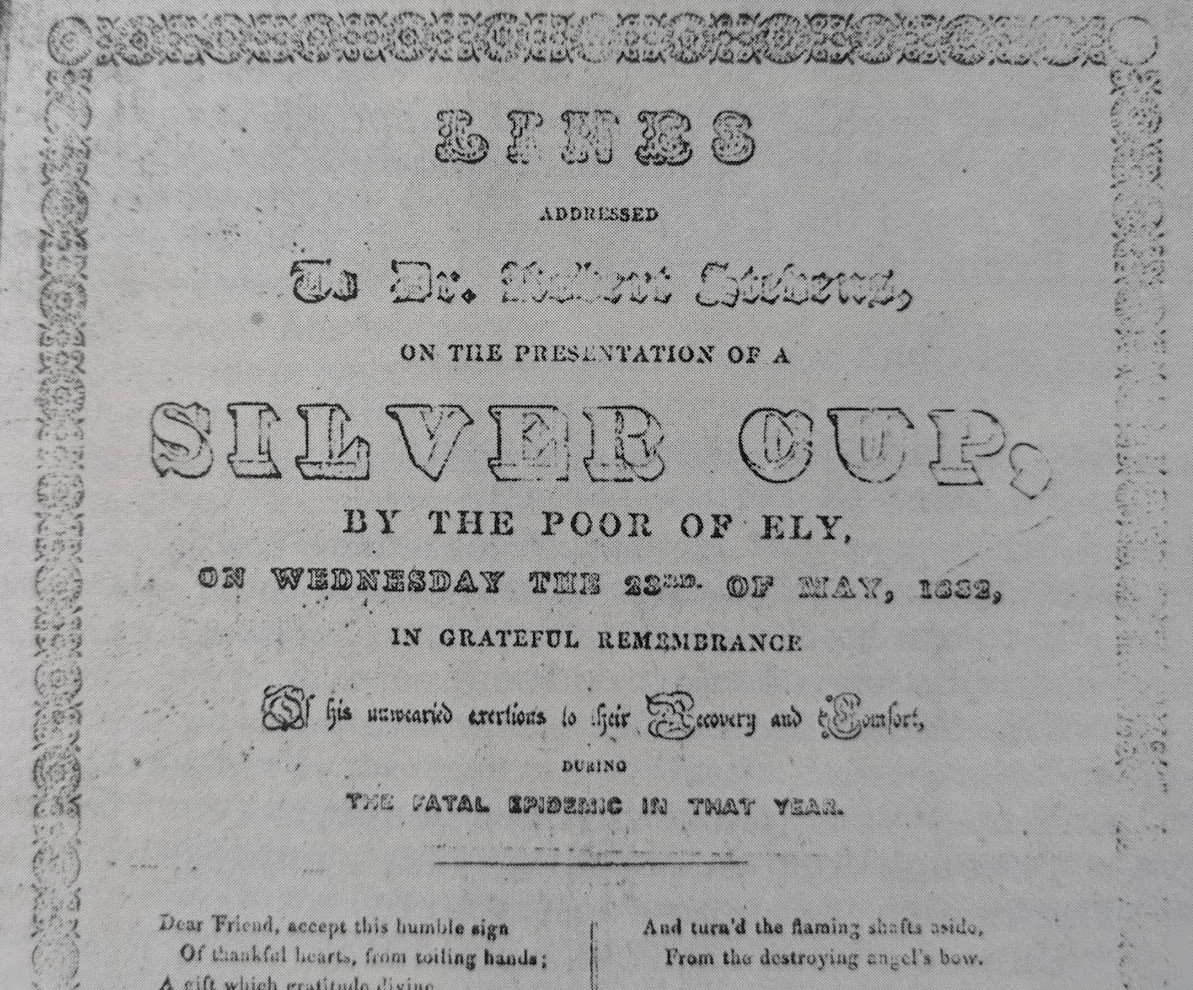
Published poem of thanks to Dr Stevens, Ely, 1832
1848 Cholera in Nordelph, Wisbech and Cambridge
16/12/1848 Cambridge Independent Press
1848 Cholera in Cambridge
20/12/1848 Cambridge General Advertiser
Wayment, 70 year old man Shelly Row
Hillsden, 21 year old woman, Quayside, spasmodic cholera
1849 Cholera in Wisbech
20/1/1849 Cambridge Independent Press
Cholera at Nordelph (Northdelp) in Upwell
24/11/1849 Cambridge Independent Press
In 3rd Quarter of 1849 there were 80 cholera deaths in Wisbech
40 cholera deaths in North Witchford
In 1849 William Ranger carried out an inquiry in Cambridge. One finding was that cholera ha been reported in Round Church Yard and a long list of alleys, courts and yards were described as frequent sources of typhus, small-pox, scarlet fever and malaria. they lack clean water, sanitation and ventilation. Crutch Alley [location unknown] off King Street was described:
In Crutch Alley a man, wife and eight children, the eldest a girl of 23 years of age (with two children), two sons 19 and 16, two girls 12 and 7, a boy of 5, and an infant 6 months, occupy three beds in one room 11 feet by 9 feet 6 inches and the window scarcely ever open. [Ranger, William, report to General Board of Health 1849]
River Lane contains five houses without any privy. Several of the occupants throw excrement into the street, and others make use of a pail, carrying it into the fields once or twice a week; others buy it in their yards; whilst the inhabitants residing in eight houses in Cardinal’s Cap Yard deposit the soil upon a midden bed. In other parts, as in the courts in York Street, pails are made use of, and soil removed by night carts that traverse the town on alternate nights – Monday, Wednesday and Friday each week. But in St Sepulchre’s Passage, which is a seat of cholera, and in numerous other places, the soil at the date of inspection was flowing over the surfaces of courts and passages.
1852 Typhoid in Cottenham
30/10/1852 Cambridge Independent
See ‘Olwyn Peacock, Cottenham’s Troubled Waters 1978’.
So many people died that autumn that a special day was set aside for prayers in the Church and Chapels. The outbreaks were without doubt caused by the liquid from household and animal cesspools seeping into the water supplies in the village.
1853 Cholera epidemic
29th October Ms Snarey of Portugal Place was the first victim in Cambridge. There were no more victims in Cambridge but Elt, Soham and Isleham all suffered casualties.
1854 Cholera in Wisbech
Death rate of 49 per 1,000 highest in the country
15/9/1854 Lincolnshire Chronicle
1855 21st October Cambridge Waterworks opened. Not everybody was pleased. The laundresses of Cherry Hinton abused the Directors for interfering with their water supply. Customers paid on a sliding scale; those with houses worth less than £5 paid 4s 4d per annum. Baths and WCs were charged extra: 10s for the first, 5s for extras. Water supplied to floors other than ground was 5s extra.
1857 Typhoid in Cottenham
1861
Prince Albert died from typhoid after visiting his son at Madingley.
1865 Cholera in Wisbech
Woman died at Parson Drove
1866 Cholera in Linton
8/9/1866 Cambridge Chronicle
4 deaths in Linton
1873 Cholera in Cambridge – Caius College
1874 Typhoid in Cambridge
24/1/1874 The Ipswich Journal
7/2/1874 Norfolk News
10/2/1874 Bury and Norwich Post
George Fowler, 46, died of typhoid, manager of Rivingtons
1877 The original pumping house was extended.
1878 Typhoid in Cambridge
23/9/1878 Bradford Daily Telegraph
Typhoid in Cambridge
1885 Typhoid in Cottenham
By March there were 65 cases with 6 deaths. With two exceptions, all cases were at Church End and could be connected with the infected area. Seven cases which occurred before 17th January broke out in the houses at the extremities of Whitehead’s or Smith’s Path. The Chesterton Medical Officer Dr. Anningson that the water distribution in the village could explain the outbreak. Part of the village was on greensand, part on gault clay. The part of the village on gault was supplied by water in pipes from the greensand area. Wells had been dug in the gault area which served as underground reservoirs. It was into these reservoirs that sewerage matter had percolated and the pipes would transfer typhoid bacteria from one well to another. Twenty seven wells in the village were tested; eighteen were unfit for drinking. Of twelve wells at Church End, nine were bad.
It was however still not generally accepted that the disease was caught via water; there was a an old tradition of placing lighted pipes of tobacco on the coffins of typhoid victims to ‘purify’ the air.
It would take 20 years for the households at Church End to get a reliable supply of clean running water. Until then, water was delivered from cart into pails. Peacock’s monograph has details of the reports and discussion that took place.
1887 Typhoid at Fulbourn
30/9/1887 Cambridge Chronicle
‘Perfectly filthy’well
1887 Typhoid at Grantchester
30/9/1887 Cambridge Chronicle
1888 Typhoid in Fen Ditton
25/5/1888 Cambridge Chronicle
30 cases in Fen Ditton
1888 Inquiry at Cottenham
16/3/1888 Cambridge Independent Press
1889 Typhoid in Ely
10/7/1889 Cambridge Daily News
1889 Typhoid in St Ives
1/7/1889 Cambridge Daily News
Miss Burgess died
1889 Typhoid in Cambridge
30/8/1889 Cambridge Daily News
Newmarket Road – 40 infected
31/8/1889 Cambridge Daily News
George Sedgeley, 14, Riverside
5/9/1889 Cambridge Daily News
Cheddar’s Lane, Cambridge
1892 Cholera in March
5/10/1892 Suffolk and Essex Free Press
J Harlow, potato merchant in March
1893 Typhoid at Fen Ditton
11/8/1893 Cambridge Independent Press
1893 Typhoid at Cherry Hinton
11/8/1893 Cambridge Independent Press
1893 Typhoid in Sawston
29/9/1893
Death of Mrs Townsend
1899 Typhoid in Sawston
8/9/1899 Cambridge Independent Press
1899 Typhoid in Cambridge
27/10/1899 Dublin Daily Nation
Annie Perrin dies of Typhoid
1901 Typhoid in Cambridge
29/3/1901 Cambridge Independent Press
Four cases in East Road
1902 Typhoid in Cottenham
27/6/1902 Cambridge Independent Press
7 cases at Green End, Cottenham
4/7/1902 Cambridge Independent Press
Typhoid and bad water at Cottenham
18/8/1902 Cambridge Independent Press
1902 Typhoid in Gamlingay and Orwell
11/7/1902 Cambridge Independent News
1903 Typhoid in Cherry Hinton
12/9/1903 London Daily News
Sewerage Dispute at Cambridge
1905 Typhoid in Fulbourn
19/5/1905 Herts and Cambs Reporter & Royston Crow
60 cases of typhoid, some fatal at Fulbourn Lunatic Asylum
1907 Typhoid in Fulbourn
4/10/1907 Lunatic Asylum reported free of Typhoid
1908 Typhoid in Fulbourn
1/5/1908 Cambridge Independent
18 cases (4 fatal) in County Asylum
1910 Cambridge Water Supply Bill
15/4/1910 Cambridge Independent Press
1916 Typhoid in Wisbech
3/12/1916 The People
Wisbech VAD hospital evacuated because of typhoid epidemic
Sources include:
A Tale of Three Pumping-stations, The development of Cambridge’s public health infrastructure in the nineteenth century, by Alasdair Massie (May 2024)
Projects
Contribute
Do you have any information about the people or places in this article? If so, then please let us know using the Contact page or by emailing capturingcambridge@
Licence
This work is licensed under CC BY-NC-SA 4.0