Search by topic
- archaeology
- Building of Local Interest
- chapel
- charity
- church
- crime
- dressmaker
- fire
- Great Eastern Railway
- Listed building
- Mapping Relief
- medieval
- oral history
- poverty
- Public House
- Religious House
- Roman
- scholar
- school
- Then and Now
- tudor
- women
- work
- world war one
- world war two
Search by text
40 Ainsworth Street
40 Ainsworth Street
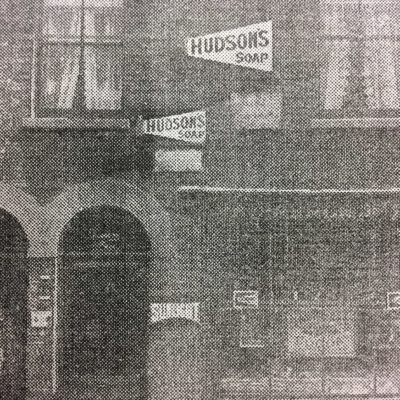
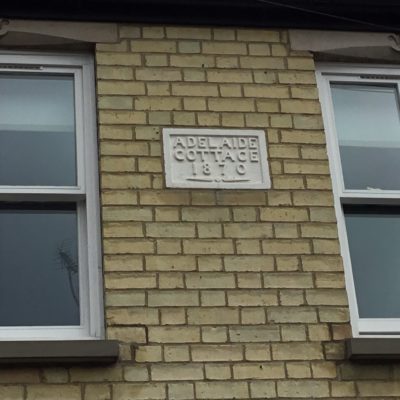
Number 40 is one of a terrace of four houses standing on the east side of Ainsworth Street.
1881 census
Sarah A Clarke, head, widow, 25, dressmaker, b. Cambridge
Charles F Clarke, son, 1, b. Cambridge
Ann Hutchinson, mother, widow, 64, b. Barrington, Cambridgeshire
Leonard Aldis, lodger, 20, railway telegraphist, b. Norwich, Norfolk
1891 census
John Wilson, head, 37, bricklayer’s labourer, b. Trumpington, Cambridgeshire
Sarah W Wilson, wife, 35, b. West Wratting, Cambridgeshire
John W Wilson, son, 15, fishmonger’s boy, b. West Wratting, Cambridgeshire
Harry H Wilson, son, 13, b. Linton, Cambridgeshire
Chas Webb, lodger, 25, coal carter, b. Linton, Cambridgeshire
The Wilson family had moved here from 38 Ainsworth Street.
A couple of months before census day, 13-year-old Harry had been in trouble with the police (Cambridge Chronicle and Journal, 16 January 1891):
CAMBRIDGESHIRE PETTY SESSIONS – MISCHIEVOUS BOYS – Henry Wilson, 13, of Ainsworth Street, Henry Arnold, 16, of Fitzroy Street and Richard Cornwall, 16, of New Street, were charged with having stolen six pork pies, of the value of 1s, the property of John Tebbs, confectioner, at Chesterton, on the 31st. Frank Coe, a boy in the employ of the prosecutor, stated that on the 31st December, he was sent out by his master to sell seven pork pies. He met the accused near the Fort St. George public house, and they asked him the price of the pies. On witness saying that they were two pence apiece, one of the boys said “Let us put half pence each and have one.” The boys then got around him and took the pies out of his basket. The defendants ran away without paying for the pies. The boys elected to be dealt with by the Magistrates. They stated that they only took the pies for a lark and they intended paying for them. The boys were each fined 2s.6.
And again two years later (Cambridge Chronicle and Journal, 26 May 1893):
THIS DAY’S POLICE – At the Borough Police Court this morning, before Dr. Cooper, presiding, … Henry Wilson, 14, of 40 Ainsworth Street, for using bad language on Station Road, on the 23rd inst. was fined 2s.6d. and costs.
1901 census
John Wilson, head, 49, bricklayer’s labourer, b. Trumpington, Cambridgeshire
Sarah Wilson, wife, 48, b. West Wratting, Cambridgeshire
John Wilson, son, 25, b. West Wratting, Cambridgeshire
In 1901 John William is still living with his parents, but no occupation is given for him. Harry can’t be located on the 1901 census, so it is possible he has died by this time.
1911 census
John Wilson, head, 56, bricklayer’s labourer, b. Trumpington, Cambridgeshire
Sarah Wilson, wife, 55, b. West Wratting, Cambridgeshire
John William Wilson, son, 29, carter’s labourer for builder, b. West Wratting, Cambridgeshire
The 1911 census records that John and Sarah have had four children and only John is still living.
1921 census
John W Wilson, head, 44, general labourer, Cambridge Corporation, b. West Wratting, Cambridgeshire
Eveline Wilson, wife, 32, at home, b. Willingham, Cambridgeshire
Nora T Jeeps, daughter, 11, b. Willingham, Cambridgeshire
By 1921 the son, John William, was living at no. 40 with his wife Eveline and stepdaughter Nora Jeeps. Electoral registers show that John and Eveline continued to live at no. 40 until 1935, before moving to 96 Hobart Road.
Sources: 1881–1921 UK Census, 1939 Register, Cambridgeshire Electoral Registers, Burgess Rolls and Poll Books (1722-1966),
Projects
Contribute
Do you have any information about the people or places in this article? If so, then please let us know using the Contact page or by emailing capturingcambridge@
Licence
This work is licensed under CC BY-NC-SA 4.0