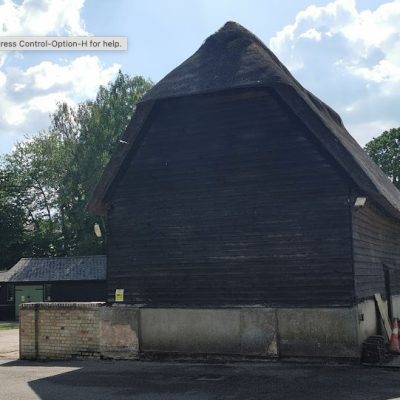
Search by topic
- archaeology
- Building of Local Interest
- chapel
- charity
- church
- crime
- dressmaker
- fire
- Great Eastern Railway
- Listed building
- Mapping Relief
- medieval
- oral history
- poverty
- Public House
- Religious House
- Roman
- scholar
- school
- Then and Now
- tudor
- women
- work
- world war one
- world war two
Search by text
St Johns, Palgrave, Suffolk
History of chapel of St John
In the Proceedings of the Suffolk Institute of Archaeology 45 (3) 2023, is an account by Cambridge architect Richard Lyon of the discovery of the lost chapel of St John the Baptist near Palgrave in Suffolk.
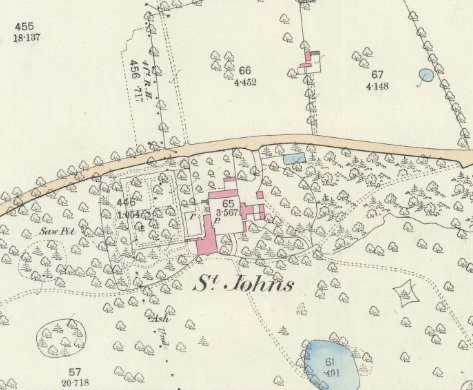
Site of St Johns on 1885 OS map of Suffolk
The chapel seems to be mentioned in a charter of AD 962. In it, Wulfstan, probably Wulfstan of Dalham, agent of King Edgar, grants land to St Edmund’s Abbey.
The lost site of the chapel was found in 2002 using a 1999 aerial photo of the site. This was part of work undertaken by Richard Lyon and Associates Architects. Suffolk County Arch. Services investigated in 2006 and agreed that the site was probably that of the lost chapel.
The conclusion of the article:
Documentary evidence suggests that a religious institution which later became the chapel of St John the Baptist was founded in Palgrave a century before the Norman Conquest and continued to operate until the Reformation, a period of almost six hundred years. However, whilst the existence of the chapel is beyond question, its location is uncertain. The site of St John’s House in Palgrave remains the most likely candidate, but there are other possible locations.
Projects
Contribute
Do you have any information about the people or places in this article? If so, then please let us know using the Contact page or by emailing capturingcambridge@
Licence
This work is licensed under CC BY-NC-SA 4.0