Search by topic
- archaeology
- Building of Local Interest
- chapel
- charity
- church
- crime
- dressmaker
- fire
- Great Eastern Railway
- Listed building
- Mapping Relief
- medieval
- oral history
- poverty
- Public House
- Religious House
- Roman
- scholar
- school
- Then and Now
- tudor
- women
- work
- world war one
- world war two
Search by text
Engagement
Who Gives a XXXX?
X marks the spot, casts a vote, spreads facts and fallacies and seals with a loving kiss. Asking Cambridge residents if they gave a XXXX was at the core The Trials of Democracy public art programme.
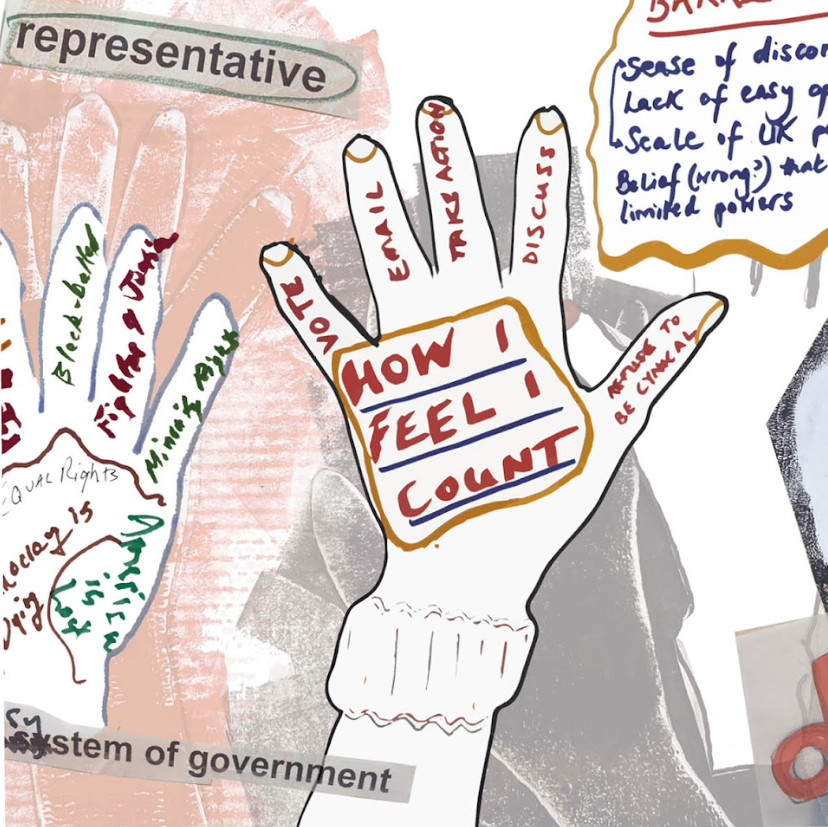
As performance and visual artists Patrick and Hilary worked to creatively engage and explore issues and ask question such as:
- From governmental structures to everyday action: what does Democracy mean to us?
- What does our relationship to Democracy look like?
- Who votes, who doesn’t – and why?
- Where does Democracy take place within our city?
- Where do we get our information from?
- How do we participate and how are we excluded?
- Where are the fault lines in Democracy?
- What are our hopes for the future?
What does Democracy mean to us?
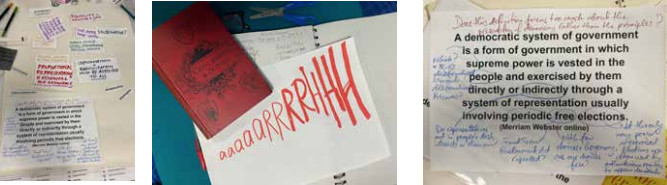
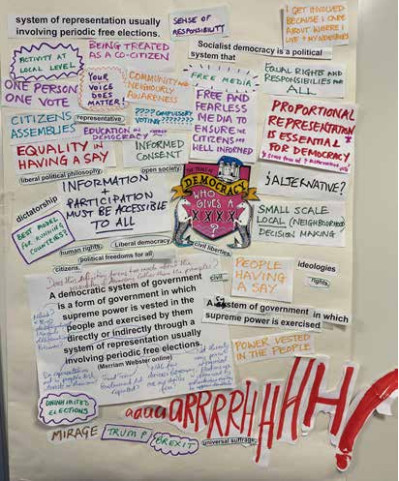
This montage exploring what Democracy means was created throughout a group conversation during one of our very early workshops – a drop-in at Cambridge Library – which then became the artwork for our Ballot Box.
Who votes?
We invited each participant at every one of our events to fill in a Voting Slip and put it into our Ballot Box, letting us know whether or not they voted in the last general election, and why.
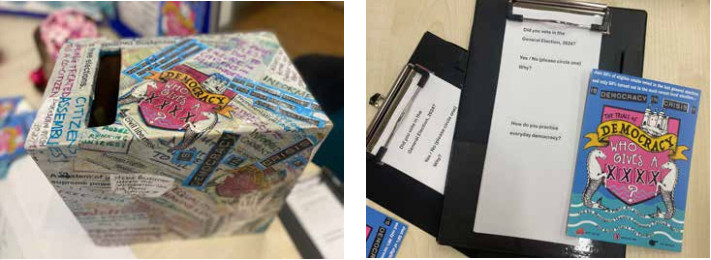
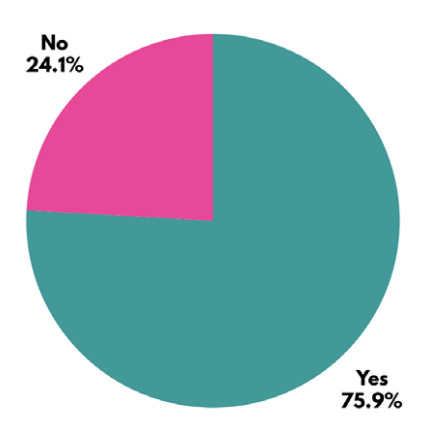
A massive 75.9% of our participants answered YES to this question, a much larger number than the national voter turnout of 59.7% and Cambridge voter turnout of 60.4% at the 2024 General Election.
View all the data gathered in response to the question Did You Vote in the Last General Election, and Why?
Voting Slips Information Jan-August 2025 – tabulated (1)
“Democracy is an everyday thing, every time you go into a shop, it’s something you practice everyday”
During one of our pop-up events we had a conversation with a resident who arrived from Bosnia – in former Yugoslavia – in the 90s, just before the war. He couldn’t vote in the general election, despite living in the Uk for decades as he’s not a UK citizen. He has indefinite leave to remain but doesn’t want citizenship: “it’s the only thing I have left of my country” he said “But Democracy is an everyday thing, every time you go into a shop, its something you practice everyday”. This conversation prompted us to add the question ‘How do you practise every day democracy?’ to the Voting Slip.
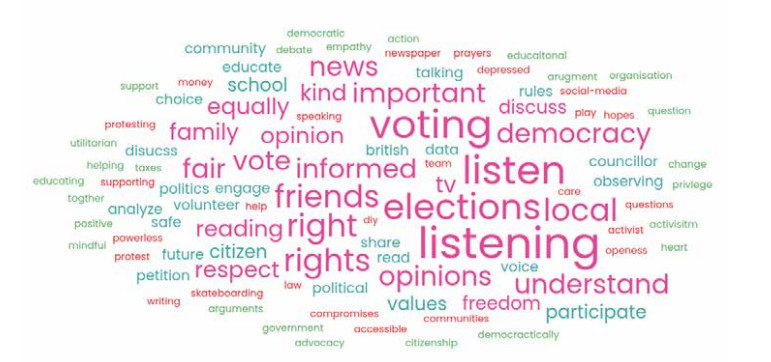
This word cloud illustrates the answers we had to that question – the larger the word, the more times it appeared in our answers.
Raise Your Hand and be counted
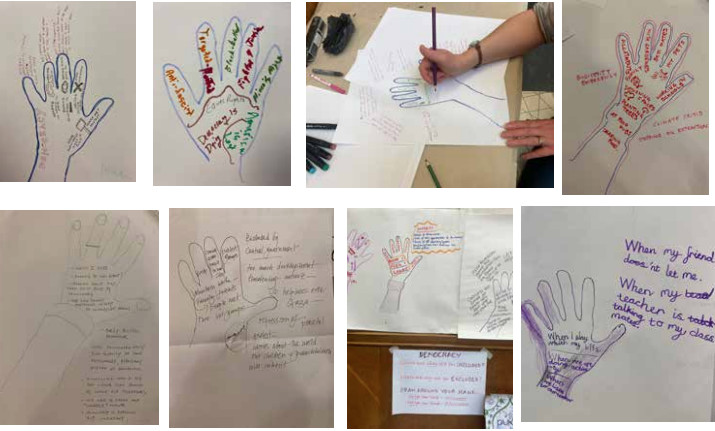
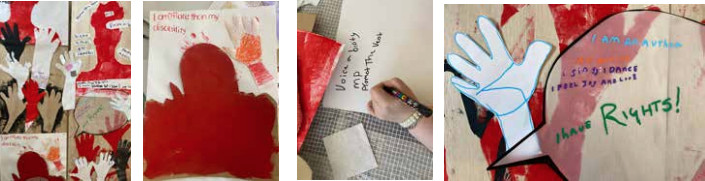
We also invited every visitor to draw around their hand as a symbol of participation, being heard and resistance. The hands were illustrated to show how and where the participant felt included in democracy (shown on the inside of the hand) and where they felt excluded (surrounding the hand).
Where does Democracy happen in our city?
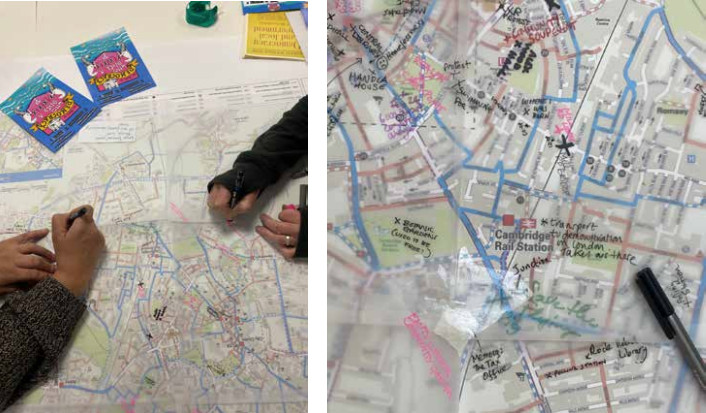
We invited residents to map the places they engaged in Democracy – our map shows us that democracy doesn’t just happen at our Polling Stations: we practice Democracy in our libraries, our schools, our Guildhall, our protests, commons, festivals, community centres, museums and homes…
How’s your relationship with democracy?
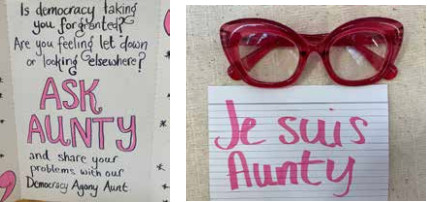
From creating a Date With Democracy profile for Singe, writing love letters and ‘Dear John’s’, to turning to an Agony Aunt for Democracy relationship advise: residents told us what they are looking for from Democracy.
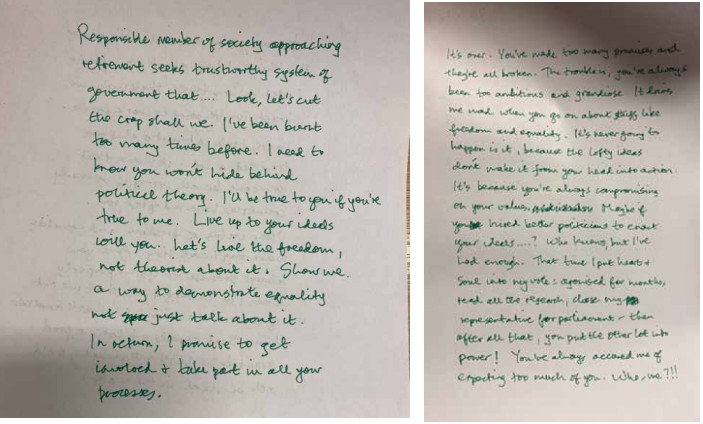
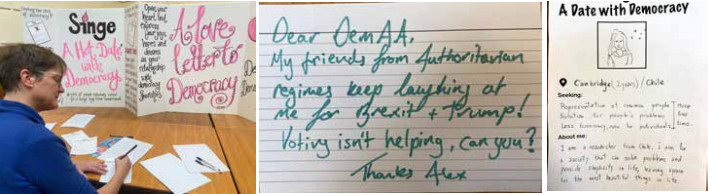
Agony Aunt ‘Aunty’ and PINK were our Democracy ultra egos – popping up in the centre of town (often outside the Guildhall alongside protesters, campaigners, market traders and shoppers) and setting up a blow-up sofa to ask residents how their relationship with democracy is going. This playful invitation broke down barriers to start conversations about how people are feeling right now – following an Agony Aunt style to think about the ‘Democracy Muscles’ we need to flex*. and the qualities (both personal and societal) that we need to nurture in order for democracy to flourish.
The Aunty theme progressed throughout the project, from talking to an Agony Aunt to ‘Je suis Aunty’ – recognising that we are all collectively able to listen, offer and receive Democracy Relationship advice and broaden connectivity and democratic involvement.
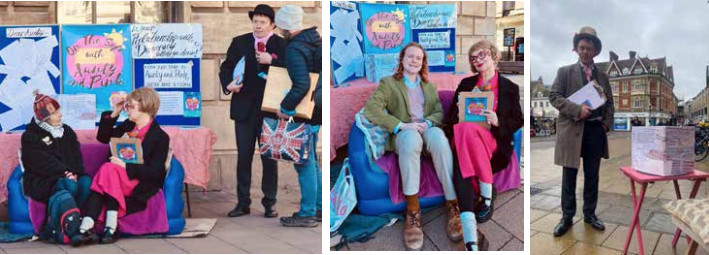
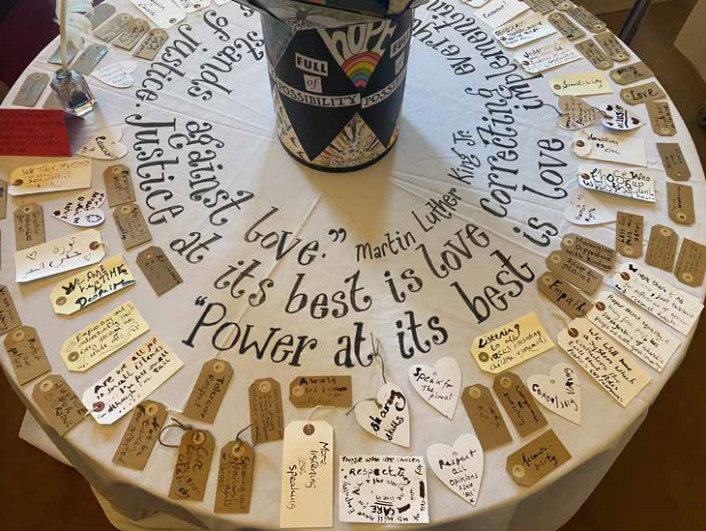
These are the conversations that helped to shape and develop the ‘Democracy Table’ as part of the Exhibition
* The idea to explore which Democracy Muscles we need to strengthen came about following an on-line presentation and Democracy Fitness workshop with ‘ We Do Democracy’: the leading Nordic advisors in democratic innovation and deliberation. You can read more about Democracy Fitness HERE
What does Community Power look like?
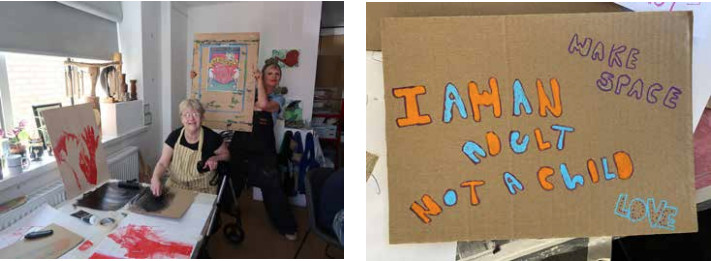
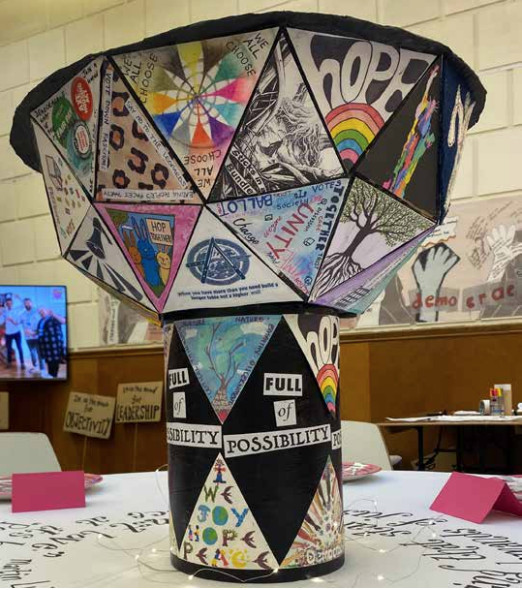
Time and time again, we spoke with participants about the Democracy we practice every day and the power of community action. More than 30 artists contributed artwork for The Bowl of Community Power, illustrating what Democracy meant to them.
Our hopes for a future Democracy
Please do have a listen to the Democracy Podcasts : conversations with 30 Cambridge residents – elected officials, activists, educators, community organisers, volunteers, unionists and artists – discussing what democracy means to them, where the fault lines are their hopes for the future.
Throughout our If You’re Not At The Table You’re On The Menu weekend event, visitors were invited to write their own hopes with quills and ink made from oakgalls and chalkstream water, intentionally slowing down the writing process, encouraging participants to be thoughtful and concise in their responses.
More about The Trials of Democracy public arts event
More The Play
More about the Exhibition
Listen to Democracy Podcasts
This project has been supported by S-106 grant funding from Cambridge City Council
Projects
Contribute
Do you have any information about the people or places in this article? If so, then please let us know using the Contact page or by emailing capturingcambridge@
Licence
This work is licensed under CC BY-NC-SA 4.0