Search by topic
- archaeology
- Building of Local Interest
- chapel
- charity
- church
- college servant
- crime
- dressmaker
- Great Eastern Railway
- Listed building
- Mapping Relief
- medieval
- oral history
- poverty
- Public House
- railway worker
- Roman
- scholar
- school
- Then and Now
- tudor
- women
- work
- world war one
- world war two
Search by text


 Christ's Lane Campaign 2026 (RGL2026)
Christ’s Lane Campaign
Christ's Lane Campaign
Christ’s Lane campaign update June 2026:
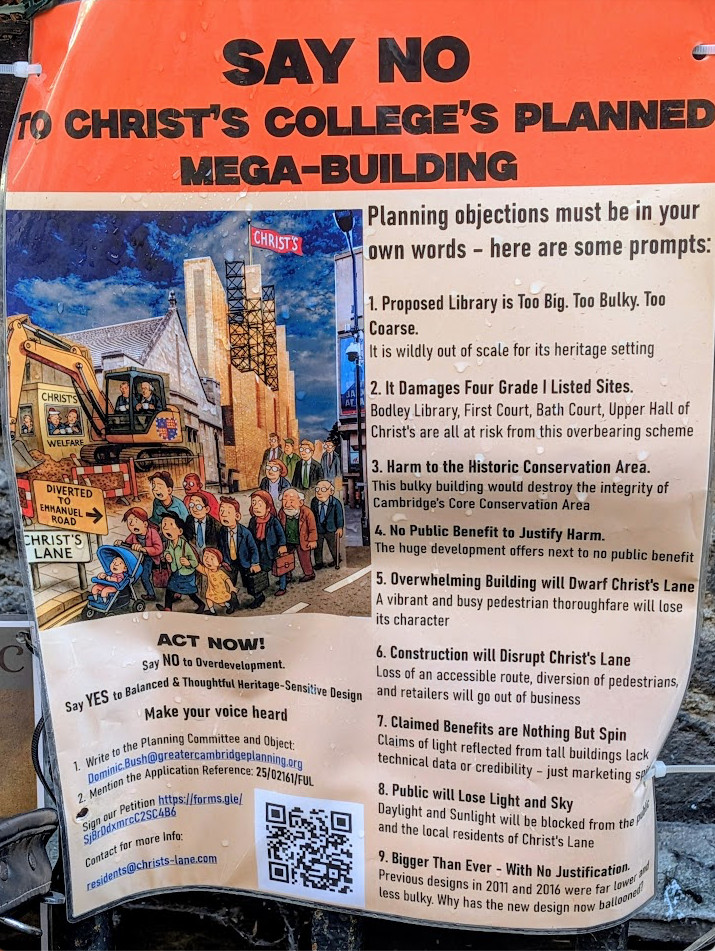
Christ’s College has proposed to demolish its 1970s library and replace it with a new four-storey building, together with works to Bath Court and the re-provision of the bridge to the Bodley Library. The site lies in the historic core of Cambridge. It includes Grade I listed College buildings, sits within the Central Conservation Area, and forms part of a Grade II Registered Park and Garden.
Historic England, the Government’s statutory adviser on heritage, assessed the scheme and concluded that it would cause heritage harm. It described the new building as “too big” and “overdominant” in Bath Court, particularly in relation to the South Range of First Court and the Bodley Library, and noted that the increased height towards Christ’s Lane appeared large alongside the more modest elevations of the College. The City Council’s own Conservation Officer identified a degree of harm, and the Victorian Society suggested the new building take its lead from the floor heights of the Bodley Library, reducing each floor by approximately half, to be sympathetic to the human scale of the Bodley.
In 2025 the City Council granted planning permission (reference 25/02161/FUL). Christ’s Lane Action Group, a group of local residents and stakeholders, challenged that decision by judicial review (case no. AC-2025-LON-004656). The High Court granted permission to proceed on all four grounds, which related to the unlawful treatment of heritage harm. Rather than defend the decision, the Council and the College agreed to a consent order quashing the permission on all four grounds. The Action Group has asked the Court to give a reasoned judgment, and a hearing is listed for 20 October 2026.
While those proceedings remain live, the College has submitted a fresh application for the same building (reference 26/02109/FUL). The College’s June 2026 covering statement states that the drawings and supporting reports are unchanged. While the earlier scheme was assessed as causing heritage harm; the current application describes the same building as producing heritage benefit. The application is open for public comment until 9 July 2026.
Further material, including the court documents, the consent order and the heritage evidence, has been published by Christ’s Lane Action Group.
Sources and further reading
Christ’s Lane Action Group — evidence pack, court documents and heritage reports: https://www.christslaneactiongroup.org
Current planning application (reference 26/02109/FUL), Greater Cambridge Planning portal — view documents and submit comments by 9 July 2026: https://applications.greatercambridgeplanning.org/online-applications (search reference: 26/02109/FUL)
Christ’s Lane Campaign 2026 (RGL2026)
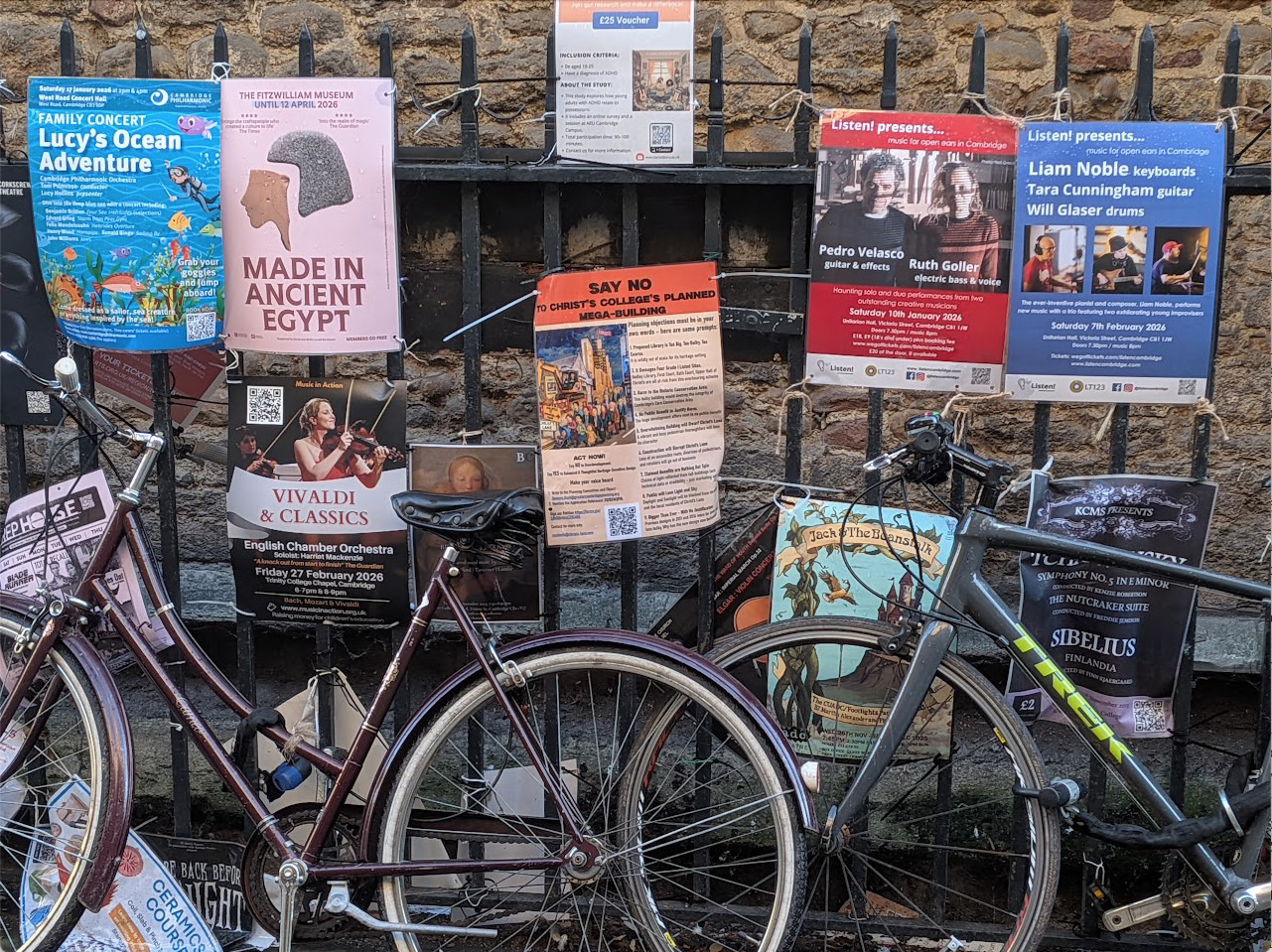
The 2025 Christ’s Lane Campaign in Cambridge concerns a proposed major redevelopment by Christ’s College along Christ’s Lane, a central pedestrian route between St Andrew’s Street and Christ’s Pieces. The campaign emerged in response to the College’s planning application (June 2025) to demolish its 1970s library building and replace it with a larger, modern library and social complex. While Christ’s College presents the plan as essential for accessibility, sustainability, and study improvement, local residents, heritage groups, and traders have mobilised under the Christ’s Lane Action Group (CLAG) to oppose aspects of the project, citing concerns about heritage impact, scale, and disruption.
The College’s plans, detailed on its Library Plus webpage and in documents submitted to Cambridge City Council, include constructing a new multi-storey library building with expanded study areas, group and quiet spaces, new kitchens and dining facilities, and step-free access throughout. The scheme also proposes a redesigned frontage onto Christ’s Lane, with a masonry wall, timber structure, and new “chimneys” forming part of a sustainable ventilation system. Christ’s argues that the existing 1970s building is inefficient and fails modern accessibility and environmental standards. The new design aims to achieve net-zero standards through air-source heat pumps, rainwater reuse, and low-energy lighting, while offering students a more flexible and comfortable academic environment.
Supporters within the College community stress the educational and environmental benefits of the redevelopment. They note that the project would provide significantly more study space for undergraduates, postgraduates, and fellows, while offering improved social and welfare facilities. The College also claims the new design will enhance the appearance of Christ’s Lane with better lighting, seating, and views into the library, transforming what is currently a plain, underused frontage into an active public space.
Opponents, led by CLAG and several heritage advocates, focus on the negative effects of the project. They argue that the new structure’s size and bulk will dominate Christ’s Lane, overshadowing the narrow pedestrian passage and detracting from the surrounding conservation area and nearby Grade I-listed college buildings. Concerns include a “canyon effect,” loss of light, and a less welcoming public realm. Critics also contend that the proposal would primarily benefit the College rather than the wider community, and that its frontage design risks appearing closed and uninviting.
A major point of contention is the construction phase, expected to last nearly two years. During this period, part of Christ’s Lane would be narrowed, limiting pedestrian flow and potentially affecting footfall to nearby shops and cafés. Local press, including the Cambridge Independent and Varsity, have reported widespread unease about disruption, noise, and the potential impact on local businesses and tourism.
Public consultation so far has drawn both support and formal objections. A Development Control Forum was held in September 2025, where campaigners and college representatives presented their arguments before city councillors. Heritage organisations such as Historic England have raised reservations about the scheme’s visual and historical impact. As of late 2025, the planning application remains under review by Cambridge City Council.
In essence, the Christ’s Lane Campaign represents a familiar Cambridge tension between preserving historic character and accommodating institutional growth. The outcome will shape not only Christ’s College’s facilities but also the look and experience of one of Cambridge’s busiest pedestrian thoroughfares. (AI 2025)
Projects
Contribute
Do you have any information about the people or places in this article? If so, then please let us know using the
Contact page or by emailing
capturingcambridge@
Licence
This work is licensed under
CC BY-NC-SA 4.0


 not including content on external links as indicated
by
not including content on external links as indicated
by .
.