Search by topic
- archaeology
- Building of Local Interest
- chapel
- charity
- church
- crime
- dressmaker
- Great Eastern Railway
- Listed building
- Mapping Relief
- medieval
- oral history
- poverty
- Public House
- railway worker
- Religious House
- Roman
- scholar
- school
- Then and Now
- tudor
- women
- work
- world war one
- world war two
Search by text


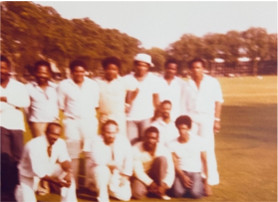 The Cambridge West Indian Cricket Team c1980s
Legacies of Windrush: The Cambridge West Indian Cricket Club 1967-1985
Legacies of Windrush: Cambridge West Indian Cricket Team
Photo: The Cambridge West Indian Cricket Team, circa 1980s
Pictured on Parker’s Piece, Cambridge
Top row (left to right): Unknown, Albert Gordon, Bertram David, Winslow Doyle, Jerry Lewis, Charlie Douglas, Unknown
Bottom row (left to right): Desmond Cuffy, Ivan Ping, Lance Bariffe, Naimen Dennis, Unknown
In the heart of Cambridge, a new chapter in local cricket emerged in 1967.
Amid a Caribbean community of around 400 residents, the formation of the Cambridge West Indian Cricket Club (CWICC) marked the beginning of a unique and vibrant journey. One of the founding members and captain of the club, Winslow Doyle, a Senior Railwayman, had arrived from Barbados in the early 1960s.
“Many were encouraged by the recruitment campaign launched by companies such as London Transport in the Caribbean at the time.”
(CEN, 25.08.1976, p. 9)
Town and Gown: A Cricketing Collaboration.
In the mid-1960s, a small group of Caribbean men in Cambridge would meet at the Midland Tavern Pub to watch the West Indies Cricket Team on TV. Motivated by their shared love of the game, they discussed forming their own cricket team. This idea led to the founding of a club, established in collaboration with three men linked to Cambridge University:
Bryan King – a white West Indian from St. Kitts and Law Lecturer and Fellow at Pembroke College.
Robert Loinsworth – a Trinidadian educationalist affiliated with Pembroke College
Tim Gosling – connected to Cambridge University.
The CWICC benefited from its university connections, opening up exciting opportunities for its development and integration within the Cambridge community.
As the Cambridge Evening News reported, the CWICC “promised to forge links between the communities as well as injecting new flair and enthusiasm into the local cricket league.” (CEN 25.08.1976, pg. 9).
Competing in the Cambridgeshire Cricket Association League, CWICC quickly earned a reputation for its fierce competitiveness and distinctive style. Facing off against Cambridgeshire teams, the club made its mark with every match it played rising to the semi-finals of the league. The vibrant spirit of West Indian cricket infused every game, captivating both players and spectators alike.
But the club’s impact extended beyond league competition. CWICC forged strong ties with the cricket teams from Cambridge’s prestigious Colleges, who relished the opportunity to challenge this formidable new presence. These encounters, marked by high-quality cricket, helped foster camaraderie and wove CWICC into the fabric of Cambridge’s cricketing community.
In July 1974, “Cambridge West Indians won another exciting Junior Cup Tie on the Piece, beating Great Shelford by 11 runs. The West Indians were all out for 130 in 32 overs. N Atkinson taking 6 for 25 and D King 3 for 36. Runs came from Lewis (34), Bains (31), and Ping (27). Atkinson followed up with an innings of 32 for Shelford, and Hanspall got 2, but the West Indians restricted their side to 119 for 9 off 42 overs. Doyle took 4 for 30 and Ping 2 for 30”. (CEN 8.07.1974 pg. 14.)
The CWICC was also affectionately known as the Midland Tavern, a nod to its roots in the pub where the founding members first gathered. In the 1980s, the club competed in the Greene King Sunday Pub and Social Clubs League.
Annual Matches against the Police
In 1982 a cricketing exercise in community relations ended in a draw. Annual matches between the CWICC and the Police continued after the team folded in 1985, with their last recorded match being in 1992.
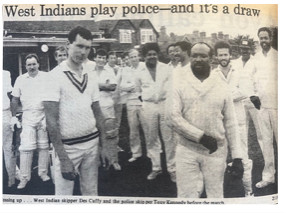
Cambridge West Indian Cricket Team (CWICC) play police at Fitzwilliam College Cricket Ground (CEN 14.6.1982)
Captains of CWICC
Winslow Doyle – 1967-1976
George Lewis – 1976-1977
Bertrum David – 1977-1979
Desmond Cuffy 1979-1982
Jerry Lewis – 1982-1985
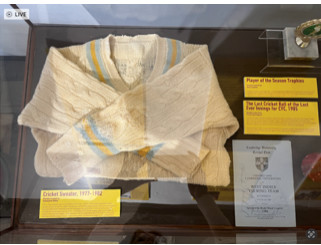
Cambridge West Indian Cricket Club Sweater
Worn by: Desmond Cuffy (1967–1992)
Exhibition: Windrush: Stories of the Caribbean Community in Cambridge, Museum of Cambridge, 2025
This sweater was worn by Desmond Cuffy during his years playing for the Cambridge West Indian Cricket Club, active from 1967. The club provided a space for Caribbean people in Cambridge to play cricket, socialise, and build community. Each sweater was handmade by Margaret Douglas, with blue symbolising the sea and yellow symbolising the sand of the Caribbean, reflecting both team pride and cultural identity.
Projects
Contribute
Do you have any information about the people or places in this article? If so, then please let us know using the Contact page or by emailing capturingcambridge@
Licence
This work is licensed under CC BY-NC-SA 4.0