Search by topic
- archaeology
- Building of Local Interest
- chapel
- charity
- church
- crime
- dressmaker
- Great Eastern Railway
- Listed building
- Mapping Relief
- medieval
- oral history
- poverty
- Public House
- railway worker
- Religious House
- Roman
- scholar
- school
- Then and Now
- tudor
- women
- work
- world war one
- world war two
Search by text


De Gestis Herwardi Saxonis
History of Hereward the Wake
De Gestis Herwardi Saxonis — usually translated as The Deeds of Hereward the Saxon — is one of the most vivid and romantic survivals of post-Conquest English historical writing. Probably composed in the late twelfth century, though drawing on earlier oral traditions and perhaps lost written sources, it tells the story of the Anglo-Saxon resistance leader Hereward the Wake. The work blends history, legend, folklore and heroic romance, creating a semi-mythic portrait of an English rebel resisting Norman conquest after 1066.
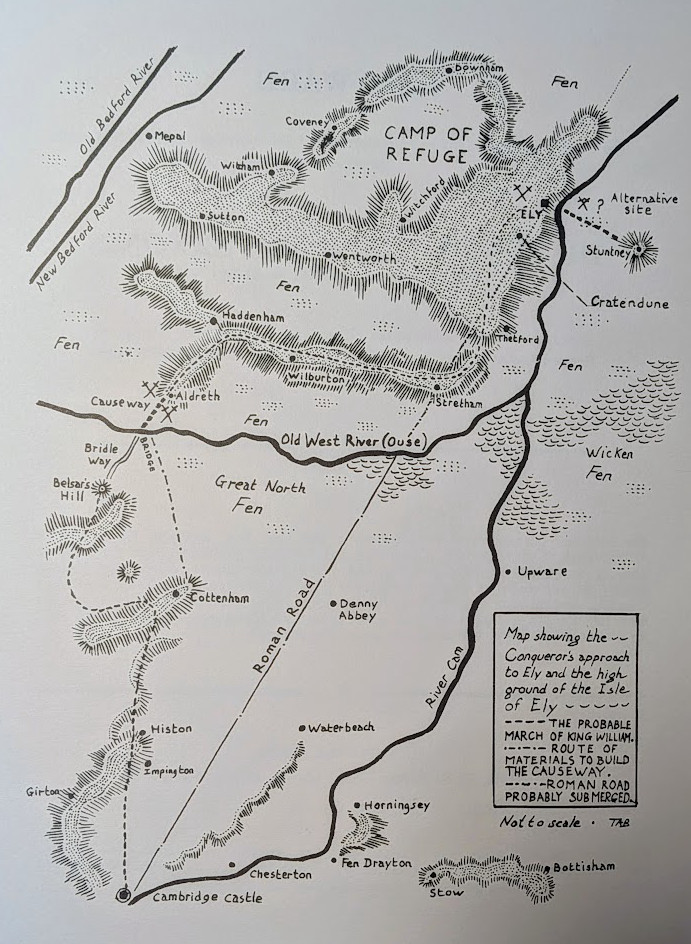
Map of William I campiagn against Hereward the Wake (Bevis 1981)
The chronicle begins by establishing Hereward’s noble ancestry and exceptional qualities. He is presented as the son of a Lincolnshire thegn, born into a respected Anglo-Danish family. From childhood he is depicted as physically powerful, unruly, courageous and difficult to control. His wild behaviour leads to conflict with local authority figures and eventually to his exile from England. This exile becomes an important literary device: it allows Hereward to acquire martial skills, worldly experience and continental fame before returning home as a mature warrior.
During his years abroad, Hereward travels through parts of northern Europe, especially Flanders. The text presents him as a mercenary knight and adventurer whose strength and cunning become renowned. He defeats champions, participates in tournaments and military campaigns, and acquires loyal companions. Many episodes have the flavour of chivalric romance rather than strict history. He disguises himself, undertakes daring infiltrations, and overcomes enemies through clever stratagems as much as through brute force. The author clearly wants to portray Hereward as an ideal heroic figure whose abilities rival those of legendary warriors.
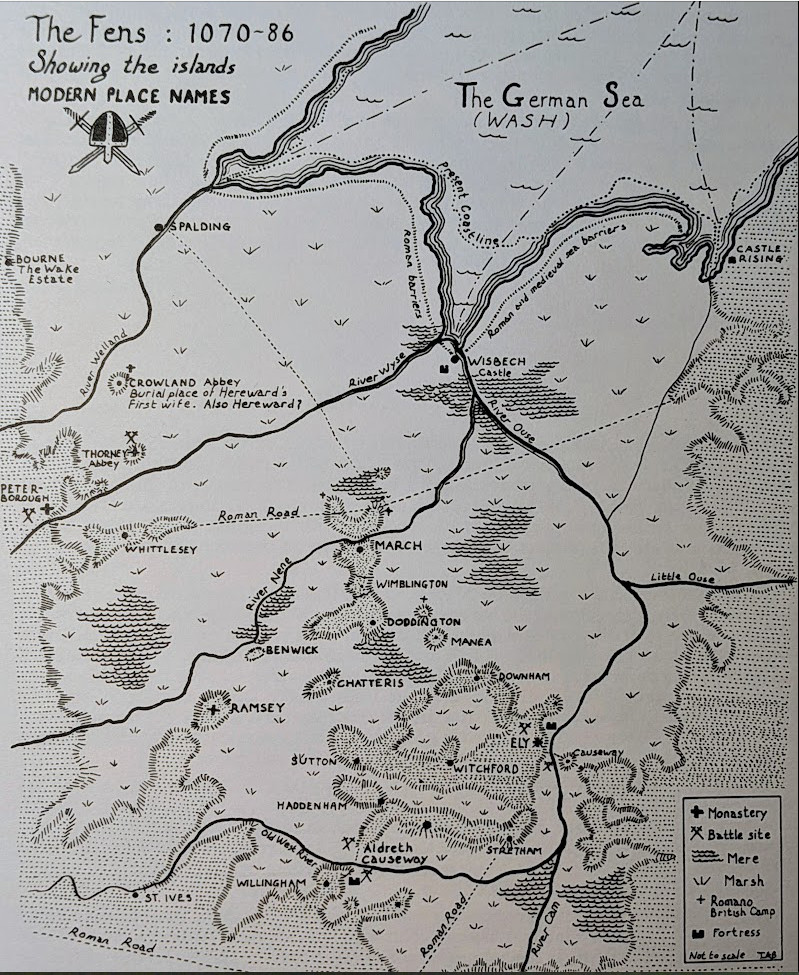
The Fens 1070-86 (Bevis 1981)
While Hereward is abroad, England undergoes the Norman Conquest led by William the Conqueror. The overthrow of the Anglo-Saxon ruling class and the redistribution of lands to Norman lords provide the political background for the story. When Hereward eventually returns to England, he discovers that his family lands have been seized, his relatives dispossessed, and the old social order shattered. In some versions of the story he finds his brother murdered and his home desolated. These scenes are intended to dramatize the suffering of the English after the Conquest and to justify resistance to Norman rule.
The emotional turning point of the narrative occurs when Hereward visits his family home and encounters the remains of his kin. The chronicle emphasizes grief, outrage and loyalty to ancestral inheritance. Hereward’s resistance is therefore framed not simply as rebellion, but as a moral response to conquest, injustice and foreign oppression. The Normans are often portrayed as arrogant occupiers, though the text occasionally acknowledges worthy individuals among them.
The best-known part of the chronicle concerns Hereward’s role in the resistance centred on the Isle of Ely in the fenlands of eastern England. Isle of Ely becomes a symbolic last refuge of Anglo-Saxon resistance. Surrounded by marshes and difficult terrain, Ely provided natural defensive advantages. The chronicle vividly describes the landscape of reeds, waterways and hidden paths, portraying the fens almost as allies of the rebels. This fenland setting is one reason the work has remained important in the historical imagination of Cambridgeshire and the east of England.
At Ely, Hereward joins forces with displaced English nobles and churchmen resisting Norman authority. The text associates him with figures such as Morcar and with the monks of Ely Cathedral. Hereward emerges as the leading military mind of the resistance. The narrative celebrates guerrilla tactics, surprise attacks and intimate knowledge of local geography. Norman troops attempting to penetrate the marshes are ambushed, misled or trapped.
One of the most famous episodes describes a Norman assault on Ely using a causeway built across the marshes. According to the chronicle, Hereward’s forces sabotage the attack by using the unstable fenland terrain against the invaders. In some retellings the defenders set fire to the reeds and cause chaos among the advancing Normans. These scenes combine realistic military detail with legendary embellishment and demonstrate the author’s admiration for tactical ingenuity.
The work repeatedly stresses Hereward’s cleverness. He is not merely a strong warrior but a master of deception and planning. Several stories involve disguises, espionage and infiltration. In one celebrated episode, Hereward enters an enemy camp disguised as a potter or common labourer in order to gather intelligence or rescue captives. Such episodes reinforce the image of a folk hero able to outwit more powerful opponents.
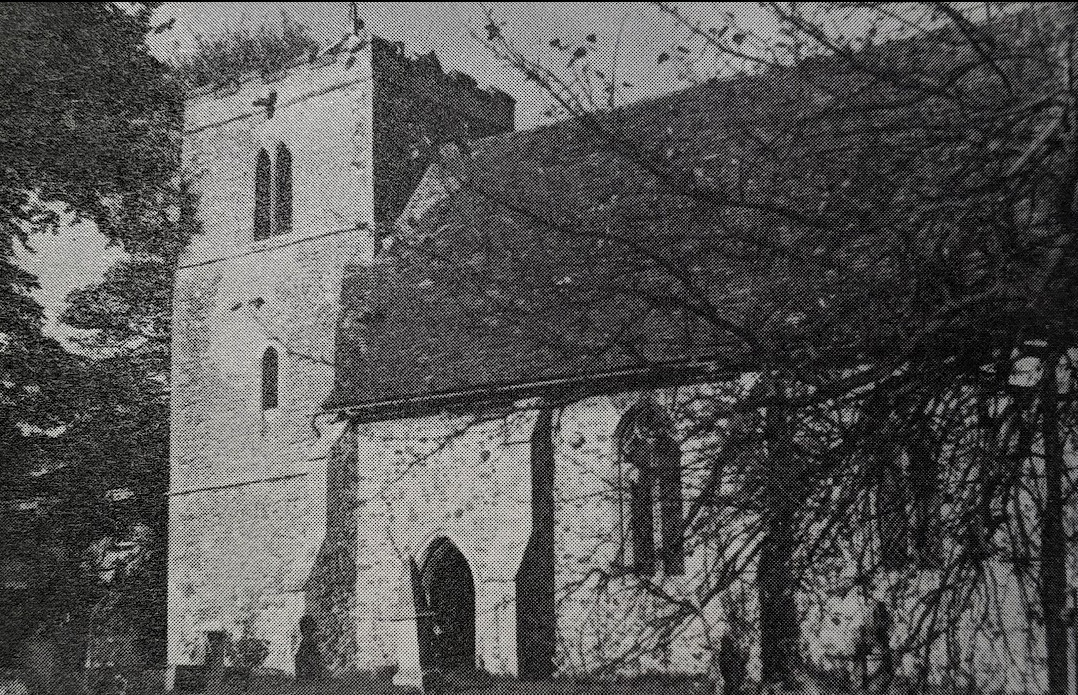
Witchford church (Bevis1981)
Despite the heroic tone, the chronicle ultimately acknowledges the triumph of Norman power. The resistance at Ely cannot last forever. The text describes betrayals, negotiations and shifting loyalties among the English nobles. William the Conqueror eventually secures control over the region. Different versions of the Hereward tradition end differently: some suggest Hereward escaped and continued resistance; others imply reconciliation with the Norman regime. The De Gestistends toward a somewhat softer ending than pure heroic tragedy. Hereward is not always depicted as dying gloriously in battle but rather as surviving through cunning and adaptability.
The chronicle’s historical reliability is mixed. Some events correspond with information from more contemporary sources such as the Anglo-Saxon Chronicle and the writings of Orderic Vitalis, particularly the existence of resistance at Ely around 1070–1071. However, many details appear highly romanticized or legendary. Historians generally believe that a real Hereward existed and participated in anti-Norman resistance, but the literary Hereward of the De Gestis is a heroic construction shaped by storytelling traditions and later political memory.
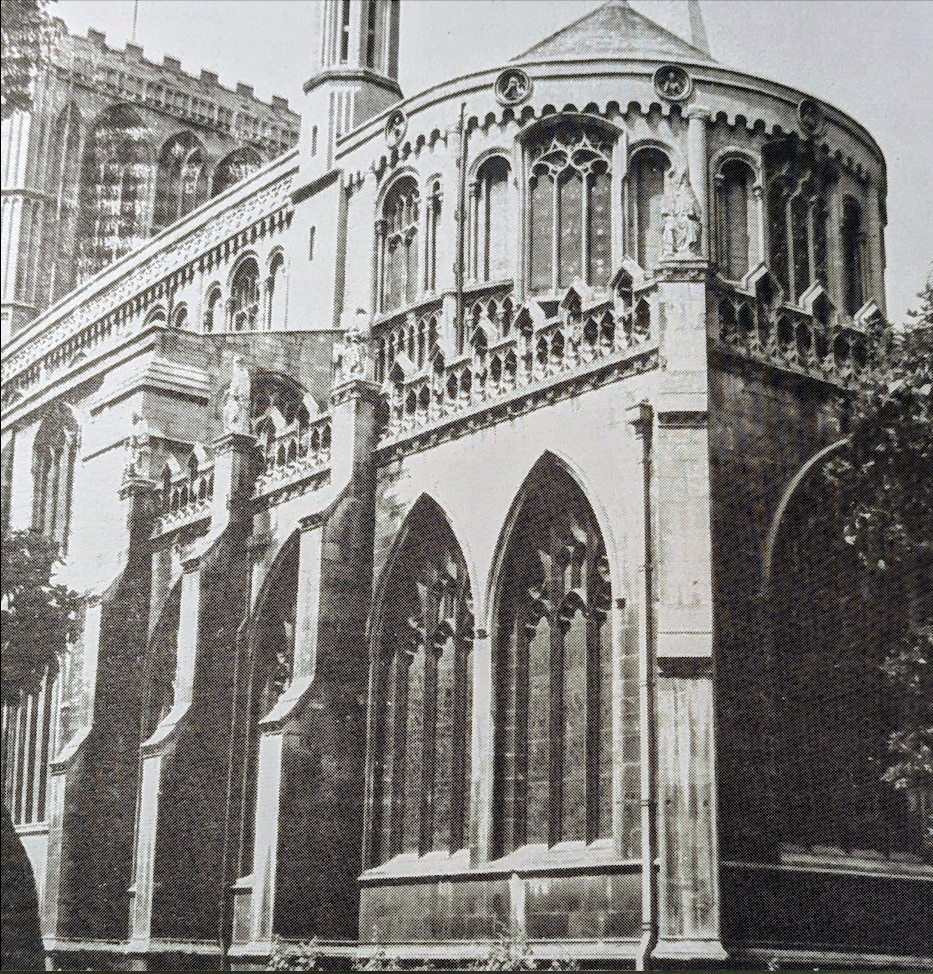
East End Peterborough Cathedral (Bevis 1981)
The importance of the text lies partly in what it reveals about twelfth-century attitudes toward the Norman Conquest. By the time the chronicle was written, Norman and English society had begun to merge, but memories of conquest and dispossession still resonated. Hereward is portrayed as the embodiment of lost English freedom, courage and local identity. Yet the work is not simply nationalist propaganda in a modern sense. It also reflects medieval aristocratic values of honour, lineage, military prowess and personal loyalty.
Literarily, the De Gestis Herwardi Saxonis stands at the crossroads between chronicle history and medieval romance. It preserves traces of oral storytelling, heroic legend and perhaps popular folklore. The text helped shape the enduring legend of Hereward the Wake in later centuries, influencing antiquarians, novelists and historians. In the nineteenth century, writers such as Charles Kingsley revived Hereward as a patriotic English hero resisting foreign domination.
Today the work remains especially significant for understanding the cultural memory of the Norman Conquest and the distinctive historical identity of the Cambridgeshire and fenland region. Its descriptions of Ely and the marshes continue to resonate strongly in local history, where Hereward survives as both historical figure and enduring folk hero.
(AI2026)
See Hereward by T A Bevis 1981
Sources
- Book
- Published Source
Projects
Contribute
Do you have any information about the people or places in this article? If so, then please let us know using the Contact page or by emailing capturingcambridge@
Licence
This work is licensed under CC BY-NC-SA 4.0