Search by topic
- archaeology
- Building of Local Interest
- chapel
- charity
- church
- crime
- dressmaker
- fire
- Great Eastern Railway
- Listed building
- Mapping Relief
- medieval
- oral history
- poverty
- Public House
- Religious House
- Roman
- scholar
- school
- Then and Now
- tudor
- women
- work
- world war one
- world war two
Search by text
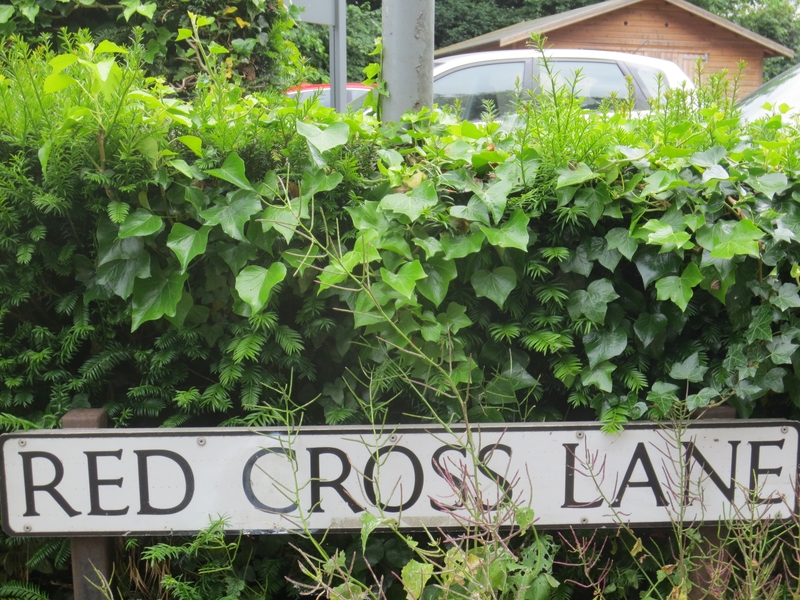
Red Cross Lane, Cambridge
Notes on the history of Red Cross Lane, Cambridge
The Red Cross refers to the cross that was often placed at the entrance to a town. A Red Cross Farm is recorded on a 16th century map at this location.
The first occupants of the road in the UK census are recorded in 1881 in the parish of Cherry Hinton. It seems likely that they all worked at Nether Hall farm.
Red Cross Road:
Thomas King 31 ag.lab., Sarah 31 laundress, Ernest Moule son 14 ag.lab., Elizabeth R King 12, James 9, Clara H 7, Harry C 5, Arthur J 2.
James Dean 34 ag.lab, Margaret 42, Herbert 7, Harry 4.
Alfred Clark 46 groom, Ellen 40, David 16 ag.lab.
John E Marsh 42 farmer of 220 acres, Elizabeth Marsh 40, Anna E Marsh 17, Florence Marsh 16, Edith Marsh 14, Emily H Marsh 13, Agnes Marsh 10, Edward C Marsh 12, Arthur B Marsh,4 John H Marsh 2, Harriet Hunt 20 cook, Ellen M Drake 16 housemaid.
In 1891 John Marsh was living at Nether Hall farm so it would be reasonable to assume that the farm he managed in 1881 was also Nether Hall since there are no occupants listed for Nether Hall farm itself.
In the 1891 census Red Cross is included in the Trumpington return.
Those listed are:
Red Cross Farm: Noah Webb 30 ag.lab., Sarah 29, Harry 6, Edward 4, Robert 2, Christie 3mos.
Red Cross House: William Knightly Vawser 47 hosier, gloves, shirt maker, William J son 23 hosier’s assistant, Ernest E 21 hosier’s assistant, Edith S Serjant niece housekeeper, Alice Fiske 21 housemaid, Emma Reed 16 kitchenmaid, Alfred Warren 19 groom and gardener.
According to data on Ancestry UK William Knightly Vawser was born in 1843 and died in Trumpington in 1926. He married Mary A Sarjant in St Ives in 1866 but she died 22 February 1888 at Red Cross House according to the National Probate Calendar. He married Eleanor Boning in 1891. He was the son of Robert, also a hosier, and Sarah Bradley. The British Newspaper Archives record that William was hon.sec. of the Cambridge Florists’ Society. The family business was at 33 Petty Cury. In 1893 he organised an entertainment at the Baptist Chapel in Cherry Hinton. A lecture entitled “Uncle Tom’s Cabin” was given by Mrs Vawser while Mr Vawser displayed a number of lantern slides. A newspaper article of 1899 also suggests that he was active in the Barnwell Mission.
Sources: UK census, British Newspaper Archive
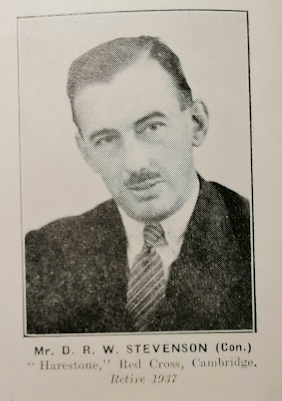
1936, Blue Book
1962
SOUTH SIDE
Forvie – vacant
Red Cross Cottage – F E Bell
The Lodge – J Lennox Cook
Bell School of Languages
NORTH SIDE
Tudor House – John Burn-Murdoch
The Old Tiled House – Mrs I Hare
Harestone – Mrs D Stevenson
Many Gates – Maurice Dickerson
Projects
Contribute
Do you have any information about the people or places in this article? If so, then please let us know using the Contact page or by emailing capturingcambridge@
Licence
This work is licensed under CC BY-NC-SA 4.0