Search by topic
- archaeology
- Building of Local Interest
- chapel
- charity
- church
- crime
- dressmaker
- Great Eastern Railway
- Listed building
- Mapping Relief
- medieval
- oral history
- poverty
- Public House
- railway worker
- Religious House
- Roman
- scholar
- school
- Then and Now
- tudor
- women
- work
- world war one
- world war two
Search by text


St John Zachary
The history of St John Zachary
British History Online states:
The church of St. John Baptist, commonly called St. John Zachary, is first mentioned in the taxation of 1217. It stood on the west side of Milne Street and served a parish originally containing many dwelling-houses which were gradually taken over by religious houses and University hostels, which, in their turn, were destroyed to make room for King’s College. The site of its east end is today covered by the western bays of King’s College Chapel. Besides being the parish church it served as a chapel for the scholars of Clare Hall and of Trinity Hall. In 1445 Henry VI acquired both the church and the churchyard, along with the adjoining lands. The church was probably destroyed soon after 25 July 1446, when the first stone of King’s College Chapel was laid. By 1453 it had been rebuilt at the charges of Henry VI at the north-west corner of the Old Court of King’s College, on a site now occupied in part by the departmental libraries of the University. This second edifice is last mentioned in 1488–9; it was presumably allowed to fall into decay since by that time the parish no longer existed, and its site was used for King’s College buildings.
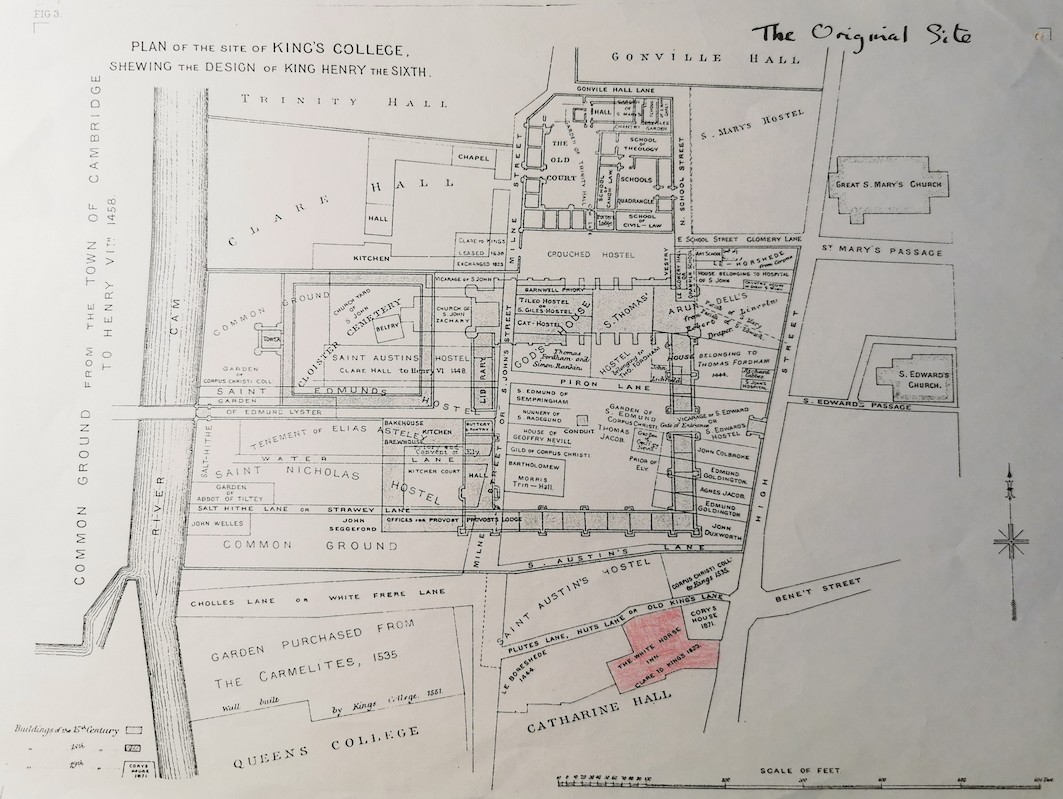
Map of King’s College site c.1500
The site is marked on the map on Susanna Gregory’s website.
Projects
Contribute
Do you have any information about the people or places in this article? If so, then please let us know using the
Contact page or by emailing
capturingcambridge@
Licence
This work is licensed under
CC BY-NC-SA 4.0


 not including content on external links as indicated
by
not including content on external links as indicated
by .
.