Search by topic
- archaeology
- Building of Local Interest
- chapel
- charity
- church
- crime
- dressmaker
- Great Eastern Railway
- Listed building
- Mapping Relief
- medieval
- oral history
- poverty
- Public House
- railway worker
- Religious House
- Roman
- scholar
- school
- Then and Now
- tudor
- women
- work
- world war one
- world war two
Search by text


49 Ainsworth Street, Cambridge
A Soda Water Bottler and a Grocer's Assistant
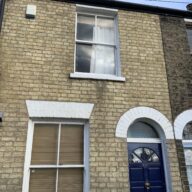
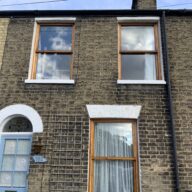
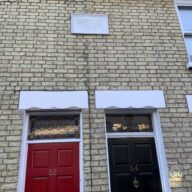
Number 49 is one of a terrace of four houses on the west side of Ainsworth Street.
1881 census
William Killingsworth, head, 57, labourer on GER, b. Earith, Huntingdonshire
Sarah A Killingsworth, wife, 61, b. Cambridge
Edward C Collins, wife’s son, 21, soda water bottler, b. Chesterton Fen, Cambridgeshire
1891 census
Edward William Tebbitt, head, 37, grocer’s assistant, b. Burwell, Cambridgeshire
Jane K Tebbitt, wife, 39, b. Bourne, Cambridgeshire
Florence J Tebbitt, daughter, 4, scholar, b. Ickleton, Cambridgeshire
Gertrude A Tebbitt, daughter, 3 months, b. Cambridge
Jane S Hopwood, visitor, 50, b. Baldock, Hertfordshire
Jane’s maiden name was also Tebbit.
Edward died on 13 Sep 1893. His probate record states that he was a ‘grocer and draper of 49 Ainsworth Street’. It is recorded in the Cambridge Independent Press of 22nd September 1893, that ‘The jury returned a verdict of ‘accidental death’, the cause of the death being concussion of the brain consequent on a fall downstairs.’
Jane moved to Vicarage Terrace with her daughters and became a fruit picker.
1901 census
Charles Long, head, 33, assurance agent, b. Waterbeach, Cambridgeshire
Ruth L Long, wife, 28, b. Waterbeach, Cambridgeshire
Victor C Long, son, 2, b. Cambridge
Elsie C Long, daughter, 7 months, b. Cambridge
Amelia E Cudworth, sister-in-law, 18, general domestic servant, b. Waterbeach, Cambridgeshire
1911 census
George Biggs, head, 1881, 30, domestic coachman, b. Cambridge
Beatrice Biggs, wife, 1880, 31
George Biggs, son, 1906, 5
Harry Biggs, son, 1908, 3
Arthur Biggs, son, 1910, 11 months
George Biggs married Beatrice Sparks in 1904. They had three children.
George was a coachman by occupation, but he was also a special police constable (Cambridge Independent Press, 21 Oct 1910):
Special Constables – Sworn in at Cambridge Police Court. At the Borough Police Court on Friday morning, before the Mayor (Mr. W.P. Spalding) and other magistrates, the following special constables were sworn: George Biggs, 49 Ainsworth Street …
The Deputy Clerk: You will receive notice if your services are required.
The Mayor: I hope they never will be required.
George Biggs and his wife Beatrice are mentioned in a news story from 1913, as witnesses to a domestic incident between his neighbour Esther Pleasants, of 51 Ainsworth Street, and her brother-in-law George Argent, of 58 Ainsworth Street: ‘Witness at once intervened, and prevented the defendant from hitting the woman again’ (Cambridge Daily News, 15 Aug 1913).
1921 census
George Biggs, head, 39, yardman, LNW Railway
Beatrice Biggs, wife, 40, b. Cambridge
George E Biggs, son, 15, errand boy, Winton Smith Pork Butchers & Pie Manufacturer, Bridge St, b. Cambridge
Harry Biggs, son, 13, b. Cambridge
Arthur Biggs, son, 11, b. Cambridge
Margery Biggs, daughter, 1
George Biggs was working for the London Northwestern Railway, based out of the Toft Siding. His son George was working as an errand boy for Winton Smith, Pork Butcher & Pie Manufacturer, of Bridge Street.
By 1926 the younger George is 19 and working as a porter for the Great Eastern Railway.
Arthur married Elsie May Parsons in 1927.
Harry married Gwendoline Gertrude Dasley in 1937, and his occupation is recorded as shop keeper.
On the 1939 Register George Edward Biggs was living here with his wife Saidee. In 1971 their son Lionel married Patricia Barham, as recorded in the Cambridge Daily News (7 June 1971):
Biggs–Barham – The twin sisters of Miss Patricia Barham were the bridesmaids at her wedding at St. Matthew’s Church, Cambridge, on Saturday when she married Mr. Lionel Biggs, younger son of Mr. & Mrs. G.E. Biggs of 49 Ainsworth Street.
Sources: UK census records (1881, 1891, 1901, 1911), England & Wales, National Probate Calendar (Index of Wills and Administrations), 1858-1966, England & Wales, FreeBMD Marriage Index: 1837-1915, Trade Union Membership Registers,
Projects
Contribute
Do you have any information about the people or places in this article? If so, then please let us know using the Contact page or by emailing capturingcambridge@
Licence
This work is licensed under CC BY-NC-SA 4.0