Search by topic
- archaeology
- Building of Local Interest
- chapel
- charity
- church
- crime
- dressmaker
- Great Eastern Railway
- Listed building
- Mapping Relief
- medieval
- oral history
- poverty
- Public House
- railway worker
- Religious House
- Roman
- scholar
- school
- Then and Now
- tudor
- women
- work
- world war one
- world war two
Search by text


 9 - 10 Fitzroy Street, W Thompson
38 (10) Fitzroy Street
History of 38 Fitzroy Street
1909 29th May, The Gentleman’s Journal and Gentlewoman’s Court Review, part of a local shopping guide featuring Cambridge, speaks of William Thompson and Son offering value for money: “The handsome main premises of the Firm, with their 40 feet of frontage to Fitzroy Street and their 90 feet to City Road, embrace every department of the house furnishing industry, affording admirable opportunities for tastefully equipping the home ….”
1913 (10) [The 1913 Cambridge Directory lists two no.10 Fitzroy Street]
W Thompson, cabinet makers and undertakers
Thompson’s started as a cabinet makers in Willow Place in 1832 and became a furniture makers and sellers by 1881. They had an undertakers business as well as selling china wholesale. In 1982, after 150 years of trading in Cambridge, they closed down. Peter Thompson said their style of business was becoming outdated: customers were now more conscious of price than quality with big warehouses changing the way furniture is sold.
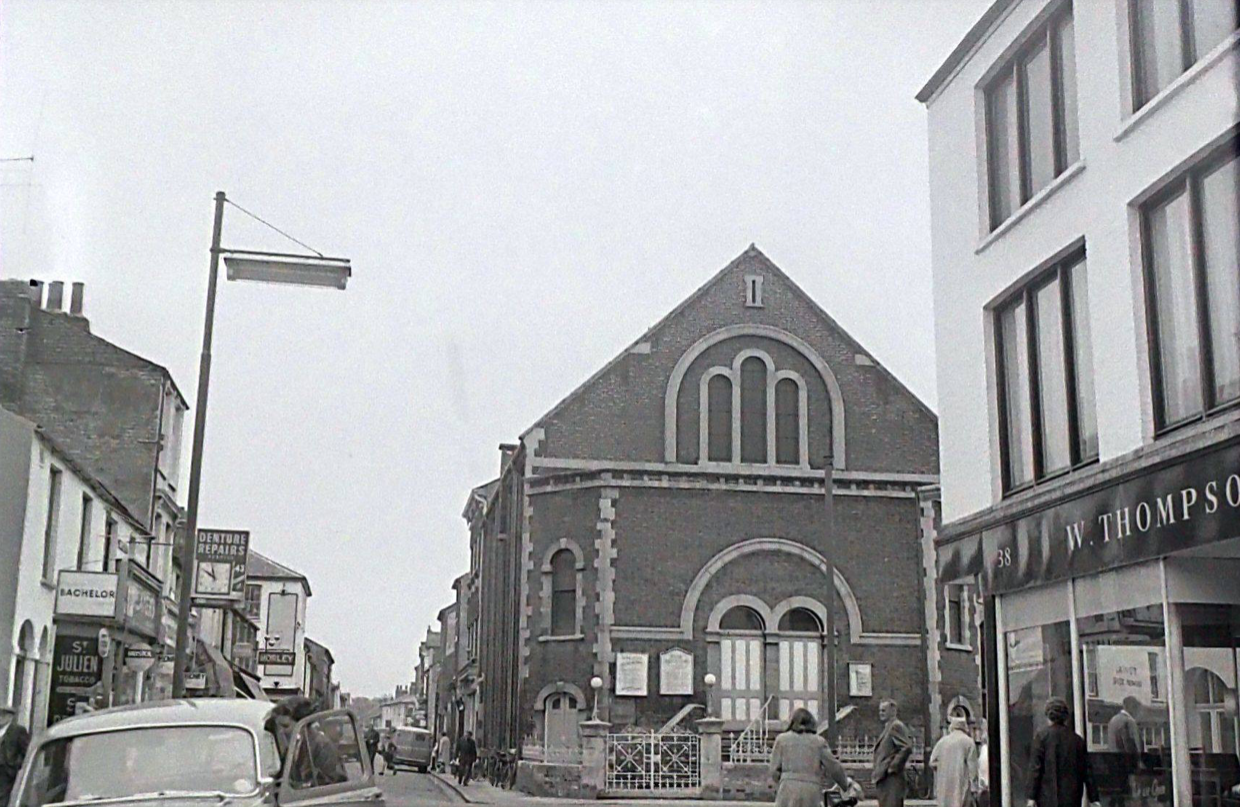
Eden Chapel and Thompson’s at junction of Fitzroy and Burleigh Streets 1964
1937 (38)
W Thompson and Son, house furnisher
In 1984 Down Your Street wrote: Thompsons are one of the oldest furnishers in Cambridge. “My great-great-grandfather who established the business was a cabinet maker at Willow Place,” said Mr Peter Frederick Thompson, the present owner. “These premises were occupied in the early 1850s and bought by my grandfather in 1881. They were burnt down both in 1899 and 1902. The story goes that my father was loaned money by Mr Bailey of Bailey and Tebbutt, the brewers, to rebuild the shop. It was then that living accommodation was built above.” Peter Thompson took over the business when he came back from the war in September 1945. “My father died in March 1940 and Alderman P J Squires who had been with the firm since the age of 14 kept the doors open during the war. He was well over 70 when war broke out.”
Projects
Contribute
Do you have any information about the people or places in this article? If so, then please let us know using the Contact page or by emailing capturingcambridge@
Licence
This work is licensed under CC BY-NC-SA 4.0