Search by topic
- archaeology
- Building of Local Interest
- chapel
- charity
- church
- crime
- dressmaker
- Great Eastern Railway
- Listed building
- Mapping Relief
- medieval
- oral history
- poverty
- Public House
- railway worker
- Religious House
- Roman
- scholar
- school
- Then and Now
- tudor
- women
- work
- world war one
- world war two
Search by text


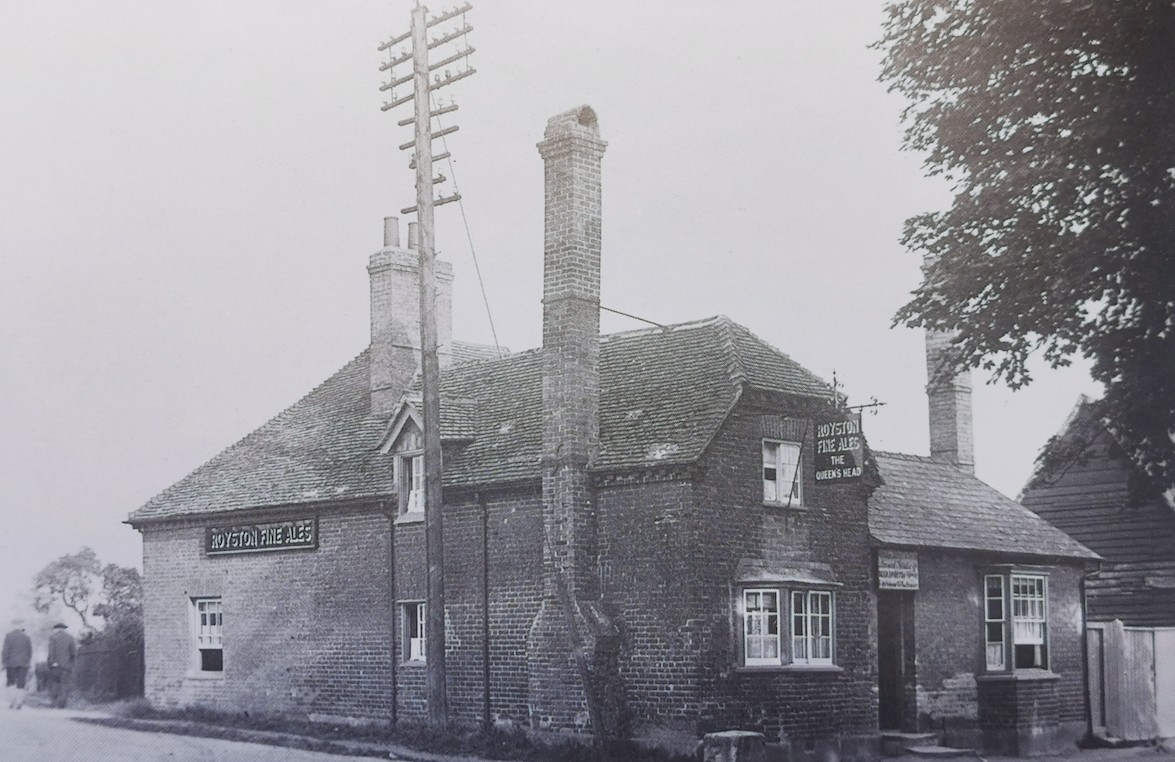 The Queen's Head, Newton, 1930, (photo E B Haddon) (Cambridgeshire Collection)
Queen’s Head, Newton
History of the Queen's Head Newton
Listed building:
Public house, early C18 extended later in C18, and in C19 and C20. Red brick, Flemish bond, with half-hipped, tiled roof and later side stack.
In 1987, J Hall wrote in ‘About Newton – the Five Went Ways,’: Within living memory it was sometimes the case that farm workers could only go and stand outside the Queen’s Head, lacking the money to enter and buy drinks.A small cottage in the yard housed the village library, the books given by the Hurrell family in connection with their Evening School.
1725 Act of Parliament which placed road from Ware to Cambridge under a Turnpike Trust.
1728-1729: Michael King of Newton
1730 two milestones erected in Newton
1731-1738 John Rule of Newton
1753-1779 Anthony Allcock of Newton
1787-1789 Thomas Mitchell
1802 earliest known description of pub as ‘Queens Head together with the Cottage House, Outhouses, Barns, Stables, Shops, Yard, Garden, Orchard.’
1807-1826 Edward Ashby
1827 licensee Edward Ashby failed to pay rent to John Phillips. Ashby’s fixtures were auctioned off and a list can be found together with an inventory of the articles belonging to John Phillips.
1827-1828 Thomas Kidman. Pub had stabling for five horses.
1834 a list of the extensive repairs required at the Queens Head by Thomas Kidman survives.
1847-1865 John Howard
1879 Peter Stubblefield
1892-1908 Mortimer Smith. By the end of the 19th century the small cottage in the yard housed the village library.
1916 Miss V J Smith
1922-1926 Mrs Caroline Smith
1929-1933 Miss V J Smith
1948 John Morris
1954 Sidney Bowditch
1960 Norman Mills
1962 Clifford Henry Short
1971 David Martin Valentine Short
Sources: Recognizances for Victuallers, trade directories etc (researched by Jessie Hall in About Newton – The Five Went Ways)
Projects
Contribute
Do you have any information about the people or places in this article? If so, then please let us know using the
Contact page or by emailing
capturingcambridge@
Licence
This work is licensed under
CC BY-NC-SA 4.0


 not including content on external links as indicated
by
not including content on external links as indicated
by .
.