Search by topic
- archaeology
- Building of Local Interest
- chapel
- charity
- church
- crime
- dressmaker
- Great Eastern Railway
- Listed building
- Mapping Relief
- medieval
- oral history
- poverty
- Public House
- railway worker
- Religious House
- Roman
- scholar
- school
- Then and Now
- tudor
- women
- work
- world war one
- world war two
Search by text


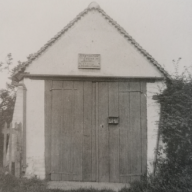
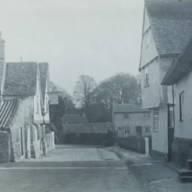
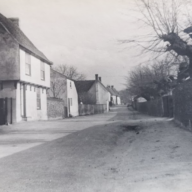
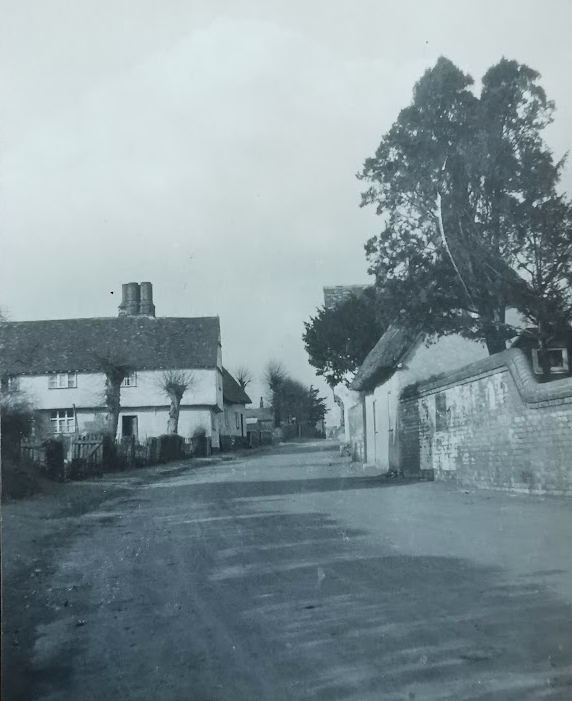 29 High Street, Hinxton, 1930 (MoC216/34)
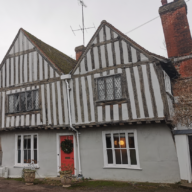
29 High Street, Old Manor House, Hinxton
History of 29 High Street
No. 29 (The Old 22.11.67 Manor House) (formerly listed as The Tudor House) . GV II* Guildhall. Late C15, converted to a manor house c.1580 with late C17 or early C18 alterations. Timber-framed and plastered with brick plinth. Red plain tiled roof. Late C16 ridge stack with four reduced octagonal shafts with moulded bases; capped stack on east side to additional C17 hearth. Two storeys with inserted late C16 or early C17 attic floor; part cellar to east.
The guildhall, part of the manor of Hinxton owned by the De Veres in 1485, Earl’s Colne Priory (Essex) in 1494, was regranted to the De Veres in 1536 and sold to John Machell and later Sir James Deane’s brother in 1597 who were possibly responsible for the alterations. A manor court was held in the courtyard by c.1600 after its conversion.
Edward Hinde, the lessee of the manor from John Machell held courts here, and they were still being held in 1804. An old flint wall running along the back gardens of houses in Red Lion Square is thought to be the original garden wall of the Court House.
It is reputed to be the oldest surviving building in the village. The woodwork is of very high quality and there are medieval interior wall paintings depicting acanthus ornamentation with grotesque heads.
1939 no.29
Harry Ripsher, b 1869, farm labourer
Projects
Contribute
Do you have any information about the people or places in this article? If so, then please let us know using the Contact page or by emailing capturingcambridge@
Licence
This work is licensed under CC BY-NC-SA 4.0