Search by topic
- archaeology
- Building of Local Interest
- chapel
- charity
- church
- crime
- dressmaker
- fire
- Great Eastern Railway
- Listed building
- Mapping Relief
- medieval
- oral history
- poverty
- Public House
- Religious House
- Roman
- scholar
- school
- Then and Now
- tudor
- women
- work
- world war one
- world war two
Search by text
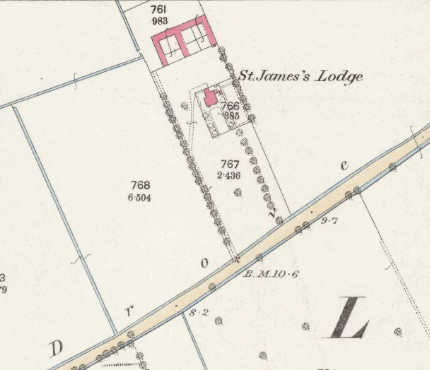 St James's Lodge, Postland, Lincs OS 1887
St James’s Lodge, Postland, Lincolnshire
History of St Jame's Lodge
Mary Liquorice, The Hartleys of Fletton Tower, 1996, argues that St Botolph’s Lodge in The Bricklands by L P Hartley is based upon St James’s Lodge, Postland, the home of L P Hartley’s own grandparents. His grandfather was Mr W J Thompson, local councillor and well-known personality in Crowland and Great Postland. he was a farmer and apparently well off.
In The Bricklands, Richard Mardick’s aunts may well be based on Mary Elizabeth’s sisters., suggesting that the novel is thinly disguised autobiography.
1891 Postland
William James Thompson, 50, farmer, b Lincs
Mary David, 57, b Lincs
Mary Elizabeth, 27, b Lincs
Kathleen Annie, 25, b Lincs
William James, 23, farmer, b Lincs
Evelyn Louise, 19, b Lincs
Fanny, 16, b Lincs
Herbert, 13, b Lincs
Harry Bark Hartley, 31, solicitor, b Yorks
Alice Lancaster, 20, servant, b Thorney
Mary Brighty, 22, housemaid, b Bury
Harry Stokes, 19, groom, b Crowland
In this household are L P Hartley’s father and mother to be, Harry Bark Hartley and Mary Elizabeth Thompson.
According to Mary Liquorice, Harry Bark Hartley was born in Yorkshire. he married Mary Elizabeth Thompson at the Old Wesleyan Chapel in Reform Street, Crowland, in June 1891. H B Hartley was a solicitor with his own practice at Whittlesey and an office near Peterborough cathedral. the newly married couple went to live in Whittlesey, in Eastgate.
Projects
Contribute
Do you have any information about the people or places in this article? If so, then please let us know using the Contact page or by emailing capturingcambridge@
Licence
This work is licensed under CC BY-NC-SA 4.0