Search by topic
- archaeology
- Building of Local Interest
- chapel
- charity
- church
- crime
- dressmaker
- fire
- Great Eastern Railway
- Listed building
- Mapping Relief
- medieval
- oral history
- poverty
- Public House
- Religious House
- Roman
- scholar
- school
- Then and Now
- tudor
- women
- work
- world war one
- world war two
Search by text
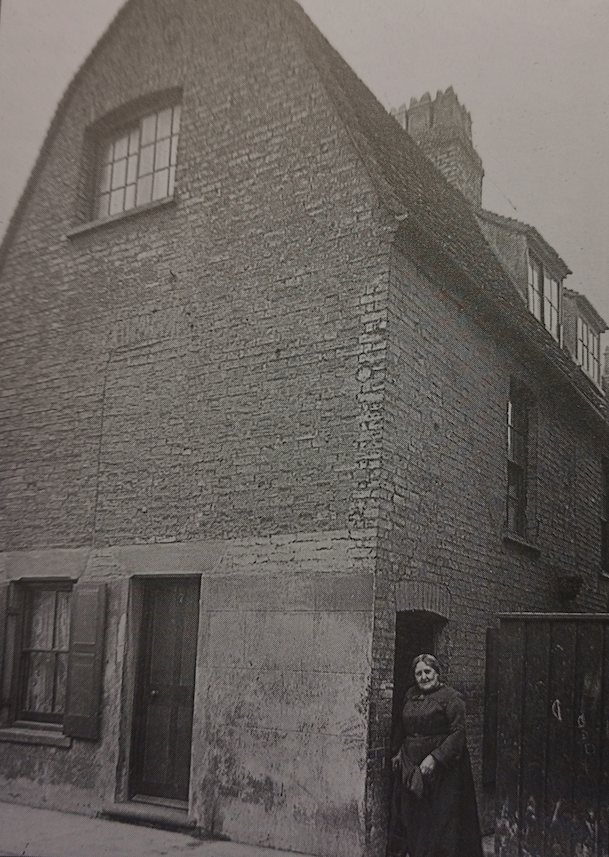 St Andrew the Less Parish workhouse, 199 (photo H P Stokes) (Cambridgeshire Collection)
8 – 9 Staffordshire Gardens, St Andrew the Less Workhouse
History of 8 - 9 Staffordshire Gardens
The St Andrew the Less Workhouse, Staffordshire Gardens was built in 1830 and could accommodate up to 46 children. It was demolished in the 1960s.
1830 Baker’s Map
The large road on the left is East Road. This workhouse is in the lower half of the map between the end of (the unlabelled) Brewhouse Lane and Staffordshire Place. The entrance to the workhouse can be seen at the end of Work House Lane (now known as Norfolk Street).
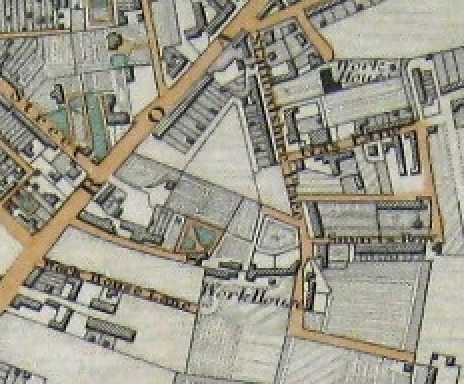
Baker’s map excerpt
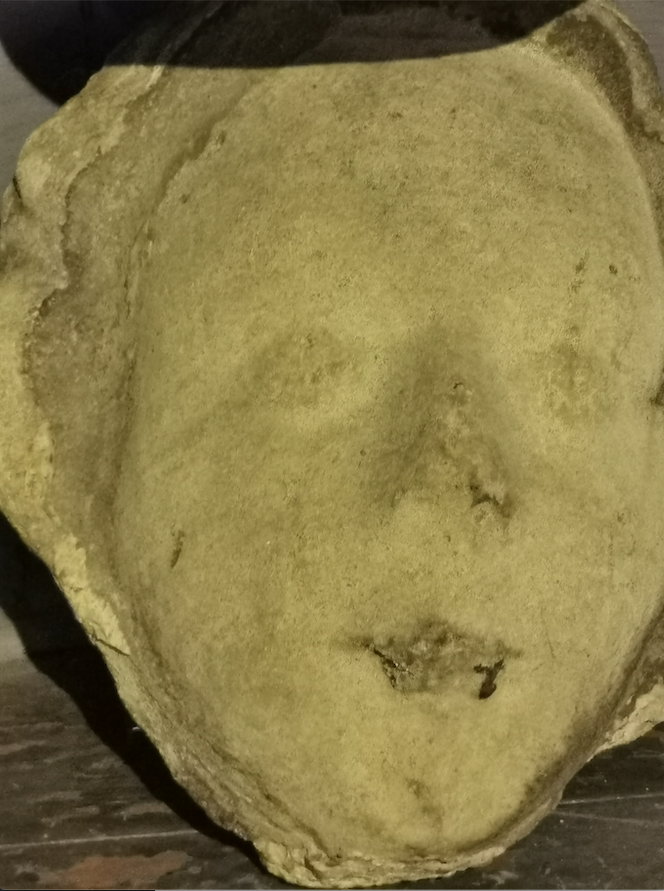
Stone head from the St Andrew’s the Less workhouse c. 1830
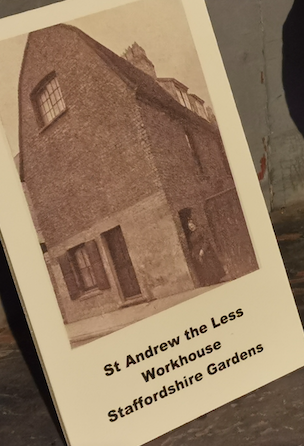
St Andrew the Less Workhouse, Staffordshire Gardens
[I have tried to locate this institution in censuses for 1851-1881 with no success to date. RGL 2.7.2020]
1911
St Andrew the Less Parish workhouse, 1911 (photo H P Stokes) (MoC64/72)
H P Stokes wrote in 1911: When the central Union was formed in 1836, this Workhouse was altered to a certain extent, and used for the reception of girls and boys (to the number of 46). The interesting house is now inhabited by a venerable and intelligent old lady who carries her 94 years with much vivacity. She knew the place well in her childhood, and she laughingly remarks that she has come to die in ‘the Workhouse’. She remembers Mr and Mrs Arnold, the former master and mistress of the institution, who used to allow her and a few children living Covent Gardens to play with the pauper boys and girls after they had finished ‘their work.’
Projects
Contribute
Do you have any information about the people or places in this article? If so, then please let us know using the Contact page or by emailing capturingcambridge@
Licence
This work is licensed under CC BY-NC-SA 4.0