Search by topic
- archaeology
- Building of Local Interest
- chapel
- charity
- church
- crime
- dressmaker
- fire
- Great Eastern Railway
- Listed building
- Mapping Relief
- medieval
- oral history
- poverty
- Public House
- Religious House
- Roman
- scholar
- school
- Then and Now
- tudor
- women
- work
- world war one
- world war two
Search by text
Brook End Farm, Hillside, Briers farm, Steeple Morden
History of Brook End Farm
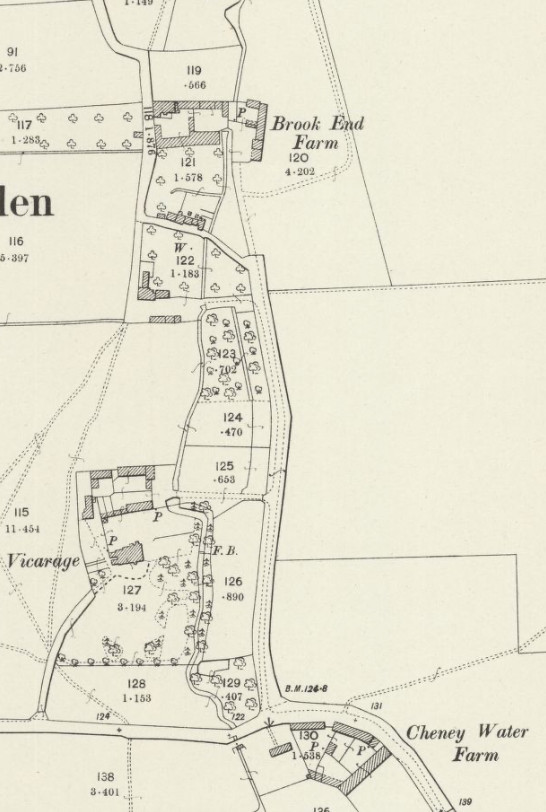
Brook End OS 1901
Herbert Godfrey Ilett was born in Brook End cottages in 1914. He describes his life and the community in detail in “A Villager’s Life” (1993).
Herbert recalls the Brocketts living at Hillside House. The house had been built for Oswald Duke. Mrs Brockett ‘a fine lady’ was also a Duke, possible Oswald Duke’s sister.
Frank Brockett was also a dealer in cattle (his father had been a butcher in Guilden Morden); he also kept pigs and sheep. There were about 12 working horses and a pony to pull a trap.
1921 Hillside farm
Frank Brockett, 43, b Steeple Morden, farmer,
Miriam, 43, b Great Chishill,
Gerald F, 16, b Guilden Morden, assisting in farm work,
Joyce Miriam, 14, b Guilden Morden
Miriam Allpress, visitor, 14, b Chatteris,
Madeline Parmenter, 27, b Suffolk,
Laura Thompson, 21, b Steeple Morden,
Around 1927 the stock were infected with foot and mouth disease. All animals were slaughtered and Brook End became a no-go area. Mr Brockett gave up animal farming.
Projects
Contribute
Do you have any information about the people or places in this article? If so, then please let us know using the Contact page or by emailing capturingcambridge@
Licence
This work is licensed under CC BY-NC-SA 4.0