Search by topic
- archaeology
- Building of Local Interest
- charity
- church
- crime
- dressmaker
- fire
- Great Eastern Railway
- Listed building
- Mapping Relief
- medieval
- oral history
- poverty
- Public House
- Rattee & Kett
- Religious House
- Roman
- scholar
- school
- Then and Now
- tudor
- women
- work
- world war one
- world war two
Search by text
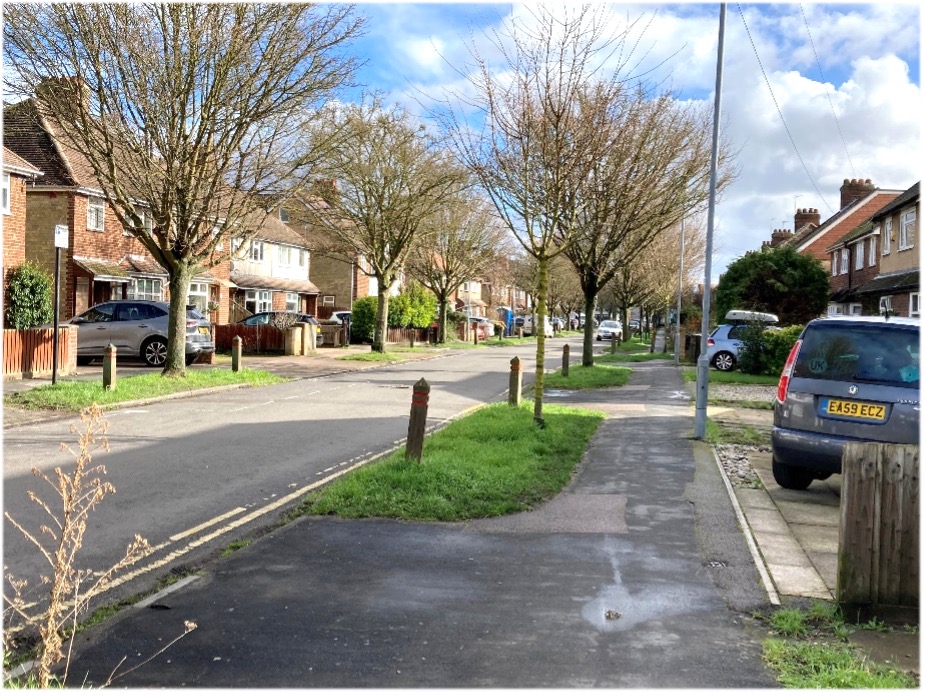 Greville Road at the turning circle 2024, courtesy of Ian Bent
Greville Road
A Street re-inventing itself
The twenty-first of the Mill Road History Society building and site reports is about Greville Road, a 1930s development south of, and roughly parallel to, Mill Road in Romsey.
Read the complete site report (PDF)
Greville Road, running east to west in the Mill Road vicinity of Romsey Town, is unique in Cambridge in as much as the whole street and every house on it was developed by one business concern – Crown & Cox. That was in the late 1930s, when many a suburban development was taking place around more or less every urban area in the UK.
Few such “mono-developments” took place in the first half of the twentieth century, when, in the majority of cases, there would be a mix of private builders (the exception being in public sector schemes, of which there were many).
It seems, from the records of the Greville Road Residents’ Association and Spalding’s Directories, that the majority of the first occupants were local Romsey Town and Petersfield folk. Many were engaged in manual trades, a few clerical, and by moving into such relatively spacious houses, and on a quiet street, most must have considered themselves on the up-and-up.
Eighty or so years later Cambridge has changed – manual occupations have decreased and professional/technical/academic employment, and population, has boomed. The new is quite evidently replacing the old.
Over the last decade or so, it would have been noticeable to any passer-by that Greville Road appears to be in a state of near-constant domestic construction work – skips and builders’ vans seem to be part of the general streetscape. Expansive tarpaulins are draped over many a roof and the sound of hammering and drilling seems pervasive. So, what’s going on?
Read more in the complete report below.
Contribute
Do you have any information about the people or places in this article? If so, then please let us know using the Contact page or by emailing capturingcambridge@
License
This work is licensed under CC BY-NC-SA 4.0