Search by topic
- archaeology
- Building of Local Interest
- chapel
- charity
- church
- crime
- dressmaker
- fire
- Great Eastern Railway
- Listed building
- Mapping Relief
- medieval
- oral history
- poverty
- Public House
- Religious House
- Roman
- scholar
- school
- Then and Now
- tudor
- women
- work
- world war one
- world war two
Search by text
26 Ainsworth Street, The Malt and Hops
The Malt and Hops Inn
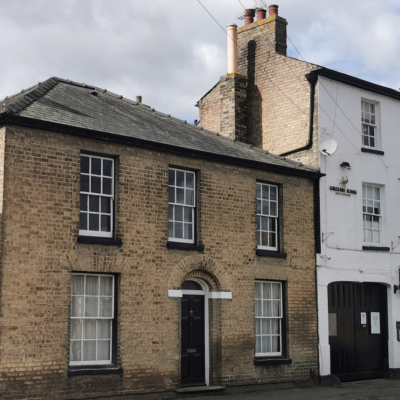
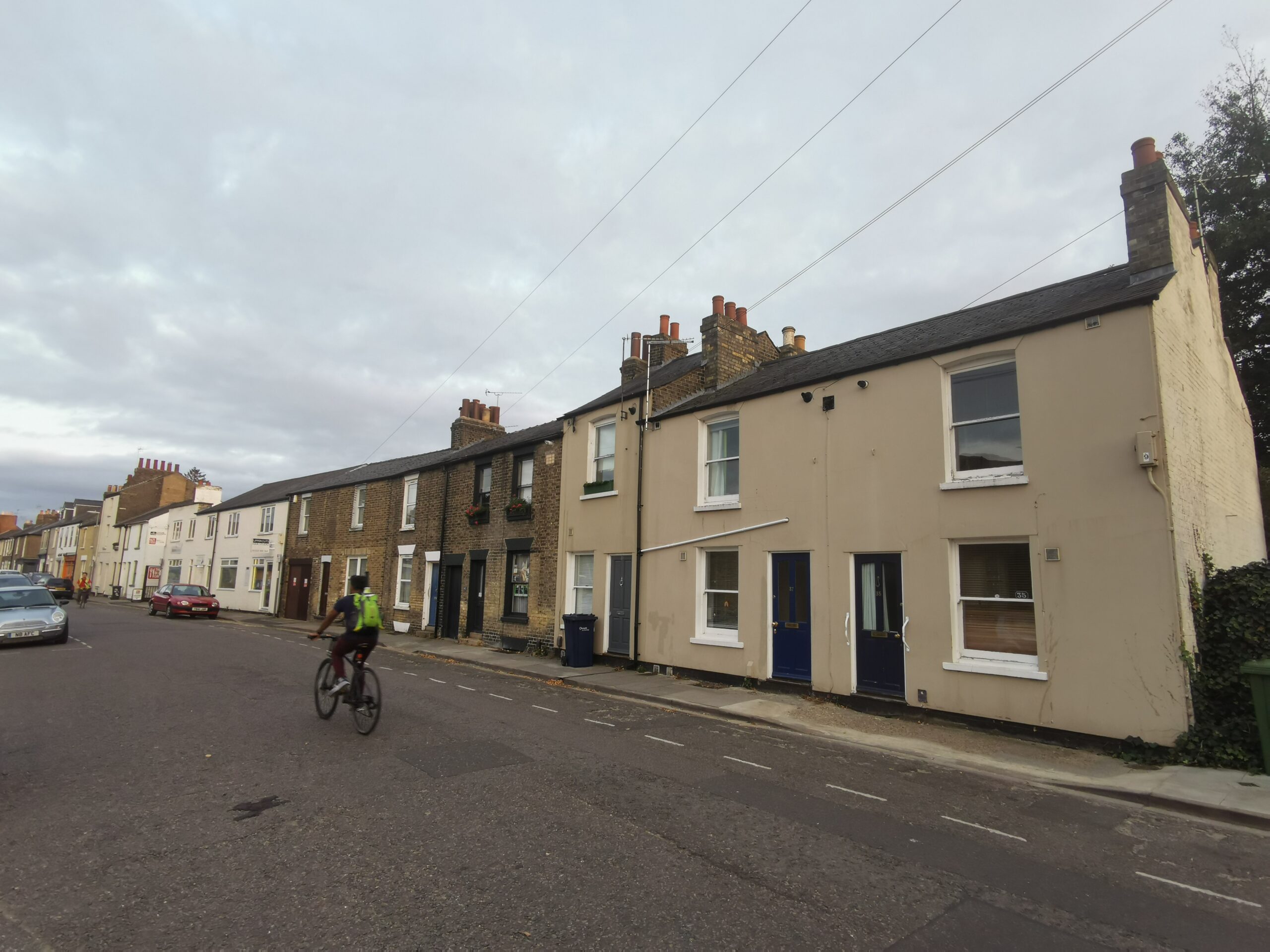
Number 26 is a corner property on the east side of Ainsworth Street. It was a public house by 1881, known as the Malt and Hops, but began its life as a grocer’s shop.
1881 census
George Gilbert, head, 34, grocer & brewer, b. Houghton, Huntingdonshire
Susanna Gilbert, wife, 33, b. Soham, Cambridgeshire
Beatrice J Gilbert, daughter, 6, scholar, b. Cambridge
Florence L Gilbert, daughter, 4, b. Cambridge
Elizabeth G Gilbert, daughter, 2, b. Cambridge
Henry A Prime, apprentice, 18, apprentice grocer, b. Cottenham, Cambridgeshire
George and Susanna Gilbert had lived on Ainsworth Street since their wedding on 10 April 1872: the newspaper account of the wedding records that George Gilbert is a grocer of Ainsworth Street. This is confirmed by the baptism record of their eldest daughter Lucy (who died in 1880). However, the street was not numbered in the early 1870s.
In August 1877 George Gilbert applied for a licence to sell ‘beer, cider and perry’. In Spalding’s Directory for 1878, George is still described as a grocer, but in Spalding’s Directory for 1881 the Malt and Hops is first listed as a public house.
1891 census
George Gilbert, head, 44, publican, b. Hemingford, Huntingdonshire
Susanna Gilbert, wife, 43, b. Soham, Cambridgeshire
Beatrice J Gilbert, daughter, 16, draper’s apprentice, b. Cambridge
Florence C Gilbert, daughter, 14, scholar, b. Cambridge
Elizabeth E Gilbert, daughter, 12, scholar, b. Cambridge
George Artemus Gilbert, son, 8, scholar, b. Cambridge
Henry A I Gilbert, son, 6, scholar, b. Cambridge
Such was the popularity of the Gilberts’ pub that Stone Street is sometimes referred to as ‘Gilbert Street or Stone Street’ on maps from this period, suggesting that people locally used the name Gilbert Street.
On 24 May 1893 there was a fatal accident on the railway when George (junior) was playing between the coal trucks. Somehow he wedged his head between the buffers and was crushed (Cambridge Independent Press, 26 May 1893):
The Coroner said it was a sad accident and he hoped it would be a warning to the lads of the neighbourhood.
It was pointed out that the railway officials had to constantly put a man on guard to keep the lads off the railway. They hoped this accident would persuade parents to talk to their children about trespass and that the railway was private property.
The article goes on to say ‘It is sad to relate that the deceased boy is the second child Mr Gilbert has lost to accidental death.’ There is a suggestion on some Ancestry.co.uk Family Trees that the eldest child Lucy died when she fell into a vat of beer and drowned.
At the time of his son’s death, George Gilbert is being referred to as a ‘brewer and mineral water manufacturer’.
George Gilbert last appears on the Electoral Register for Cambridge in 1897, and the 1901 Census shows the family living in Rotherhithe.
Florence Gilbert married restaurant keeper George Fidler in April 1901.
Elizabeth Gilbert married bootmaker Percy Fortin (he grew up on Gwydir Street) in 1905 and they moved to Leighton Buzzard. They named their eldest son ‘Gilbert’ and their second son had the middle name ‘Artemus’.
Beatrice Gilbert married Mariner 1st Mate Arthur Thomas Williams in 1908. In 1911 they were living in East Ham with their 3-year-old adopted daughter Gertrude Maud Gilbert.
By 1911 George Gilbert had died and Susanna was living alone in East Ham. She died in 1912.
1901 census
Albert Wilden, head, 43, licensed victualler, own account, b. Cranbrook, Kent
Jessie A F Wilden, wife, 37, sick nurse, own account, b. London, Middlesex
Florence J Hawkins, daughter, 17, b. Reading, Berkshire
The Wildens’ daughter Florence has no occupation listed, so is likely helping her working parents run their household and the pub downstairs.
1911 census
Robert Varley, head, 44, publican, b. Preston, Lancashire
Mary Ann Varley, wife, 41, assisting in the business, b. Spike Island, Cork, Ireland
William Bloomer Varley, son, 14, b. Preston, Lancashire
Frank Varley, son, 11, school, b. Preston, Lancashire
Ena Alice Varley, daughter, 3, b. Cambridge
Ivy Florence Varley, daughter, 6 months, b. Cambridge
Robert and Mary Ann Varley had been married for 18 years and had six children, of which two had died.
1921 census
Eliza Back, head, 1861, 60, widow, licensed victualler, b. Horndon on the Hill, Essex
Nellie Back, daughter, 1885, 36, fish caterer, b. Folkestone, Kent
Florrie Back, daughter, 1892, 29, fish caterer, b. Folkestone, Kent
John Back, son, 1893, 28, fish caterer, b. Folkestone, Kent
Abbie Back, daughter, 1895, 26, mother’s help, at home, b. Folkestone, Kent
Sidney Back, son, 1897, 24, fish caterer, b. Upton Park, Essex
Adie Back, daughter, 1899, 22, confectioner, b. Upton Park, Essex
As stated on the Census, the Back family were running four businesses. Matriarch Eliza was a licensed victualler running the Malt and Hops at home. Her children Nellie and Sidney were fish caterers with a business at 42 Burleigh Street, and Florrie and John also fish caterers at 16 Chesterton Road. The youngest daughter Adie was a confectioner with a business at 58 Burleigh Street.
Sources: 1878, 1881 Spalding Directory, 1881, 1891, 1901, 1911 and 1921 census, Cambridgeshire Banns, Cambridgeshire Baptisms, London, England, Church of England Marriages and Banns, 1754–1932, England & Wales Deaths 1837–2007, Cambridge Chronicle and Journal 13 April 1872, Cambridge Independent Press 4 August 1877, Cambridge Independent Press 26 May 1893, www.ancestry.co.uk, Cambridgeshire, England, Electoral Registers, Burgess Rolls and Poll Books, 1722–1966
Projects
Contribute
Do you have any information about the people or places in this article? If so, then please let us know using the Contact page or by emailing capturingcambridge@
Licence
This work is licensed under CC BY-NC-SA 4.0