Search by topic
- archaeology
- Building of Local Interest
- chapel
- charity
- church
- crime
- dressmaker
- fire
- Great Eastern Railway
- Listed building
- Mapping Relief
- medieval
- oral history
- poverty
- Public House
- Religious House
- Roman
- scholar
- school
- Then and Now
- tudor
- women
- work
- world war one
- world war two
Search by text
96 Ainsworth Street
96 Ainsworth Street
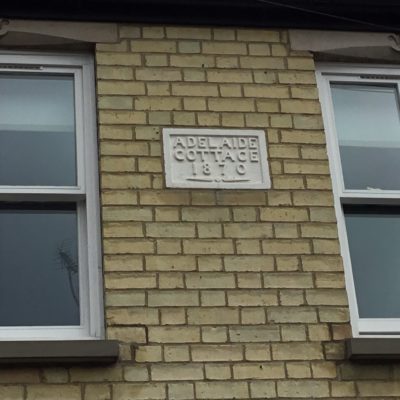
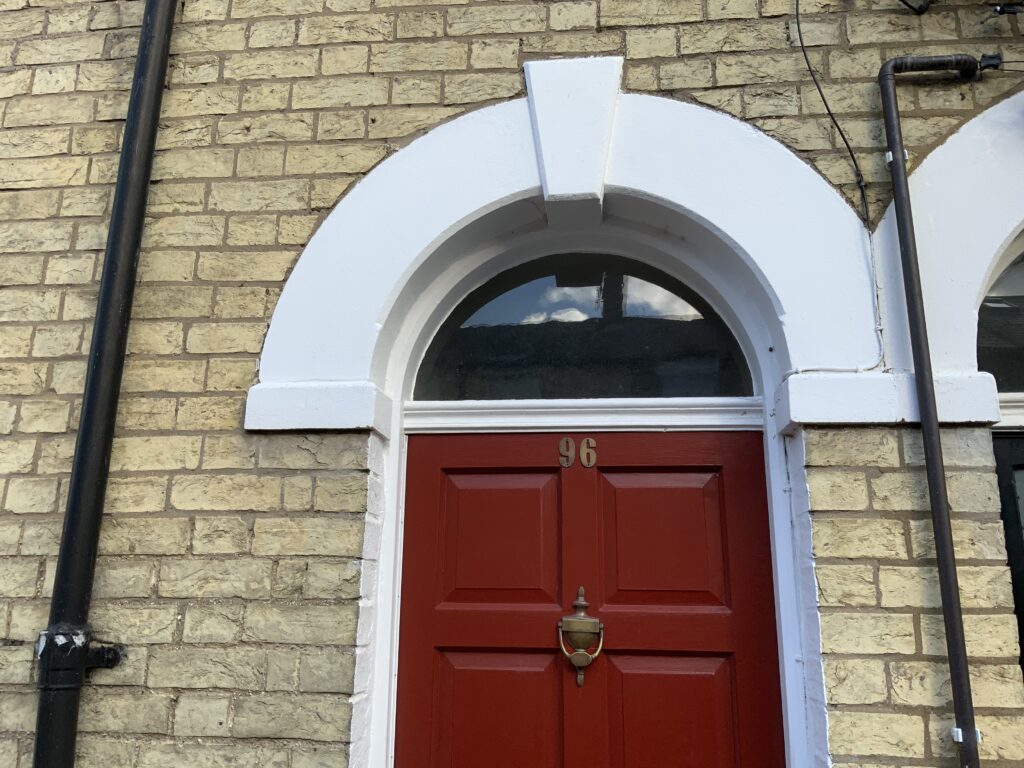
Number 96 is one of four mid-terraced houses on the east side of Ainsworth Street, built around 1870.
1871 census for households 221, 222 and 223*
William Squires, head, 29, railway porter, b. Somerton, Norfolk
Betsy Squires, wife, 35, b. Burwell, Cambridgeshire
Albert Squires, son, 1, b. Cambridge
Florence E Squires, daughter, 3 mo, b. Cambridge
John Stacey, lodger, 22, railway fireman, b. Dunkerton, Somerset
Arthur Coleman, lodger, 19, carpenter & joiner, b. Cherryhinton, Cambridgeshire
*In 1871 Ainsworth Street was not yet numbered. Identification of houses is tentative.
A sketch map from 1874 indicates that the house was owned by engine driver Joseph Turner, who lived next door at 98 Ainsworth Street.
1881 census
Sarah Kitchener, head, 67, waiting room attendant GE Railway, b. Bennington, Hertfordshire
William E Wheeler, nephew, 21, telegraphist GER, b. St Andrews, Hertfordshire
Mary A Wheeler, niece, 22, teacher of music, b. Hatfield, Hertfordshire
In 1885 Mary Ann Wheeler married William Moody and they had a daughter called Alice. William died in 1887.
1891 census
Mary Ann Moody, head, 31, waiting room attendant, b. Newgate St, Hertfordshire
Alice Moody, daughter, 4, b. Cambridge
Sarah Kitchener, aunt, 81, b. Bennington, Hertfordshire
Sarah Page, servant, 16, general servant, b. Shelford, Cambridgeshire
In 1891 Mary Ann is listed as head of household, and she has taken on her aunt Sarah’s role as a waiting room attendant at the railway station.
Sarah Kitchener died in 1892. The 1901 census shows Mary Ann and her daughter living with her mother-in-law in Basingstoke.
1901 census
George C Newman, head, 43, railway guard, b. Bottisham, Cambridgeshire
Jane Newman, wife, 42, b. Beccles, Suffolk
Percy Newman, son, 12, b. Cambridge
Ada Newman, daughter, 10, b. Cambridge
Frank Newman, son, 8, b. Cambridge
Grace Newman, daughter, 4, b. Cambridge
Mary Newman, boarder, 82, b. Bottisham, Cambridgeshire
George Clayton Newman, his wife Jane (née Brady) and their children moved here from 59 Ainsworth Street. Their boarder Mary Newman was George’s mother.
1911 census
George Newman, head, 52, railway guard, Great Eastern Railway, b. Bottisham, Cambridgeshire
Jane Newman, wife, 51, b. Beccles, Suffolk
Percy Newman, son, 22, railway porter, Great Eastern Railway, b. Cambridge
Frank Newman, son, 18, cycle mechanic for cycle agent, b. Cambridge
Grace Newman, daughter, 14, dressmaking apprentice, b. Cambridge
23 years married, 4 children
In 1911 Ada Newman was boarding in Luton and working as a straw hat machinist. She married Horace Leopold Brown in 1912.
On 8 April 1911, a few days after filling in the census, while working as a goods guard in Fordham, George crushed his right leg and bruised his thigh. The report writes ‘The victim walked into the goods shed alongside the side of wagons which he was about to unload. As he prepared to go up steps onto the platform, he was struck by the first wagon.’ It further states, ‘The victim unnecessarily exposed himself to danger contrary to the Rules.’
In 1913 George joined the National Union of Railwaymen.
Percy married Rose Lillian Pottinger in 1915. He was a railway passenger guard and they lived in Essex.
1921 census
Grace Victoria Newman, daughter, 24, single, home duties, b. Cambridge
In the 1921 census form, Grace’s name is written in the third line, with the previous two left blank. This suggests that her parents were normally resident but away for the night.
Grace married George Murfitt in 1924. George and Jane remained at this property until their deaths. George died in 1930 and Jane in 1935.
Source: 1871–1921 England Census, Cambridgeshire Banns, Register of Railway Employee Injuries and Deaths, 1911–1915, Burial and Cremation Index, 1576–2014, Cambridgeshire, England, Electoral Registers, Burgess Rolls and Poll Books, 1722–1966, Trade Union Membership Registers, Cambridgeshire Baptisms
Projects
Contribute
Do you have any information about the people or places in this article? If so, then please let us know using the Contact page or by emailing capturingcambridge@
Licence
This work is licensed under CC BY-NC-SA 4.0