Search by topic
- archaeology
- Building of Local Interest
- chapel
- charity
- church
- crime
- dressmaker
- fire
- Great Eastern Railway
- Listed building
- Mapping Relief
- medieval
- oral history
- poverty
- Public House
- Religious House
- Roman
- scholar
- school
- Then and Now
- tudor
- women
- work
- world war one
- world war two
Search by text
78a (77) Kingston Street
Railway Policeman & a Widow
77 Kingston Street was previously part of the shop ownership at number 78 and sat on the odd numbered side of street, but more recently it has been numbered as 78a, date of renumbering in mid 1900s.
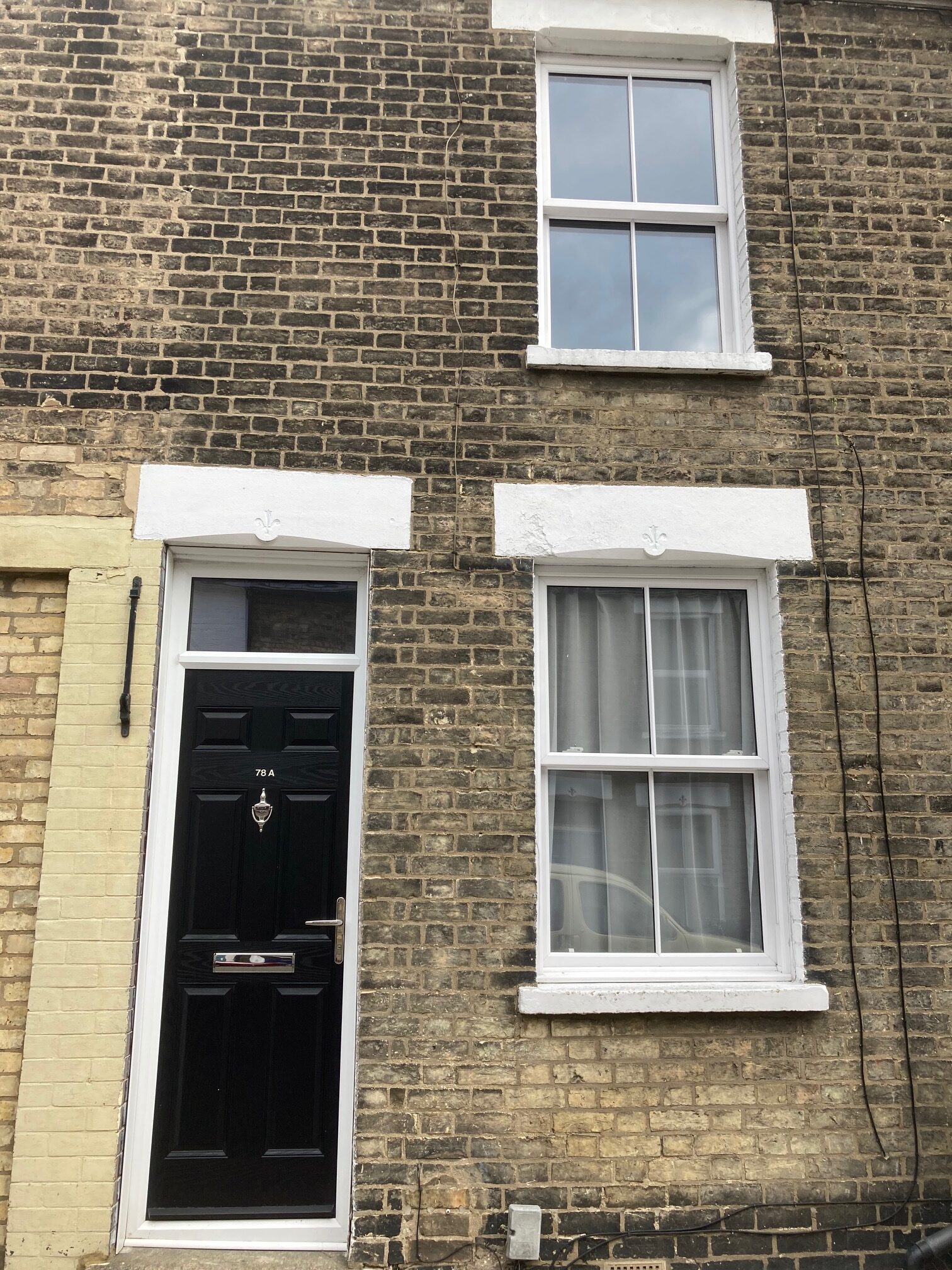
78a Kingston Street was previously numbered 77
1881
The property doesn’t appear on the 1881 Census.
1891
In 1891, 77 Kingston Street is home to Charles Denny, aged 43, from Essex, who is married to Annie Denny, a 44 year old born in Barbados, though searching reveals no further information. Charles Denny works as a Railway Policeman, which doesn’t mean that he was a policeman in the modern sense, as in the early days of the railways a ‘policeman’ was in charge of trains ran on the right lines and apart from one another.
1901
By 1901, 77 Kingston Street is home to Sarah Farr, a 62 year old widow, living on her own means. She has a boarder, 70 year old widower George Watkins, a Coal Dealer from Ipswich.
1911
In 1911, Number 77 is home to the Edwards family. Elizabeth Ann Edwards, a 58 year old from Salisbury, is married to Harry Alfred Edwards, a 66 year old Machineman from Cambridge. They have one son, Thomas Edwards, aged 18, working as a boiler maker’s apprentice. Alongside this, they have a boarder, 20 year old Clarence Victor Howards from Haddenham, a fitter’s apprentice, meaning it is likely that Harry, Thomas and Victor all work for the same company, as they all work in the same industry.
Sources: 1881, 1891, 1901, 1911 UK Census, Spalding Trade Directory 1895, Land Tax 1910, Ordnance Survey Town Plan 1888,
Projects
Contribute
Do you have any information about the people or places in this article? If so, then please let us know using the Contact page or by emailing capturingcambridge@
Licence
This work is licensed under CC BY-NC-SA 4.0