Search by topic
- archaeology
- Building of Local Interest
- chapel
- charity
- church
- crime
- dressmaker
- fire
- Great Eastern Railway
- Listed building
- Mapping Relief
- medieval
- oral history
- poverty
- Public House
- Religious House
- Roman
- scholar
- school
- Then and Now
- tudor
- women
- work
- world war one
- world war two
Search by text
42 Sturton Street, Cambridge
History of 42 Sturton Street
This building no longer stands.
1880 – 1883
Head of Household in 1881 is William Squires, a 39 year old railway porter for the Great Eastern Railway. He lives here with his wife Betsey (nee Porter) and four children. Alice is 13, Albert is 11, Florence Eliza is 10 and Mary is 7. They all attend school.
All the children were born in Cambridge, but William is from Somerton in Norfolk and Betsey is from Burwell.
The electoral registers first show William at this property from 1880/81 until 1883/84 when William and Betsey can be found living at 24 Sturton Street with Alice and Mary.
Albert was baptised in June 1869 at Castle Street Methodist Chapel. At that time William gives his occupation as “baker”. However, the family can be found on Ainsworth Street in 1871 (the street was unnumbered at that time) and William is working as a railway porter.
1891
William F Human, 21, Carpenter, b. Newmarket, Suffolk
Hannah Human, 21, b. Comberton, Cambridgeshire
Edith Human, 8 months, b. Cambridge
1901
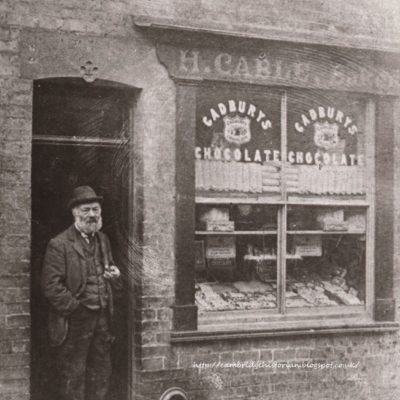
Ann Maria Harding, 59, Widow, b. Swaffham Bulbeck. The census records that she is a grocer and works from home. This suggests that 42 Sturton Street was a grocer’s shop.
Amelia Harding, 21, bookbinder, b. Swaffham Bulbeck
Percy Harding, 9, grandson, b. Cambridge
1911
Ann Maria Harding, head, 69, widow [married 29 years, 6 children], b. Swaffham Bulbeck
Amelia Harding, daughter, 31, book sewer, bookbinding, b. Swaffham Bulbeck
Percy Harding, grandson, 19, grocers porter, b. Cambridge
Roland Harding grandson, 7, school, b. City Road, London
Ann died whilst living with her daughter at number 56 Sturton Street. She is buried in Mill Road Cemetery, with her daughter Grace and Grace’s husband Charles Coe.
Sources – 1881, 1891, 1901, 1911 UK Census, Mill Road Cemetery, England Select Marriages (1538-1973), Cambridgeshire Baptisms, England & Wales Births (1837-2006),
Projects
Contribute
Do you have any information about the people or places in this article? If so, then please let us know using the Contact page or by emailing capturingcambridge@
Licence
This work is licensed under CC BY-NC-SA 4.0