Search by topic
- archaeology
- Building of Local Interest
- chapel
- charity
- church
- crime
- dressmaker
- fire
- Great Eastern Railway
- Listed building
- Mapping Relief
- medieval
- oral history
- poverty
- Public House
- Religious House
- Roman
- scholar
- school
- Then and Now
- tudor
- women
- work
- world war one
- world war two
Search by text
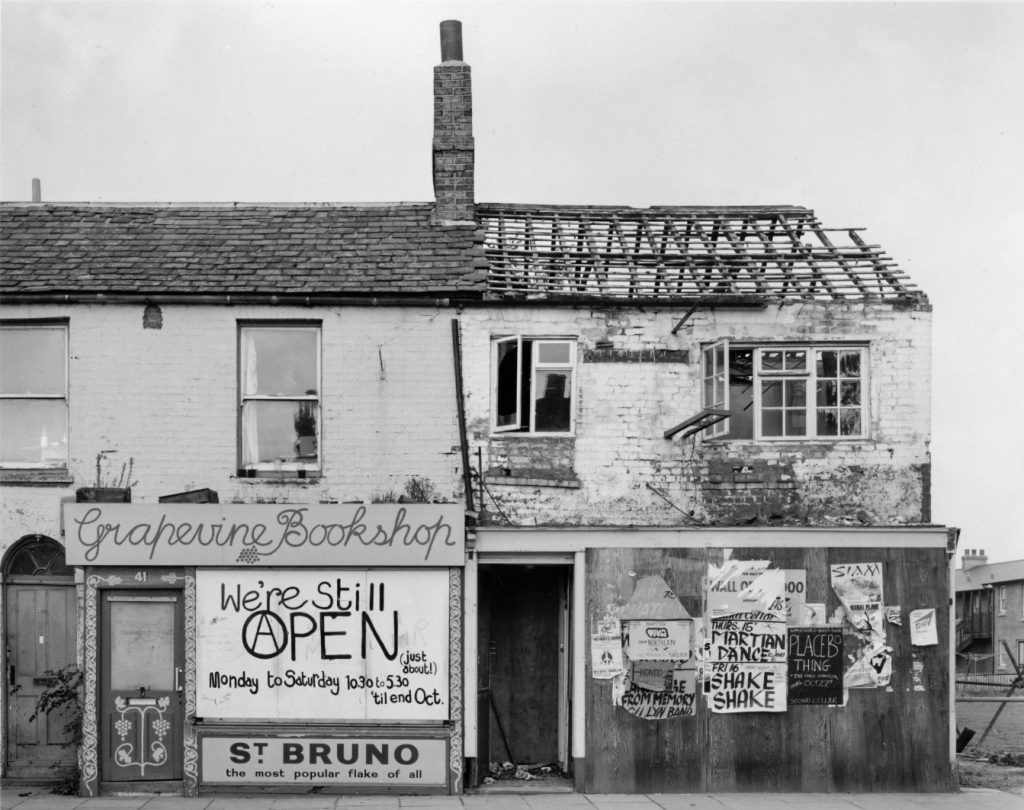 Grapevine, 41 Fitzroy Street, 1980s, Roy Hammans (the-golden-fleece.co.uk).
Grapevine Bookshop, 41 Fitzroy Street, Cambridge
Radical Bookshop Grapevine
The photo shows 41 and 43 Fitzroy Street around 1980.
Grapevine Bookshop opened at 41 Fitzroy Street in 1979.
The following description is taken from https://map.radicalbooksellers.co.uk/explore/grapevine/
Grapevine specialised in feminist fiction, social and political thought, gay and lesbian literature, and children’s books, with a stock of around 3,000 titles. It also provided bookstalls for radical meetings and events, serving as a hub for community activism and creativity.
The community newspaper associated with Grapevine Bookshop, The Grapevine, explained in its 1979 issue that the bookshop was collectively run by six people. They wanted to be a resource for various activist groups, including Cambridge Women’s Aid, Friends of the Earth, and the Cambridge Campaign against Racism and Fascism.
A notable figure associated with the bookshop was Lisa Jardine, Jesus College’s first female fellow, who helped establish the shop as a centre for local campaigns and community organisation.
The bookshop was part of a broader movement in the 1970s and 1980s that resisted developers and landowners, particularly in the Kite area of Cambridge. This movement, supported by community members and university dons, aimed to preserve local spaces and empower the community against the intrusion of commercial interests.
Former customers fondly remember the bookshop for its unique selection and its role as a focal point for information and activism.
In 1981, it moved to 186 East Road, but that shop was demolished in 1983 due to the road being widened. Despite the demolition, the bookshop continued to operate through stalls. In 1984, it reopened in Dales Brewery on Gwydir Street and remained there until its closure in 1991.
Antony Carpen has digitised four of the Grapevine newsletters which you can read below.
- Grapevine No 07 – Nov-Dec 1978
- Grapevine No 10 – May-June 1979
- Grapevine No 11 – Jul-Aug 1979
- Grapevine No 12 – Nov-Dec 1979
Projects
Contribute
Do you have any information about the people or places in this article? If so, then please let us know using the Contact page or by emailing capturingcambridge@
Licence
This work is licensed under CC BY-NC-SA 4.0