Search by topic
- archaeology
- Building of Local Interest
- chapel
- charity
- church
- crime
- dressmaker
- Great Eastern Railway
- Listed building
- Mapping Relief
- medieval
- oral history
- poverty
- Public House
- railway worker
- Religious House
- Roman
- scholar
- school
- Then and Now
- tudor
- women
- work
- world war one
- world war two
Search by text


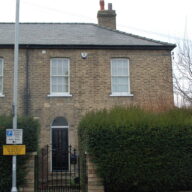
(11-13) King Street, Sidney Dairy (111-112)
History of (13) King Street
1861
(111) Martha Overall, 70, college servant, b Sawston
(112) Ann Brooker, 72, b Chatteris
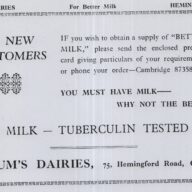
1874 Sidney Dairy
Thomas Hawkins
1913 Sidney Dairy
Tom Hawkins, dairyman
1962
(11) Mrs Dowyn
(13) Horace Brown, dairyman
Sidney Dairy, King Street by Gill Rushworth
(From C L H S Review no. 13 September 2004)
Until around 1922 King Street was numbered consecutively from the corner with Hobson Street along the south side and returning along the north side. The 1874 directory shows that Sidney Dairy was at numbers 111-112.
From c. 1871 the dairy was run by Thomas Hawkins, from 1896 by William Hawkins, from 1916-c. 1928 by another Thomas Hawkins, and then from c. 1929 to c. 1940 by Miss Hilda Hawkins. Then it was rented by Horace Brown who was joined by his brother Percival. The dairy continued at number 11 while Miss Hawkins lived at 13.
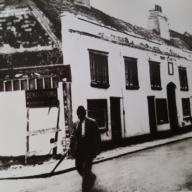
The dairy was situated under the living portion of the house, number 13, lived in by the Hawkins family. Entry was through a centre door from the street, and one step down. Either side of the door was a was a small display cabinet, probably once used to display dairy products.
The working area had a sloping floor, possibly tiled and held a large sink with a cold water tap and a tin bath in which the milk bottles were washed. Hot water had to be fetched from number 13.
Before the war the milk was fetched from Baker’s [Barker’s] farm at Comberton. Three churns in a motorcycle side car. Later the two or three churns of milk arrived by truck, possibly from Keith Wright’s of Fenstanton, about 5 or 6am. The churns would then be rolled down the step, through the shop to the back where the filling of bottles would begin. The round cardboard caps were then pressed into the tops of the bottles and loaded in to the crates both fore and aft on the delivery bicycle, ready to leave about 7am.
Once the round was finished the empty bottles were washed in hot soapy water and left to drain until the whole cycle started again the following morning. This happened seven days a week.
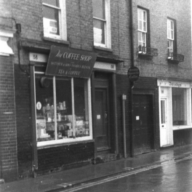
The dairy continued to operate until the mid 1960s when the small row of buildings in that part of King Street was demolished.
…………………………..
Projects
Contribute
Do you have any information about the people or places in this article? If so, then please let us know using the Contact page or by emailing capturingcambridge@
Licence
This work is licensed under CC BY-NC-SA 4.0