Search by topic
- archaeology
- Building of Local Interest
- chapel
- charity
- church
- college servant
- crime
- dressmaker
- Great Eastern Railway
- Listed building
- Mapping Relief
- medieval
- oral history
- poverty
- Public House
- railway worker
- Roman
- scholar
- school
- Then and Now
- tudor
- women
- work
- world war one
- world war two
Search by text


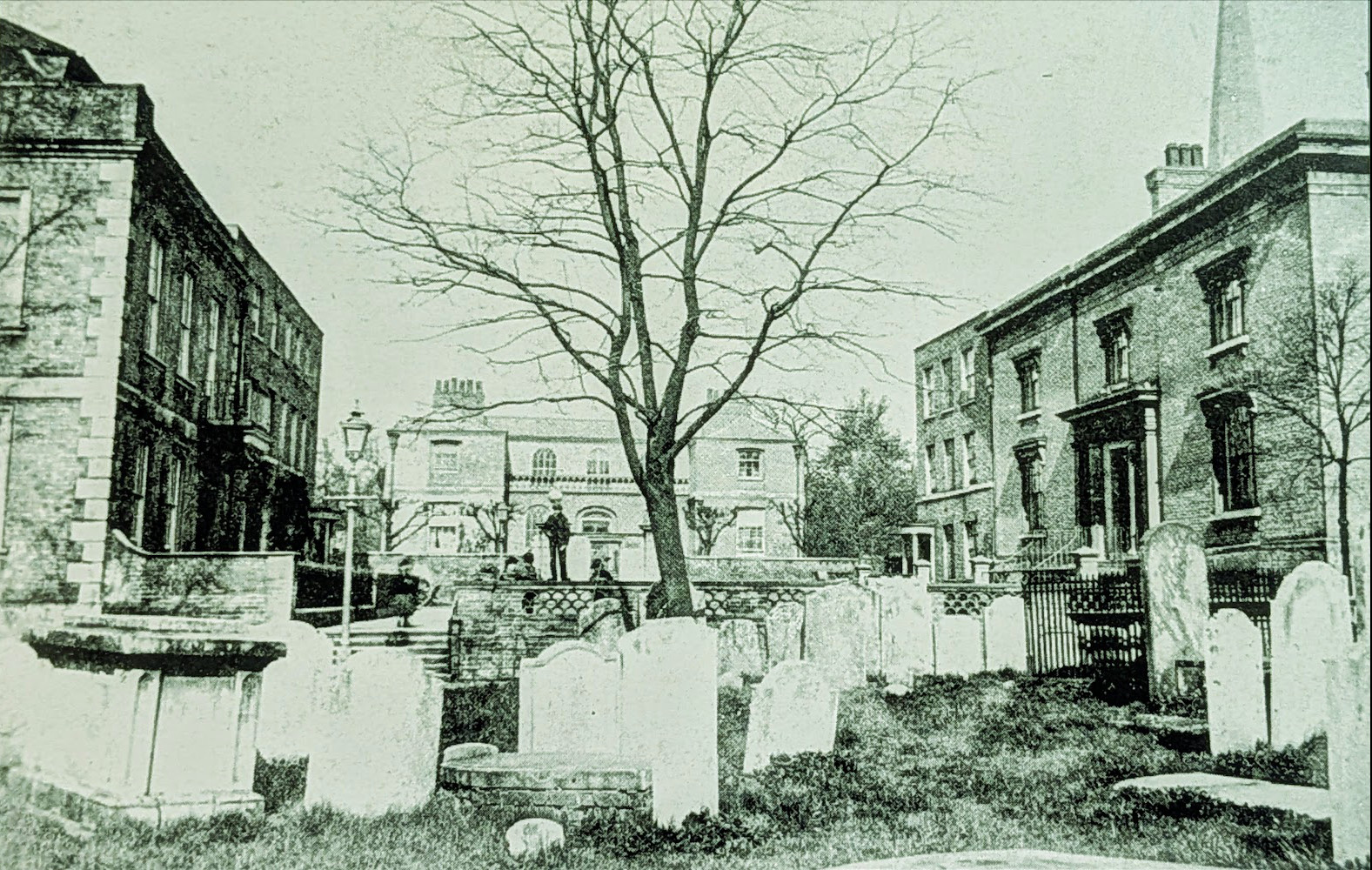 Churchyard of St Peter and St Paul, Wisbech c1880
St Peter and St Paul, Wisbech
History of St Peter and St Paul
Listed Building
The Church of St Peter and St Paul, Wisbech was constructed in the C12 and was substantially rebuilt in the C14. It has C15, C16 and C19 alterations, and is built from stone with Barnack limestone dressings and a lead roof.
Chest tomb in the churchyard to the south-east of St Peter and Paul Tomb with no inscription, possibly C15 with patterned walls and coped cover.
Chest tomb to John Baxter in the churchyard to south-east of St Peter and Paul. Inscribed “JOHN BAXTER / FOUNDER OF / “BAXTER CHARITY” / 1798.” Limestone with plinth and scalloped bases to pilasters.
Obelisk to Captain Shultz in the churchyard to south-west of St Peter and Paul. Obelisk with rounded head and shield of arms on limestone plinth. Raised panel with inscription to Capt Shultz, R M d1854.
Chest tomb to Elizabeth 6/277 (ii) Stevens, 1837. In the churchyard to south-west of St Peter and Paul Limestone raised on stepped plinth, ball and chain feet, pyramidal shapted corner with stiff corner foliage decoration.
Chest tomb to Joseph Medworth 6/277 (i) in the churchyard to south-west of St Peter and Paul Inscription faint, b1754, d1827 Limestone with sunk panelled quoins and plinth.
Headstone, mid C18. Limestone. Architectural form of engaged Ionic columns with entablature and segmental pediment having a figure of the risen deceased in the tympanum. Below is an oval panel with inscription, now indecipherable, in bas-relief with, in the upper spandrels, a crown of honours and trumpet of victory and, in the tower spandrels, an hour glass and skull of mortality.
Headstone, c.1767, probably by Samuel Andrews of Wisbech. Limestone. Shaped head formed of C and S – leaf scrolls around a glory. Below is a panel with inscription and Gothic, Italic and Roman lettering and a border of bead and egg and dart moulding flanked by drops of fruit and leaf ornament.
Headstone, Henry Adams, 1740. Limestone. Architectural form of engaged Corinthian columns with entablature and shaped pediment with angel trumpeter and two winged cherubs heads. Below is a circular panel for the inscription with flowers and foliage to the upper spandrels and hour glass and skull to tower.
Headstone, a member of Adams family, 1742, and similar to (iii).
St Peter and St Paul’s Church is the historic parish church of Wisbech and one of the most distinctive medieval churches in Cambridgeshire. Standing at the heart of the old market town, it reflects Wisbech’s long history as an important inland port on the edge of the Fens. The present building developed over several centuries, from its Norman origins to the magnificent Perpendicular church seen today, and its unusual plan and architectural complexity make it unlike any other parish church in the county.
Perhaps its most striking feature is the great detached bell tower, which stands apart from the main body of the church. Although detached towers are uncommon in England, they are a distinctive feature of a small number of Fenland churches, possibly reflecting concerns over unstable ground or the practical needs of busy medieval towns. The tower forms an impressive landmark and contributes greatly to the church’s unique silhouette.
Inside, visitors encounter an unusually spacious interior created by centuries of rebuilding and extension. The church is notable for its double-naved arrangement, with broad arcades leading towards twin chancels that reflect its complex medieval development. Elegant Perpendicular windows flood the building with light, while finely carved roofs, medieval stonework and later monuments illustrate the wealth and confidence of medieval Wisbech. The spacious interior conveys the importance of the town as one of the principal commercial centres of the Fens.
The church also preserves an attractive collection of historic furnishings, including a medieval font, memorials to prominent local families and examples of Victorian restoration carried out with considerable sensitivity. Throughout the building, successive generations have added to its fabric while respecting its medieval character.
Today St Peter and St Paul’s remains one of Cambridgeshire’s most remarkable churches. Its detached tower, unusual layout and rich architectural history provide a fascinating record of the growth of one of the Fenland’s most important market towns and make it a rewarding destination for anyone interested in the history of English parish churches.
Reference: based on the description of Wisbech in Simon Jenkins, England’s Thousand Best Churches, with additional architectural and historical context.
The photo shows Museum Square viewed from St Peter’s graveyard c1880. On the left is Castle Lodge, constructed from material salvaged from the demolition of Thurloe’s Castle.
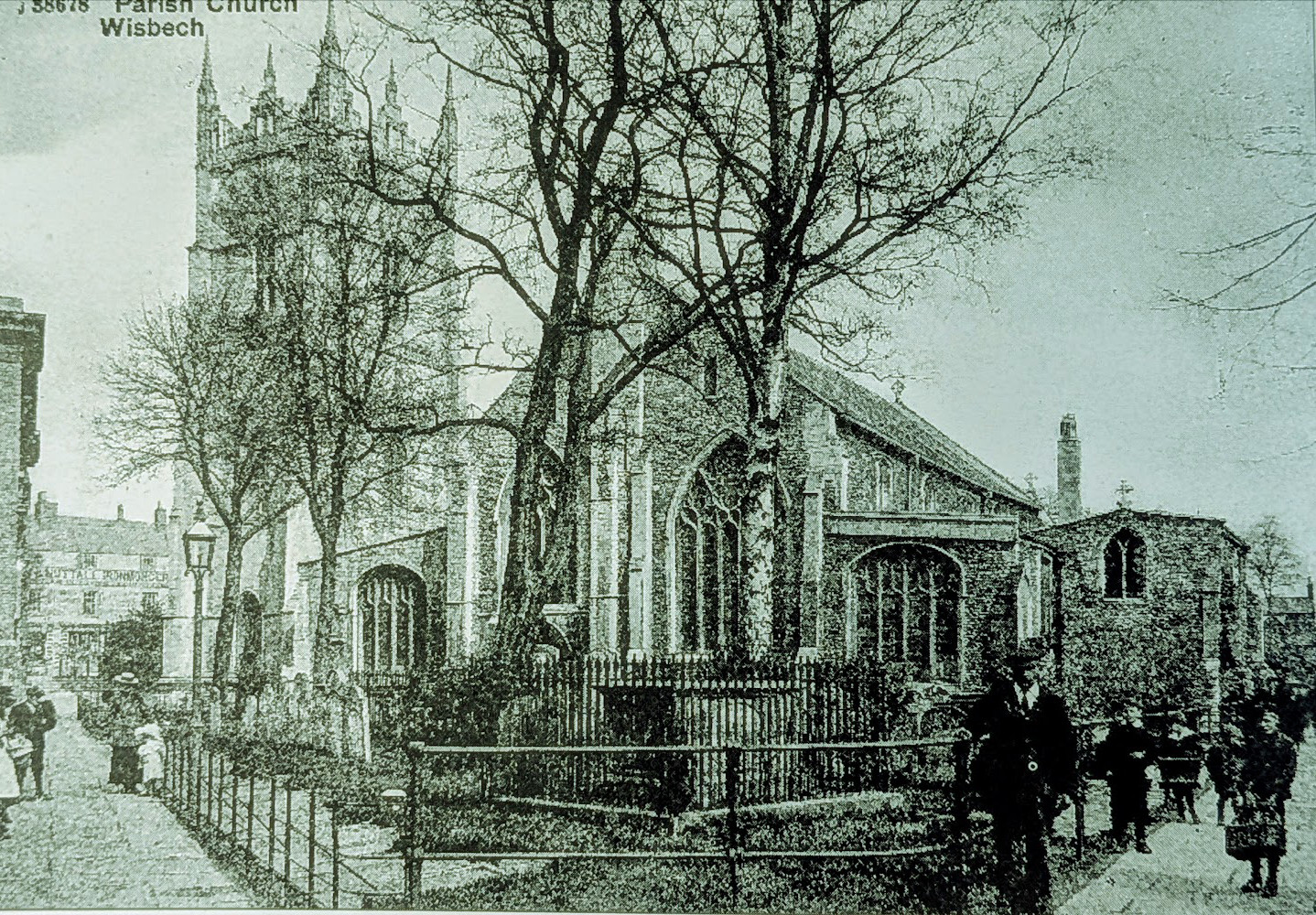
St Peter and St Paul, Wisbech c1900
St Peter and St Paul, Wisbech c1900The south porch was once the home of the town library.
Projects
Contribute
Do you have any information about the people or places in this article? If so, then please let us know using the
Contact page or by emailing
capturingcambridge@
Licence
This work is licensed under
CC BY-NC-SA 4.0


 not including content on external links as indicated
by
not including content on external links as indicated
by .
.