Search by topic
- archaeology
- Building of Local Interest
- chapel
- charity
- church
- crime
- dressmaker
- Great Eastern Railway
- Listed building
- Mapping Relief
- medieval
- oral history
- poverty
- Public House
- railway worker
- Religious House
- Roman
- scholar
- school
- Then and Now
- tudor
- women
- work
- world war one
- world war two
Search by text


The Fison family of Horningsea & Teversham
History of the Fison Family
The Fison Family, Horningsea, Teversham and the Rise of Artificial Fertilisers
The history of the Fison family is closely linked with the agricultural transformation of nineteenth-century East Anglia and the emergence of Britain’s artificial fertiliser industry. Through their involvement in phosphate fertilisers, the family became associated with the wider “coprolite boom” that reshaped parts of Cambridgeshire during the Victorian period. Villages such as Horningsea and Teversham, east of Cambridge, formed part of the landscape influenced by this remarkable development in agricultural science and rural industry.
Agriculture and the Search for Fertility
During the nineteenth century British agriculture faced increasing pressure to improve productivity. Rapid population growth and urbanisation created rising demand for food, while farmers sought new ways to maintain soil fertility. Traditional manures and crop rotation were often insufficient for intensive farming.
A major breakthrough came with the discovery that phosphatic deposits found in eastern England could be processed into powerful artificial fertilisers. These deposits became known as “coprolites” because early geologists mistakenly believed they were fossilised animal dung. In reality, they were phosphate-rich nodules formed in ancient marine sediments, especially within the Cambridge Greensand. Large deposits were worked across Cambridgeshire and Suffolk during the mid- to late nineteenth century.
The scientific importance of these deposits was recognised by John Stevens Henslow, Professor of Botany at Cambridge and mentor to Charles Darwin. Henslow demonstrated that the phosphatic nodules could be treated with sulphuric acid to create “superphosphate”, a fertiliser capable of significantly increasing crop yields. This helped launch the widespread commercial use of artificial fertilisers in Britain.
The Cambridgeshire Coprolite Industry
By the 1850s and 1860s eastern Cambridgeshire experienced a major boom in coprolite extraction. Extensive workings developed around villages such as Horningsea, Fen Ditton, Burwell, Reach, and Bottisham, where labourers excavated phosphate-rich layers beneath agricultural land.
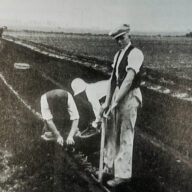
The industry transformed parts of the rural landscape. Digging gangs excavated long trenches across fields, while washing plants, spoil heaps, carts, and temporary industrial structures became common sights. Coprolite digging was hard and dangerous work, but wages were often better than those available through ordinary agricultural labour. The industry therefore altered local employment patterns and brought new money into some rural communities.
Although Teversham lay within the broader Cambridgeshire phosphate belt and was closely connected to the regional agricultural economy, definitive evidence for large-scale commercial coprolite extraction within the parish itself remains uncertain. Extensive workings are, however, well documented in neighbouring districts east of Cambridge. Teversham’s importance may therefore have lain more in its connections to the wider fertiliser economy than in direct mining activity.
The Fison Family and Fertiliser Manufacture
The Fison family emerged as one of the most important names associated with agricultural fertilisers in East Anglia. The business originated with James Fison, who established an agricultural merchant enterprise at Thetford in the early nineteenth century. Initially dealing in seeds and farming supplies, the company expanded rapidly as artificial fertilisers became commercially viable.
The development of superphosphate manufacture transformed the scale of the business. By processing phosphate-bearing materials into fertiliser products, the Fisons became part of a rapidly growing agricultural chemical industry that supplied farmers across Britain.
The family developed strong associations with villages east of Cambridge, including Horningsea and Teversham, areas situated within the wider agricultural and geological landscape shaped by the phosphate trade. Their success reflected broader Victorian trends in scientific farming, industrial chemistry, and commercial agriculture.
Over time the company evolved into the internationally known firm Fisons, later diversifying into agricultural chemicals, horticulture, and pharmaceuticals during the twentieth century.
Horningsea, Teversham and Rural Change
The coprolite and fertiliser industries formed part of a wider transformation in rural Cambridgeshire during the Victorian era. Villages east of Cambridge increasingly became connected to scientific innovation, industrial processing, and national agricultural markets.
Horningsea and Teversham remained agricultural communities, but they existed within a region undergoing significant economic and technological change. Improved transport links, proximity to Cambridge, and the growth of agricultural science all contributed to the reshaping of rural life.
Even where direct extraction cannot be firmly demonstrated, villages within the phosphate belt were affected by the movement of labour, investment, and industrial activity associated with fertiliser production. The landscape east of Cambridge thus became part of a much larger story: the industrialisation of agriculture and the rise of modern chemical fertilisers.
Decline of the Coprolite Industry
By the late nineteenth century the Cambridgeshire coprolite industry began to decline. Imported phosphates from North Africa and North America proved cheaper and easier to obtain than local deposits. Many East Anglian workings closed, and agricultural land was gradually restored.
Although the industry itself faded, its historical significance remained considerable. The fertiliser revolution helped increase agricultural productivity and supported Britain’s expanding urban population during the Victorian age. The Fison family played an important role in this transformation, linking East Anglia’s rural landscapes to national and international agricultural change.
References
Bernard O’Connor, The Origins and Development of the British Coprolite Industry.
East Midlands Geological Society, “A Vanished Industry: Coprolite Mining in Cambridgeshire.”
Geological studies of the Cambridge Greensand and phosphate extraction in eastern England.
Fisons company history and development.
Research on John Stevens Henslow and the development of superphosphate fertilisers.
(AI2026)
Projects
Contribute
Do you have any information about the people or places in this article? If so, then please let us know using the Contact page or by emailing capturingcambridge@
Licence
This work is licensed under CC BY-NC-SA 4.0