Search by topic
- archaeology
- Building of Local Interest
- chapel
- charity
- church
- college servant
- crime
- dressmaker
- Great Eastern Railway
- Listed building
- Mapping Relief
- medieval
- oral history
- poverty
- Public House
- railway worker
- Roman
- scholar
- school
- Then and Now
- tudor
- women
- work
- world war one
- world war two
Search by text


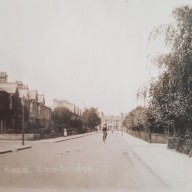
21 Rock Road, Cromer Villa, Cambridge
History of 21 Rock Road
1911
(Cromer Villa)
James Plant, 57, commercial traveller provisions, born Liverpool
Lucy, 51, born Norwich
Arthur, 25, hairdresser, born Cambridge
James, 24, commercial traveller provisions, born Cambridge
William, 20, pianoforte tuner, born Cambridge
Annie, 17, costumier, born Cambridge
Edith, 13, born Cambridge
John, 12, born Cambridge
Clifford, 10, born Cambridge
Gertrude Wisby, 17, general servant, born Herts
In 1901 the Plant family were living at 35 Emery Street.
1913
(Cromer Villa)
James Plant
John Edward Plant, born 1900, pioneer 334888 with Royal Engineers (Spec. Brigade). He was a chemist’s apprentice and this is probably the reason he was selected to join the section of the Royal Engineers that handled gas. On 17/8/1919 on active service he overstayed his leave from 6.30 hrs 17/8/1919 to 06.30 hrs 18/8/1919, and was fined 4 days pay.
James Plant married in 1912, Miriam Amps daughter of John and and Annie Amps of Symonds Lane, Grantchester. They were the first couple to be married in the Baptist Chapel in Broadway. They then set up home at Sweet Briar Cottage in Fulbourn Road, Cherry Hinton.
He joined the RAMC and was sent to France on 5th March 1916 and attached to the 124th Field Ambulance. On 26th September 1917 he was wounded in the leg and in the abdomen according to a letter sent by a colleague to his widow. James died the next day.
(See World War 1, Francis Burkitt)
Projects
Contribute
Do you have any information about the people or places in this article? If so, then please let us know using the
Contact page or by emailing
capturingcambridge@
Licence
This work is licensed under
CC BY-NC-SA 4.0


 not including content on external links as indicated
by
not including content on external links as indicated
by .
.