Search by topic
- archaeology
- Building of Local Interest
- chapel
- charity
- church
- crime
- dressmaker
- Great Eastern Railway
- Listed building
- Mapping Relief
- medieval
- oral history
- poverty
- Public House
- railway worker
- Religious House
- Roman
- scholar
- school
- Then and Now
- tudor
- women
- work
- world war one
- world war two
Search by text
 The Bird in Hand
73 – 75 Newmarket Road, The Bird in Hand
History of 73-75 Newmarket Road
In 1921 A E Gray described the Bird in Hand as ‘one of the few old houses that has survived the ravages of time and fire.’ He quotes an eighteenth century writer:
This village [Barnwell] hath often been reduced by fire but the last, which happened on September 30th 1731 consumed a great part thereof. The fire was so very fierce that the engine which was carried thither to extinguish it was destroyed therewith; for getting it into a fam yard, surrounded with houses and barns, the fire spread so fast that the people could scarcely get out without being burnt.
1901 The Bird in Hand
George Turner, 51, builders carter and publican, b Suffolk
Mary, 45, b Coton
Havelock, 14, b Coton
Janett, 10, b Coton
1906
A London newspaper describes Barnwell as a slum area of Cambridge chiefly inhabited by Brickmakers. It claims there is little traffic along the road but within four minutes walking one passes 14 alehouses, some positively next door to each other. However in recent years the area has undergone a great improvement with the building of the Abbey Estate, and the amount of traffic has increased. But no one will gainsay the comments on the number of superfluous public houses. (Press 29/12/1906)
1913 The Bird in Hand
Charles Byatt
1922 4th March
Det-Constable Abbott presented is report (to the Borough Licencing panel.) He said the trade in beer of the Bird in Hand, newmarket Road, was better than that of the Hare and Hounds which was 107 yards away. The next nearest house was the Crown in Wellington-street. Charles Byatt, the tenant, said he had held the licence for about 20 years. he was quite satisfied with the living he was making. Arthur E.W.Payne, secretary for Messrs Bailey and Tebbutt said the house had been doing four barrels a day.
1962
Bird in Hand PH
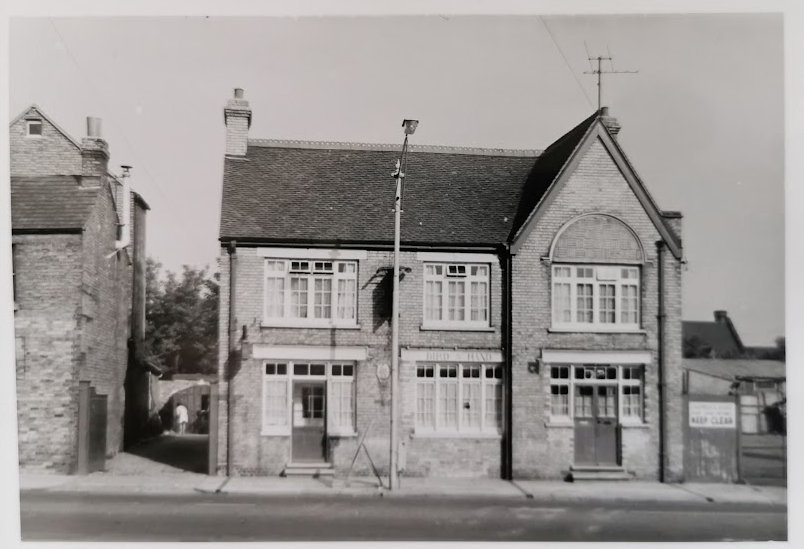
The Bird in Hand (MoC282.70)
Projects
Contribute
Do you have any information about the people or places in this article? If so, then please let us know using the Contact page or by emailing capturingcambridge@
Licence
This work is licensed under CC BY-NC-SA 4.0