Search by topic
- archaeology
- Building of Local Interest
- chapel
- charity
- church
- crime
- dressmaker
- Great Eastern Railway
- Listed building
- Mapping Relief
- medieval
- oral history
- poverty
- Public House
- railway worker
- Religious House
- Roman
- scholar
- school
- Then and Now
- tudor
- women
- work
- world war one
- world war two
Search by text


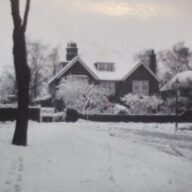
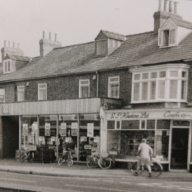
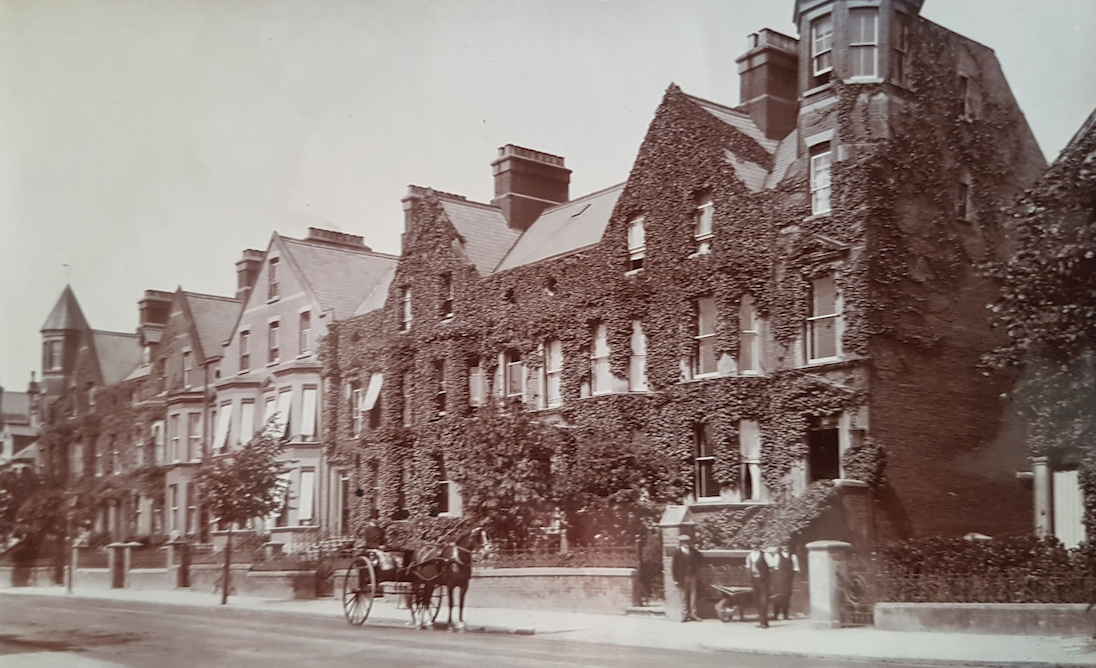 45-61 Chesterton Road later Arundel House, Chesterton Road
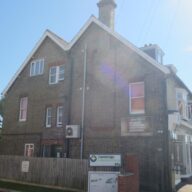
53 Chesterton Road, New Burlington House, (Arundel House)
History of 53 Chesterton Road
1883-88
This was the home of Anatole von Huegel at the time he took up his post as curator of the museum of Archaeology and Ethnology in 1883, after his marriage in 1880 to Eliza Margaret Froude. At the initiative of Baroness Huegel, a chapel for catechism classes was established in the basement of 53 Chesterton Road but was closed when the von Huegels moved away in 1888.
1891
Mary Wade Wall, 29, Ireland
Abiathar B H, 7, b Ireland
Charles E, 1, b Cambridge
Heinrich E Just 23, teacher of classic, b Camanda
Arthur W H Grindon, 17, student of music, b Canada
Charles S Karenside, 26, teacher of modern history, b Middlesex
Arthur E Allcroth, 26, teacher of classics, b Lincs
Edward Plaistowe, 19, student of engineering, b London
Isabella M Zeomans [?], 28, cook, Hants
Kate Chapman, 20, housemaid, b Hunts
Mary Jane Cross, 14, nurse, b Ely
1901

J Lambert
John Lambert, 65, retired post master, b Notts
Annie M Lambert, 51, b Cheshire
John, 21, medical student, b Yorks
Henry, 20, university student, b Yorks
Annie, 18, b Yorks
Amelia ‘Millie’ Kent Lambert, 13, b Lincs
Stanford L, 11, b Lincs
William, 9, b Lincs
Elizabeth E Mansfield, 19, servant, b Chesterton
The Cambridge Graphic contained this article:
The Retirement of the Postmaster of Cambridge
Mr Lambert. Postmaster of Cambridge, having retired on Monday last, on superannuation, after a service of nearly 47 years, at the age of 65 …
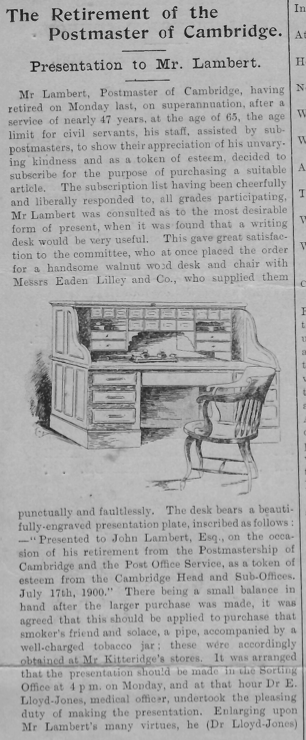
Retirement of Postmaster Pt 1
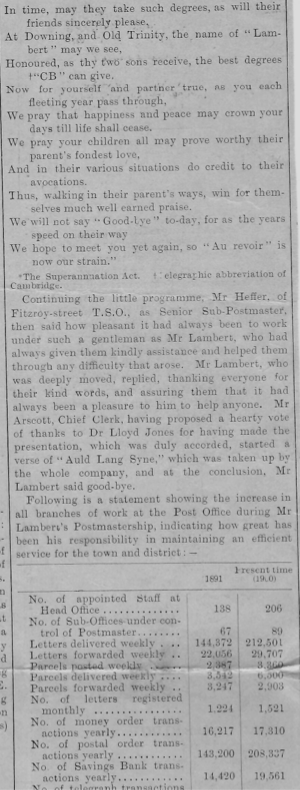
Retirement of Postmaster pt2
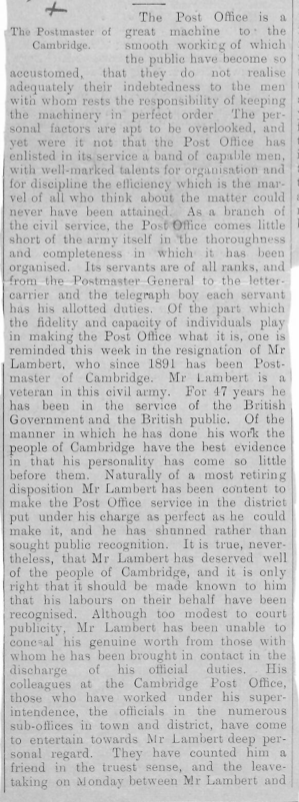
Retirement of Postmaster Pt3
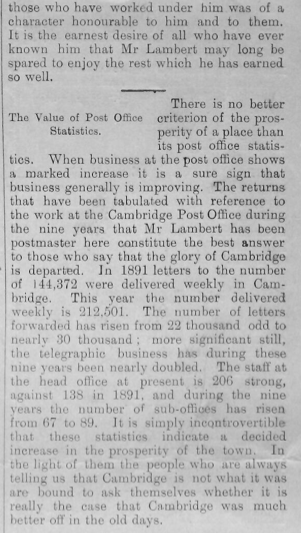
Retirement of Postmaster pt4
1913 New Burlington House
William Pushee Hollis, councillor of the Borough
1918
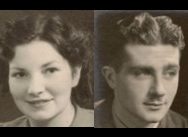
Lieut. Nelson Ernest Suttle. He had been employed by Messrs Banks Ashton Harley of Bury St Edmunds. He joined the Suffolk Yeomanry and was wounded at the Battle of the Somme losing his right hand. He died after a brief illness 4.11.1918, probably Spanish Flu related, Three of his brother served during WWI.

Lieut Nelson Ernest Suttle
Bury Free Press 2.9.1916:
We regret to record that Lieut. N.E. Suttle, of the Suffolks, was wounded in an attack (on August 18th) on the ‘Somme’ receiving four wounds in the right hand (all the fingers were blown off) three wounds on the right wrist, a wound on the right forearm, two wounds on the left leg, and two in the face. He had the right hand below the wrist amputated at a clearing station in France, and is now progressing very well at the first Southern General Hospital, Edgbaston, Birmingham. Lieut. Suttle’s home is at Stowmarket. He joined the Suffolk Yeomanry in 1913, and was given a commission in the infantry in September 1915. He went to France at the beginning of the Somme advance. Lieut. Suttle was in the Stowmarket office of Messrs. Bankes Ashton and Co. Solicitors, and at the outbreak of war was the representative in that town of the ‘Bury Free Press’. He took a keen interest in local sport, and amongst other things was a capable exponent of the art of boxing. Of a pleasant and cheery disposition, he was very popular with all who knew him.
http://histonroadcemetery.org/graves/wargraves/ww1/nesuttle/
1962
Geoffrey D Carnall
Projects
Contribute
Do you have any information about the people or places in this article? If so, then please let us know using the Contact page or by emailing capturingcambridge@
Licence
This work is licensed under CC BY-NC-SA 4.0