Search by topic
- archaeology
- Building of Local Interest
- chapel
- charity
- church
- crime
- dressmaker
- fire
- Great Eastern Railway
- Listed building
- Mapping Relief
- medieval
- oral history
- poverty
- Public House
- Religious House
- Roman
- scholar
- school
- Then and Now
- tudor
- women
- work
- world war one
- world war two
Search by text
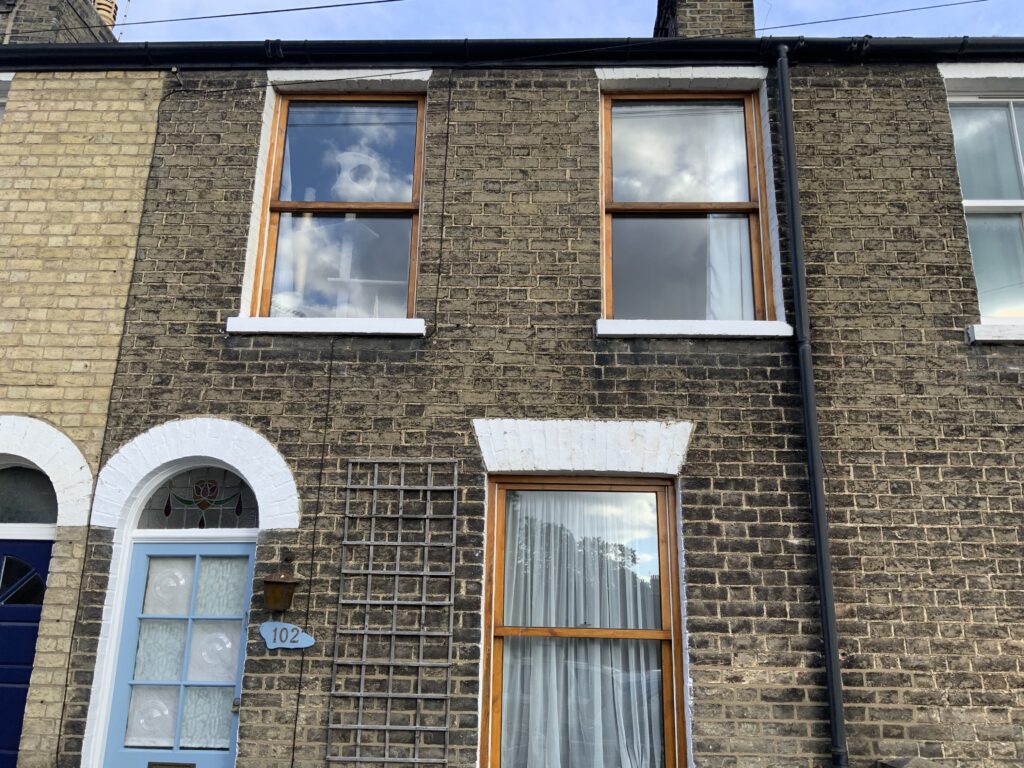
102 Ainsworth Street
102 Ainsworth Street
Number 102 is one of a terrace of five houses on the east side of Ainsworth Street, built around 1870.
1871 census for household 226*
John Smith, head, 38, railway guard, b. Hugglescote, Leicestershire
Anne M Smith, wife, 32, b. Wymmelly, Hertfordshire
Anne M Smith, daughter, 9, scholar, b. Hitchin, Hertfordshire
Lucy Smith, daughter, 8, scholar, b. Hitchin, Hertfordshire
Sidney J Smith, son, 4, scholar, b. Cambridge
*In 1871 Ainsworth Street was not yet numbered. Identification of houses is tentative.
In 1875 John Smith died, and in 1880 Ann married neighbour Joseph Turner, a railway engine driver. Her children Lucy and Sidney joined her at her new home, 98 Ainsworth Street.
1881 census
Benjamin Rayner, head, 36, engine fireman on GER, b. Landbeach, Cambridgeshire
Emma Rayner, wife, 34, b. Landbeach, Cambridgeshire
Alfred Rayner, son, 15, errand boy, b. Landbeach, Cambridgeshire
Kate Rayner, daughter, 10, scholar, b. Landbeach, Cambridgeshire
Earnest Rayner, son, 6, scholar, b. Landbeach, Cambridgeshire
Mabel A Rayner, daughter, 4, scholar, b. Landbeach, Cambridgeshire
Herbert B Rayner, son, 5 months, b. Landbeach, Cambridgeshire
Thomas W Hyde, boarder, 22, number taker at railway clearing house, b. Luton, Bedfordshire
In 1871, before the three youngest children were born, the Rayners lived next door at 100 Ainsworth Street.
1891 census
Mary Ann G Taylor, wife, 29, b. Bow, London
George Taylor, son, 4, b. Cambridge
Ada M M Hull, sister, 20, b. New England, [Peterborough,] Northamptonshire
The census officer has written down John Taylor and then crossed this out and written instead Mary Ann Taylor, wife, as head of the household. Perhaps John was away working that day of the census, as the officer only writes down people resident in the house that day.
Also resident in the house with Mary Anne Taylor was her 4-year-old son George. In addition, there was Ada Hull, described as Mary Ann’s sister. This fact points to Ada joining her sister Mary Ann to give her company and help her run the household, so perhaps John Taylor was away in a regular capacity in a job such as a sailor or soldier sending a wage home to support this family living at no. 102 without occupations listed. It is unusual for women on their own in a house not to be working or taking in income from lodgers or boarders, so the wage from John Taylor must have been sufficient.
Looking into other records, both in the parish, and in the military, may answer the questions of why the husband John Taylor was absent for the census, and give information about his occupation.
1901 census
Alice Nightingale, wife, 32, b. Cambridge
Bertram C Nightingale, son, 6, b. Cambridge
On the night the census was taken Frederick William Nightingale, 34, was working at King’s College in his job as a college porter. So his wife Alice, 32, and their six year old son Bertram were at no. 102 on their own.
By 1911 Frederick was head porter and the family were living in the Porter’s Lodge at King’s College.
1911 census
George Hasdell Allen, head, 25, cabinet maker & fixer for furniture dealer, b. Cambridge
Agnes E Allen, wife, 25, b. Cambridge
1 year married
George Hasdell Allen grew up on Ainsworth Street. In 1891 he was living at 51 Ainsworth Street with his parents, Frederick and Sarah. Then he moved with them to 104 Ainsworth Street, where they continued living into the 1920s.
George married Agnes Elizabeth Wallis in 1909.
1921 census
George Hasdell Allen, head, 36, cabinet maker, W Eaden Lilley, 38 Sidney St, b. Cambridge
Agnes Elizabeth Allen, wife, 35, household duties, b. Cambridge
They lived the rest of their lives at 102 Ainsworth Street and they are both buried in Mill Road Cemetery.
Source: 1871–1921 England Census, Mill Road Cemetery, 1939 register, England & Wales, Civil Registration Marriage Index, 1837–1915
Projects
Contribute
Do you have any information about the people or places in this article? If so, then please let us know using the Contact page or by emailing capturingcambridge@
Licence
This work is licensed under CC BY-NC-SA 4.0