Search by topic
- archaeology
- Building of Local Interest
- chapel
- charity
- church
- crime
- dressmaker
- fire
- Great Eastern Railway
- Listed building
- Mapping Relief
- medieval
- oral history
- poverty
- Public House
- Religious House
- Roman
- scholar
- school
- Then and Now
- tudor
- women
- work
- world war one
- world war two
Search by text
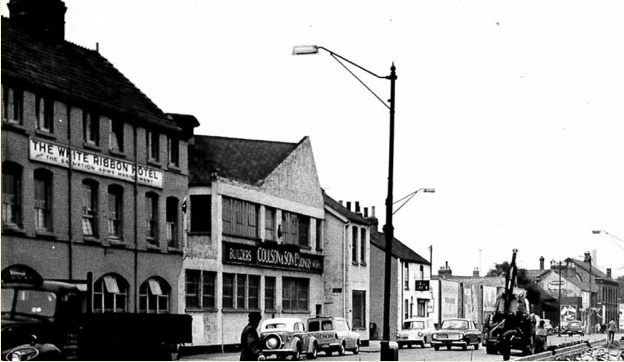 White Ribbon Hotel circa 1950s
160 & 161 East Road, Barnwell Coffee Palace / The White Ribbon Temperance Hotel
History of the White Ribbon Temperance Hotel
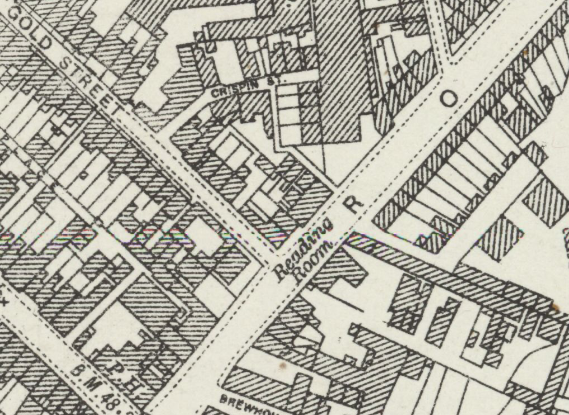
East Road, OS 1901. The Coffee Palace was adjacent to Crispin Street, presumably to the left of the capital R in this map extract.
1880 Barnwell Coffee Palace
CIP 2/10/1880
Attempted Suicides – Attempted Suicides – A couple of persons at Cambridge attempted Monday to put an end to their existence but both were, happily, frustrated. The first was the case of a servant girl in the employment of Mr. Morley, of Hobson-street. particulars of which will found in our police report. The other case occurred at the Barnwell Coffee Palace, East-road, the manager of which has furnished the following particulars :—lt appears from his statement that on Monday evening. Alfred Mills a plasterer, who had only recently been liberated from prison, where had spent a month in default of finding sureties to keep the peace for threatening his wife, applied for a night’s lodgings at the Barnwell Coffee Palace, being quite a stranger to the manager. He as was informed by Mr. Warland. the manager, that he could be accommodated and retired to his bedroom about half-past ten, making some rather strange remarks, which excited the suspicions of the manager. The latter, on going round to turn the gas out after locking-up-time. heard Mills shrieking and groaning, and tried the door, which he found looked. Shaking the door, Mills rushed at it and opened it, but Warland. fearing that his lodger was dangerous, secreted himself in the next room. Mills came out into the passage, and afterwards returned to his bedroom. The manager then went in search of a policeman and on their return, they listened at the door, and presently heard groans and a cry. “Will no one come: can’t I have a doctor.” They then went in the room and found him sitting on the bed with his head resting his left hand, and blood flowing profusely from wounds in his throat, supposed to have been inflicted with a penknife. He was sensible, and. being asked why he had done it. said “It’s all through ___ mentioning by name a person whom had before asserted his wife had been false him with. Mr. Knowles, the surgeon, was fetched, and. under , his advice, the man was taken to Addenbrooke’s Hospital, where the wounds were sown u,. and, as he not severed the jugular vein, hopes were entertained that might recover. He formerly lived in Gwydir-street. It seems that since he was liberated from prison he has been drinking hard, and, it is believed, that he was suffering from delirium tremens when he made this fearful attempt upon his life.
CIP 21.8.1880 p.8
VIOLENT ASSAULT. Alfred Mills, plasterer, of Gwydir street, was brought up a warrant charged with assaulting his wife on the previous Thursday and Friday.—Mr. Ellison appeared for the complainant.—Complainant said on Wednesday morning last, about eight o’clock, the defendant came home the worse for drink. Witness took off his boots, and advised him to go to bed, which he did. He had not been in bed more than seven minutes before he came down and wanted some money to go and get some beer. Defendant looked about for his lath hammer, and said, “You __ , you shall not run loose.” Defendant, not finding his hammer, got the poker. Witness ran out of the house. On Friday morning defendant went out at half-past seven, and came back the worse for drink. Defendant had some beer before went out. He went and laid down for about half-an-hour and then got up and went out. Defendant asked for some money, but witness refused to give him any. Defendant then fought the witness like a man, striking her on both sides of the head, and biting her arm. Defendant threatened to kill witness, who was reluctant to press the charge, but was afraid defendant would do her some injury.—Defendant said he was very excited at the time, and was sorry for what he had done. —The Mayor remarked that £4 10s. 10d. was found on the defendant, and the complainant said defendant must have got it out of the house while she was out.—The Mayor said the magistrates had no hesitation in sending him for one month’s imprisonment.
1905 Barnwell Coffee Palace acquired by British Women’s Temperance Association
1913 (160 & 161)
The White Ribbon Temperance Hotel, Frank Herbert Clapham, manager
1937
(160 & 161)
White Ribbon Temperance Hotel, Capt David S Craig, manager
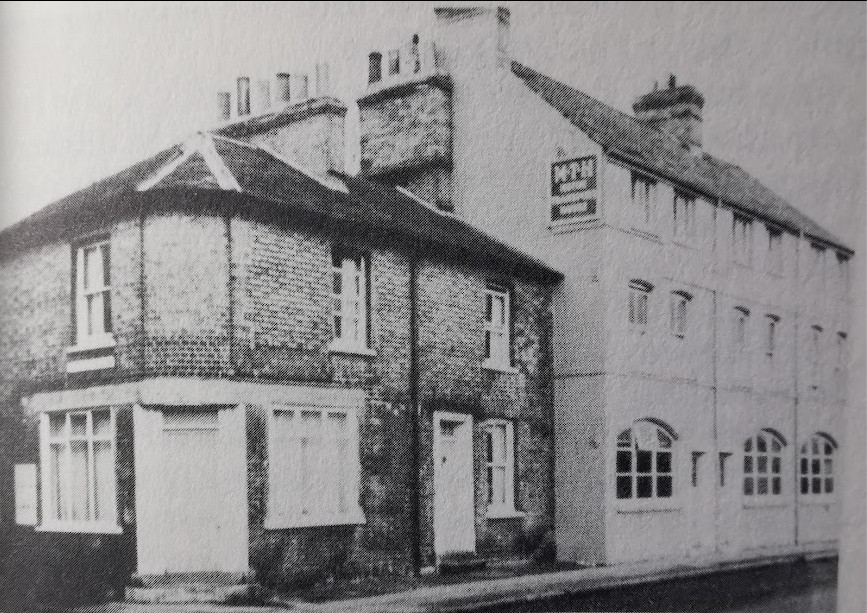
White Ribbon Hotel (Salvation Army)
Tommy Tucker, the milkman, lived in a small house in the photo according to F T Unwin.
See the article on Stanley Buckmaster:
Stanley Buckmaster and the opening of the White Ribbon Temperance Hotel on East Road in Barnwell
Projects
Contribute
Do you have any information about the people or places in this article? If so, then please let us know using the Contact page or by emailing capturingcambridge@
Licence
This work is licensed under CC BY-NC-SA 4.0