Search by topic
- archaeology
- Building of Local Interest
- chapel
- charity
- church
- crime
- dressmaker
- Great Eastern Railway
- Listed building
- Mapping Relief
- medieval
- oral history
- poverty
- Public House
- railway worker
- Religious House
- Roman
- scholar
- school
- Then and Now
- tudor
- women
- work
- world war one
- world war two
Search by text


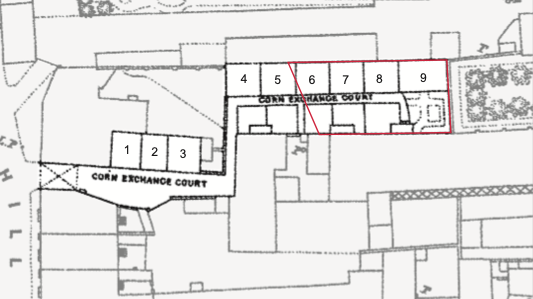 Corn Exchange Court 1885 OS map (from Grand Arcade report)
Corn Exchange Court (St Andrew’s Hill)
History of Corn Exchange Court
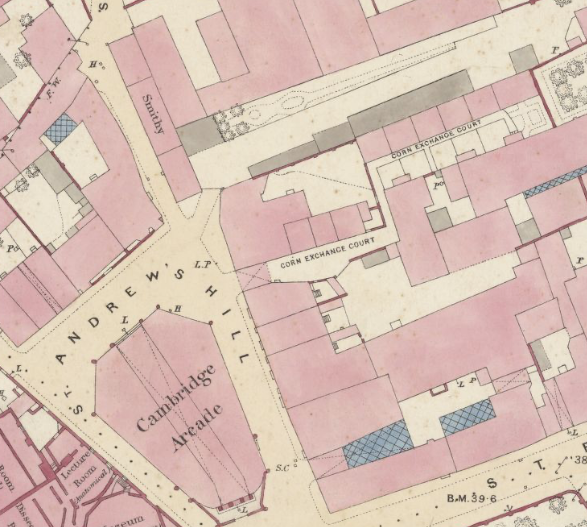
St Andrew’s Hill area 1886 OS Town Plan
The Grand Arcade report (2019) p.291 describes the archaeological significance of the work that was carried out in the 1840s:
The first stage in the construction of Corn Exchange Court was the demolition of the existing above ground structures and the backfilling of various features including Cellar 4. This feature contained one of the largest and most diverse nineteenth-century assemblages from the site (MNI 290, or 343 if shellfish are included), which is linked to an inn as well as several Colleges. As this material has been published in detail elsewhere (Cessford 2014a), only an overview will be presented here. The backfilling of Cellar 4 involved the dumping of c. 3.1 cubic m of material. The primary constituent of the infill was building debris, consisting of crushed mortar and hundreds of brick and tile fragments, some of which were of the same fabric as the walls of the cellar while others appear to derive from the demolition of different structures elsewhere on the plot. There was also a considerable quantity of ash, charcoal and cinder. The material culture that was recovered was dominated by pottery (MNI 205), plus glass vessels (MNI 13), bone (46 MNBU, plus 5 others) and edible shellfish (MNI 193), plus some clay tobacco pipes (MNI 10), a small amount of window glass, some heavily corroded and unidentifiable iron fragments plus the iron portion of the heel of a shoe, part of a ceramic figurine, two bone knife handles, a whetstone, a small bone button and four copper alloy objects.
Despite the plot’s known association with the Cock Inn relatively few items were recovered that appear to be inn-related. The most obvious was a half pint capacity stoneware tankard-shaped jug with a pinched spout and an ale measure mark consisting of a crown over the initials WR. This was in compliance with the act for ascertaining the measures for retailing ale and beer of 1700, which covered vessels of up to a quart capacity used in inns and other commercial establishments and was in force until 1876 (Bimson 1970).
1844
Corn Exchange Court created.
Corn Exchange Court 1885 OS map (from Grand Arcade report)
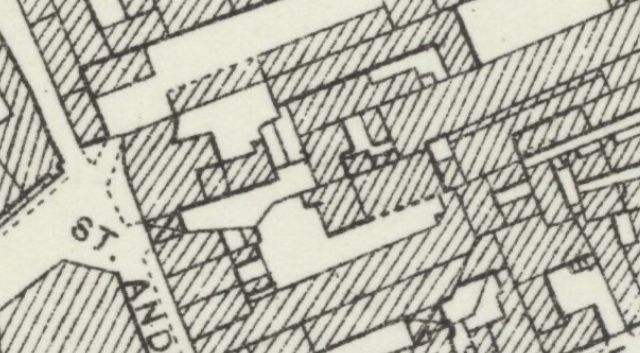
Corn Exchange Court 1901 OS map
1861
(1) John Cook, 55, dealer in books, b Gamlingay
(2)
Peter Rawe, 30, groom, b Newmarket
Anne Rawe, 35, b Waterbeach
(3) to let
(4) Thomas Edwards, 26, college servant, b Cambridge
(5) Mary Ann Hyde, 23, dress maker, b Cambridge
(6) Frederick Nunn, 41, omnibus driver, b Wood Ditton
(7) James Claver, 33, flyman, b Pampisford
(8) Susannah Rowton, 40, school mistress, b Cambridge
(9) Henry Sauter, 27, ????, b Norfolk
1880s
By 1887 the rear portion of Corn Exchange Court had ceased to be used as residential premises and had become horse stables.
1913
Barrett and Son, china, earthenware and hardware merchants
Projects
Contribute
Do you have any information about the people or places in this article? If so, then please let us know using the Contact page or by emailing capturingcambridge@
Licence
This work is licensed under CC BY-NC-SA 4.0