Search by topic
- archaeology
- Building of Local Interest
- chapel
- charity
- church
- crime
- dressmaker
- Great Eastern Railway
- Listed building
- Mapping Relief
- medieval
- oral history
- poverty
- Public House
- railway worker
- Religious House
- Roman
- scholar
- school
- Then and Now
- tudor
- women
- work
- world war one
- world war two
Search by text


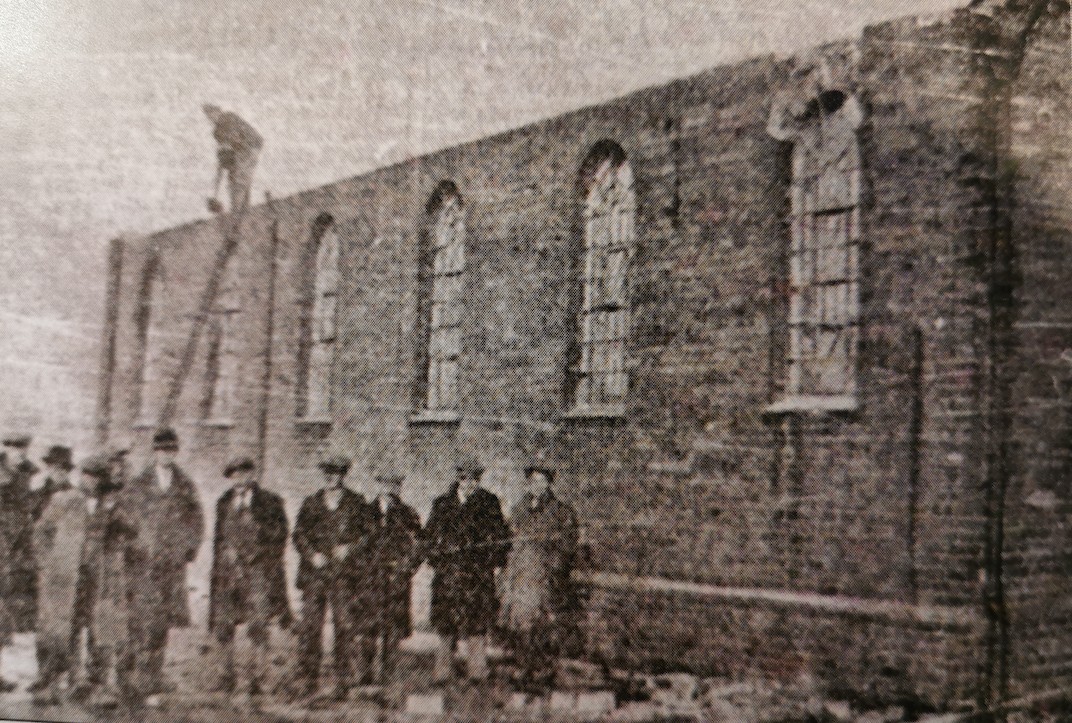 1936 Margett Street fire, Cottenham (Cambs Collection)
Margett Street School, Library
History of Margett Street School site
1855
See Francis Garrett, Cottenham Ablaze
4.5.1855: this fire destroyed houses in Margett Street and along the High Street facing the Baptist Chapel. There was a fire in the yard of Thomas Kimpton in Margaret’s Lane on the morning of 3rd May but it had been believed that this was put out. the next morning a fire broke out in a barn on the same premises; all the family except for one daughter were working in the fields two miles away.
All of Kimpton’s property was destroyed, followed by the 4 cottages of Thomas Christmas (builder), John Saintey’s, William Graves’s, Oliver Emerson’s, three cottages belonging to Re A W Ivatt of Coveney, 4 cottages belonging to Marmaduke Ivatt, 6 cottages belonging to Mrs Lee and 4 belonging to Mrs Ann Buck.
Marmaduke Ivatt’s own house was of brick and slate and escaped. the fire devastated an area of about 5 acres. All the Cottenham fire engine could do was stop the fire spreading to the other side of the High Street. On the whole, the landlords were insured but the tenants were not and lost everything. One man named Pauley lost his £3 savings; another, widow Burkett, ran from her house with her gown in flames.
The daughter of Thomas Kimpton who had been left at home was arrested and charged with arson but the case was dropped for lack of evidence.
1865 The first part of the school had been built by the Dissenters for a cost of £788 and opened on 10th July.
It was surrounded by a brick wall and iron railings and called the British School. By the 1870s 229 children were being educated.
1867 Inspector gave the school a favourable report but school was not compulsory and fees had to be charged.
1869 Inspector visited at harvest time and 40 children were absent.
1873
British School became the Board School
1875
Extra buildings constructed.
1880
By this year, other schools in the village had closed and all children in village went to the Nargett Street school.
1903
Became council school.
1936
15.1.1936: the school was found to be on fire at 7 in the morning. The main hall was ablaze; the fire had started in the boiler room which was situated below a large wooden gallery. the fire was prevented from spreading tot eh rest of the school.
1939
During WWII some children had to attend lesson in the church schoolroom because there were so many evacuees. School dinners were served from 1939 to feed evacuees.
Margett Street School closed in 1981.
See Cottenham in Focus (2002)
Projects
Contribute
Do you have any information about the people or places in this article? If so, then please let us know using the Contact page or by emailing capturingcambridge@
Licence
This work is licensed under CC BY-NC-SA 4.0