Search by topic
- archaeology
- Building of Local Interest
- chapel
- charity
- church
- crime
- dressmaker
- fire
- Great Eastern Railway
- Listed building
- Mapping Relief
- medieval
- oral history
- poverty
- Public House
- Religious House
- Roman
- scholar
- school
- Then and Now
- tudor
- women
- work
- world war one
- world war two
Search by text
Linton Union Workhouse
History of Linton Union Workhouse
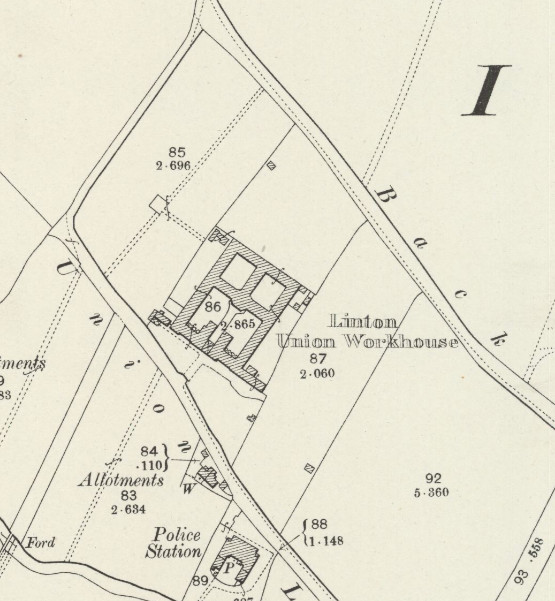
Linton OS 1901
Old Pampisford by O C Mayo has a section on the workhouse at Linton because it also covered the parish of Pampisford.
The Union Workhouse was built in 1835 just outside the village. There were two courtyards and space for 230 inmates from 22 parishes. Able paupers who were willing to move to the north of England or to Canada or Australia could receive financial assistance.
There was also an infirmary for the mentally ill. Later a school and two fever wards were added.
In 1929 it became a Poor Law Institution containing mostly orphans, elderly and unmarried mothers.
By 1974 it had become a home for the elderly, Symond’s House.
Projects
Contribute
Do you have any information about the people or places in this article? If so, then please let us know using the Contact page or by emailing capturingcambridge@
Licence
This work is licensed under CC BY-NC-SA 4.0