Search by topic
- archaeology
- Building of Local Interest
- chapel
- charity
- church
- college servant
- crime
- dressmaker
- Great Eastern Railway
- Listed building
- Mapping Relief
- medieval
- oral history
- poverty
- Public House
- railway worker
- Roman
- scholar
- school
- Then and Now
- tudor
- women
- work
- world war one
- world war two
Search by text


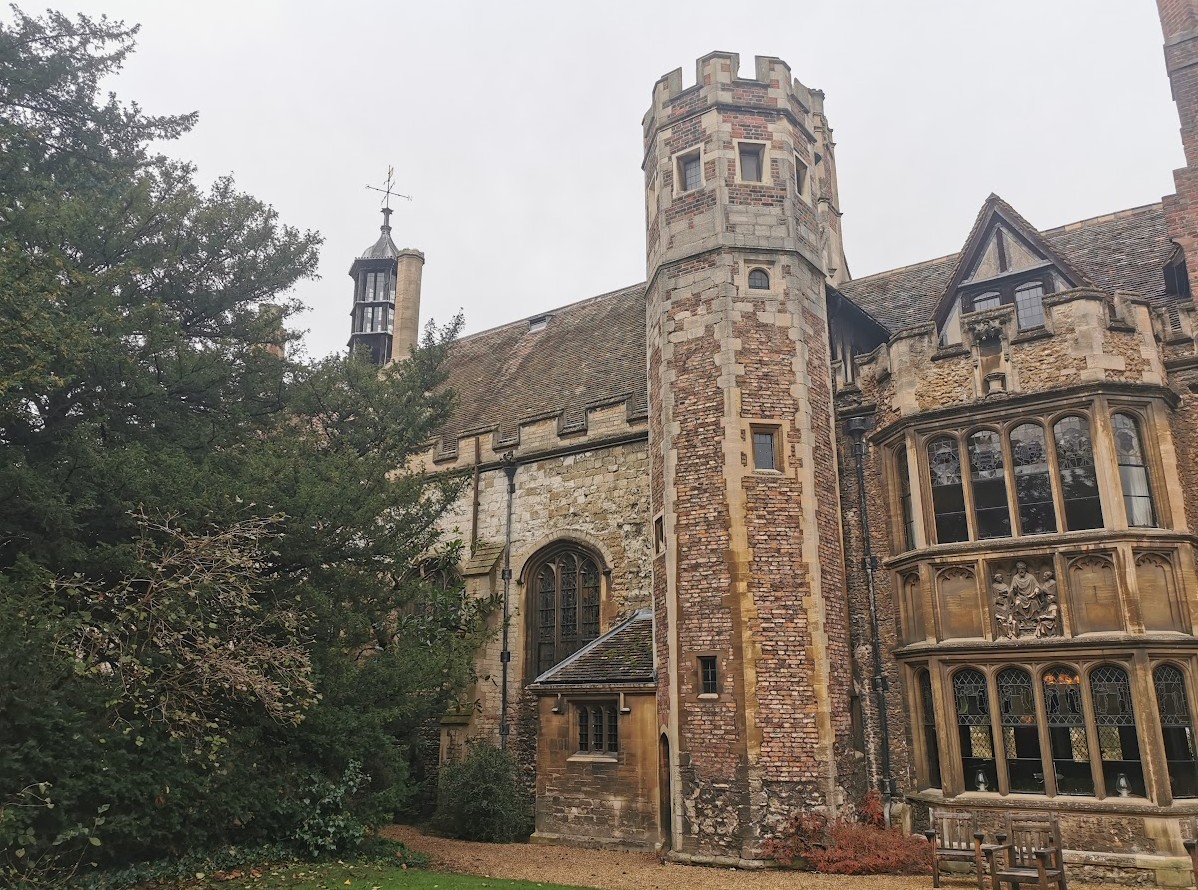 Peterhouse (RGL2023)
Peterhouse, Cambridge
History of Peterhouse Cambridge
General information about Peterhouse can be found on Wikipedia.
The college website can be found here:
https://www.pet.cam.ac.uk/about-college
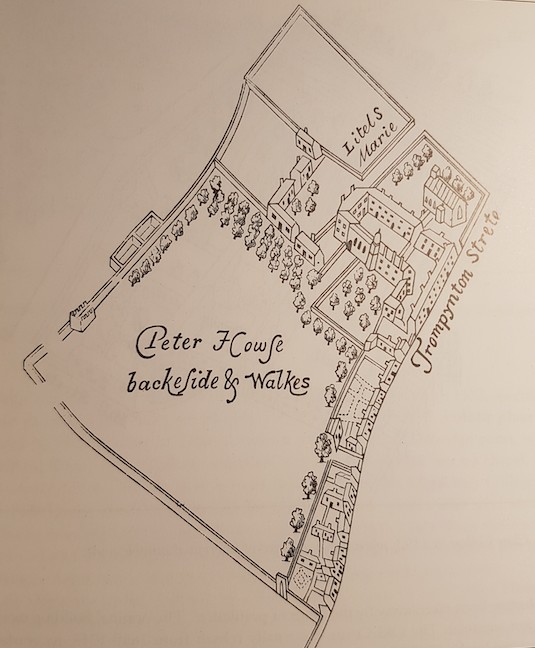
Peterhouse in 1592
F A Reeve writes in The Cambridge Nobody Knows, 1977, describes the Water Gate that enabled the Bishop of Ely and others to arrive at Peterhouse via Coe Fen by boat, together with a flight of steps on the college side that enabled members to watch the water rushing by in times of flood. The arms on the Fen side of the gate are those of John Hotham, Bishop of Ely, 1316-1337, and those inside are of Bishop John Alcock, 1486-1500. Coe Fen had been very marshy but in the C19th rubbish and road sweepings were dumped on it to raise the level.
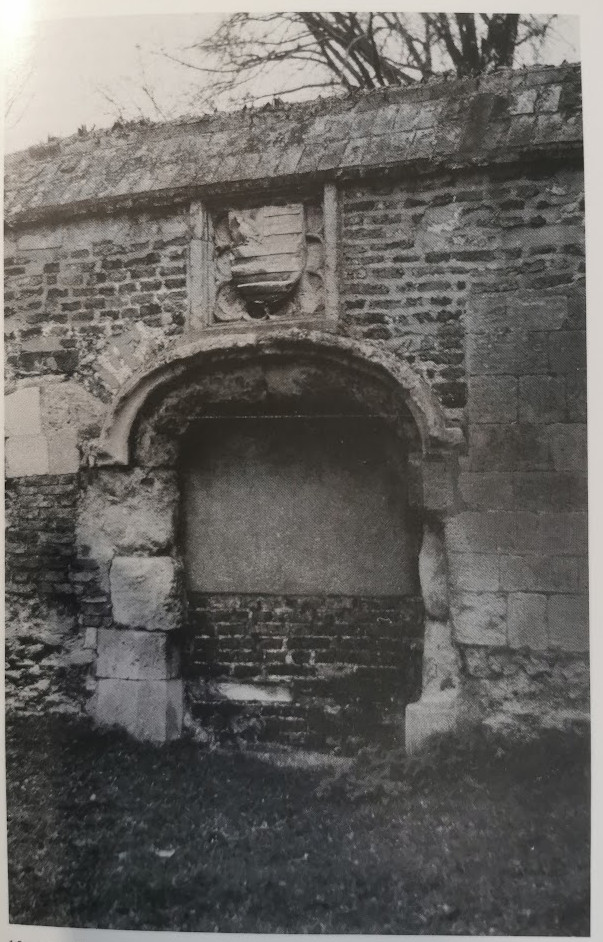
Water Gate Peterhouse
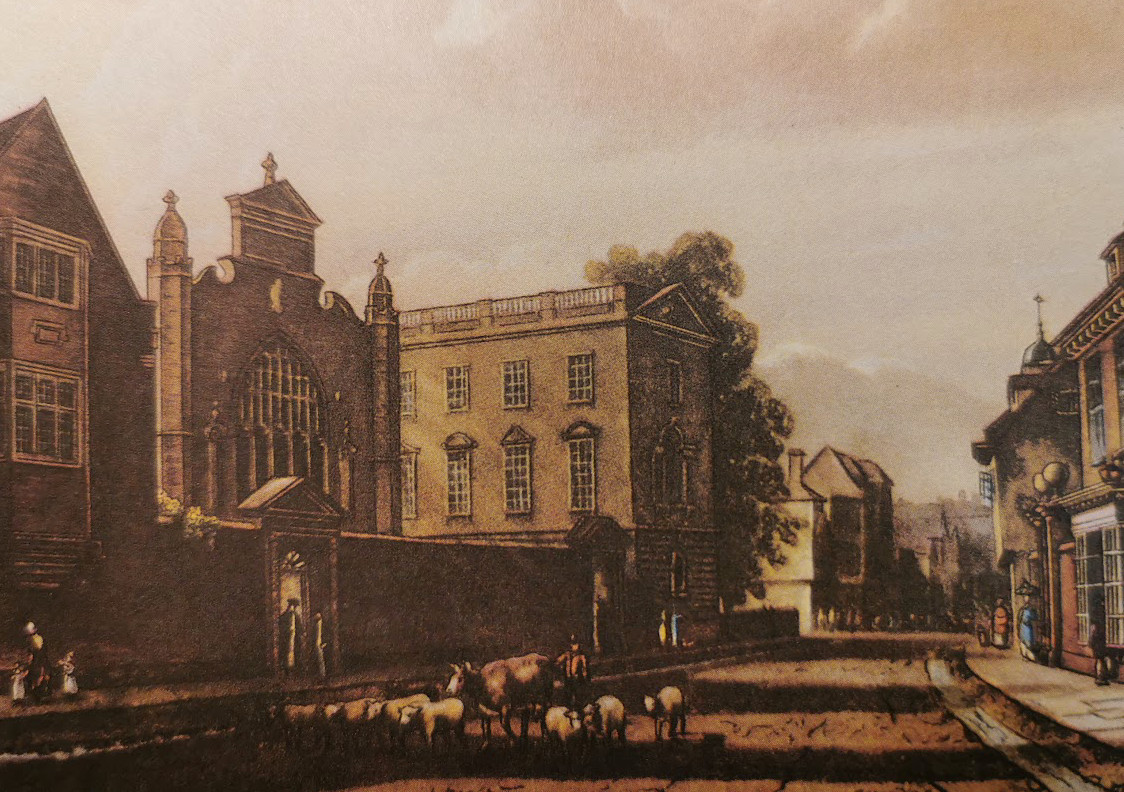
Peterhouse and Trumpington Street, Ackermann’s Cambridge, 1815
1926 The Cambridgeshire Collection holds this account from a Peterhouse student, J M V Luard, written in 1993, of his participation in the General Strike of 1926.
This is an engaging primary source because it captures a distinctly undergraduate perspective on the strike. Several details are especially noteworthy:
- Student volunteers were recruited through Cambridge Station almost immediately after the strike began.
- Cambridge undergraduates acted as volunteer railway workers and parcel carriers.
- The account records direct physical confrontation with hostile crowds in Stratford, East London.
- Liverpool Street Station apparently organised accommodation and incentives for volunteers, including 10 shillings a day, beer and cigarettes.
- Luard recalls the limited role of radio and the dominance of Churchill’s British Gazette as a source of strike news.
- The anecdote about police investigating the “theft” of the Cambridge truck is particularly memorable and may well have been retold in Cambridge student circles afterwards.
- The final remark about examinations confirms that the strike overlapped with the Cambridge examination season, an issue discussed in several contemporary Cambridge newspaper reports.
As a source for Cambridge during the General Strike, it complements accounts centred on Clara Rackham, Leah Manning, trade unionists and Romsey workers by illustrating the experiences and attitudes of the volunteer undergraduate strike-breakers.
Cambridge during the General Strike
1926
The General Strike called out the entire undergraduate population for work of “national importance”. So far as I was concerned it began with three colleagues and myself asking for work at Cambridge Station manned that day by staff who did not seem sympathetic to the strike. We were told to take an L.N.E.R. truck to load flour for a baker in Stratford and with strict instructions to return that night. But London we all felt was where the action was going to be and it seemed provident to collect overnight clothing. The miller was dubious about handing over his consignment to amateurs, had already heard from his customer that Stratford railwaymen were rioting and we had some difficulty in persuading him to part with his flour. “If it doesn’t get there safely you’ll be charged for it”. The journey was uneventful and we got a royal welcome from the baker who was about to run out of flour but with enough in hand to give us a much needed meal.
Stratford was very much a railwaymen’s centre and we turned onto the main road to be greeted by intimidating crowds. Any truck was immediately suspect as a possible strike breaker and with our college scarves and ties we became a target for a hostile group of strikers. I think our first reaction was to backtrack but the truck was heavy to turn, the driver inexperienced and “drive on” was clearly the lesser evil. During an agonising moment when the engine stalled an attempt was made to drag two of us out of the cab but was beaten off with a heavy spanner and we finally got under way pursued by a hail of missiles and the shouts of a frustrated crowd. We were thankful to find the Mile End Road as peaceful as Stratford had been turbulent.
By this time we had decided to hand over the truck to the L.N.E.R. at Liverpool Station, not very sure whether it would be barricaded by pickets, or, if entry was possible, we would be accused of stealing railway property. We eventually arrived after a tricky moment when, having lost our way, the driver elected to do a U-turn in the middle of Holborn Viaduct. Traffic stalled in both directions and seemed as unfriendly as Stratford railwaymen. The Station Master was delighted to have another vehicle to aid his depleted fleet, provided blankets and a third class carriage for sleeping quarters together with the offer of ten shillings a day, a pint of beer and a packet of cigarettes if we would stay “for the duration”. We would with enthusiasm.
Reporting for work the next day we encountered a splendid figure in plus fours and deerstalker who announced that he was about to take off as the driver of the Royal Scot for Edinburgh. The volunteers were identifiable by dress alone. Our job was to take loads of parcels to other London stations, picking up return loads though not always for Liverpool St.
All stations mounted guard pickets at the goods entrances and all stations; the guards’ invariable comment when we told them our next destination on departure was “Well Charing Cross – or Waterloo or whatever – is very rough, you didn’t ought to go there”, but we had no more alarms like that at Stratford.
Once at Paddington, while waiting for a load, we all did a spell as platform porters and quickly learned to pick out the traveller most likely to tip well. The Canadian with a pile of luggage earned plenty of thanks when he gave me a gold half sovereign which I hung onto until a financial crisis long since forgotten compelled me to sell it.
Churchill’s British Gazette was the only news sheet. There were no such things as transistor radios and news broadcasts were not as widely heard as one might have expected. Nor indeed do I remember anyone in Peterhouse with a radio, probably because a 1920s receiver needed a long external aerial. The thought of college courts being festooned with wires would have shocked the faculty.
Though undergraduate eyes the strike was a heaven-sent escape from the fever of revising for examinations so that when it ended suddenly after ten days we did not exactly share the relief of the rest of the country. Back in Cambridge — and minus our truck which had been handed over to the Station Master at Liverpool St. — we were told by my tutor that the police had visited him two days after our departure to make enquiries about the theft of a truck from Cambridge Station. The tutor had no idea where we were, the police departed and nothing more was heard from them.
The examiners were sympathetic to the earnest students who had been deprived of that essential period for revision and with relief I was able to read my name in the third class tripos lists.
J. M. V. Luard. Peterhouse 1926.
The Cambridge Ghost Book, Halliday and Murdie, 2000, has a chapter on ghosts of Peterhouse. Accounts seem to focus on the area of Peterhouse adjoining the churchyard of Little St Mary’s Church; a Dean of Peterhouse even performed an exorcism in the area. There is a story of a ‘Blue Lady’ haunting F staircase which forms part of the original 13th century building.
It was in 1997 that there were several supernatural sightings. There were many witnesses. These events were reported in the national press and it was suggested that the ghost was that of James Dawes, a fellow of Peterhouse who hanged himself in 1789. The authors, after consideration of the facts around the case, state that this is one of the ‘most striking examples of a haunting in Britain in recent times.’
See also ‘Cambridge College Ghosts’ by Geoff Yeates.
1966
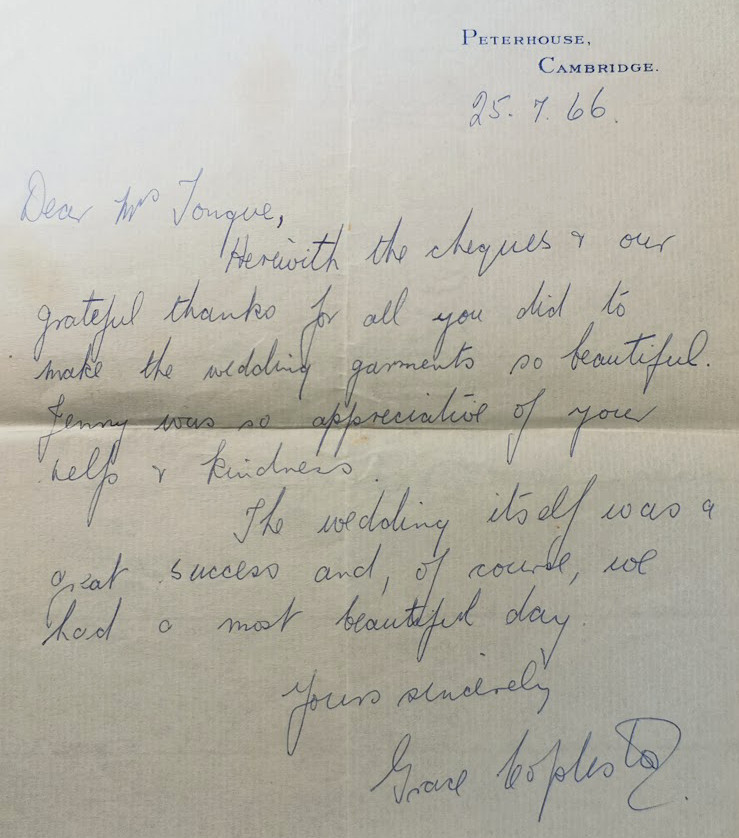
Letter to Constance Pyle 1966
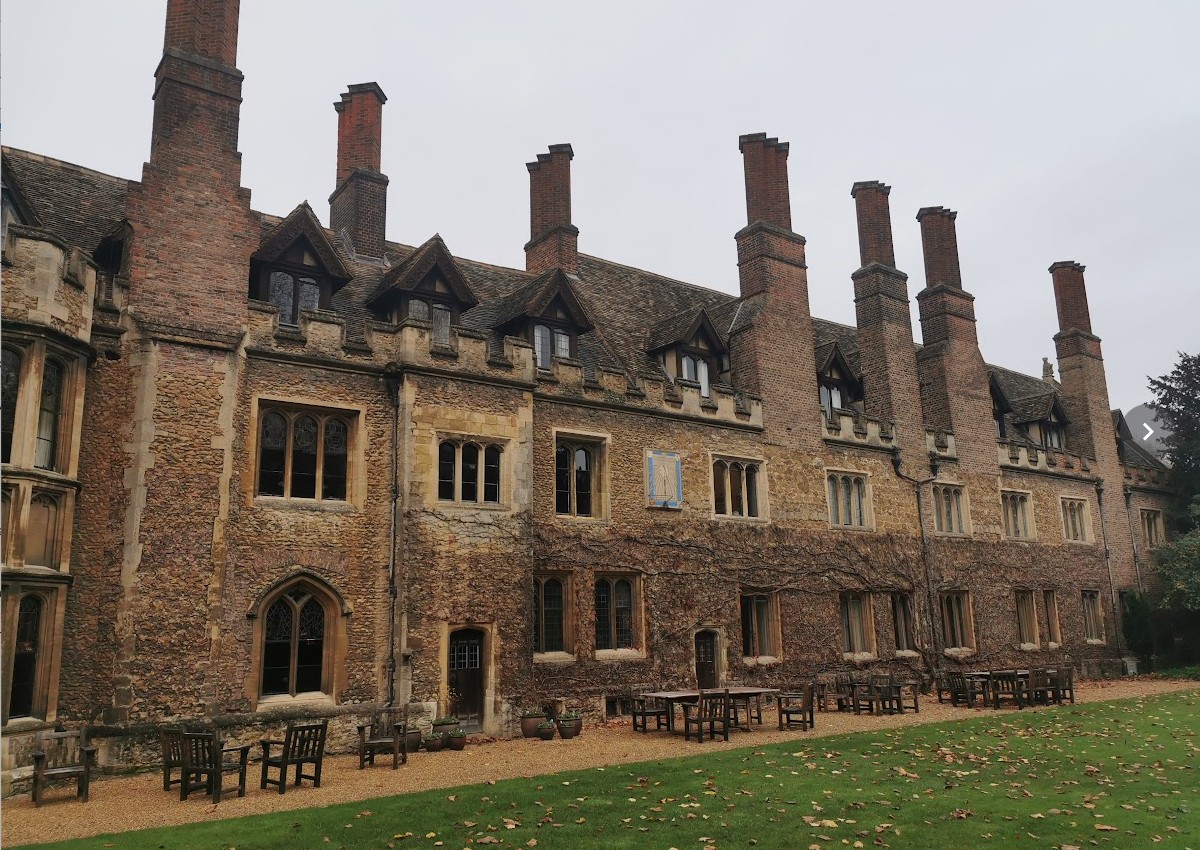
Peterhouse (RGL2023)
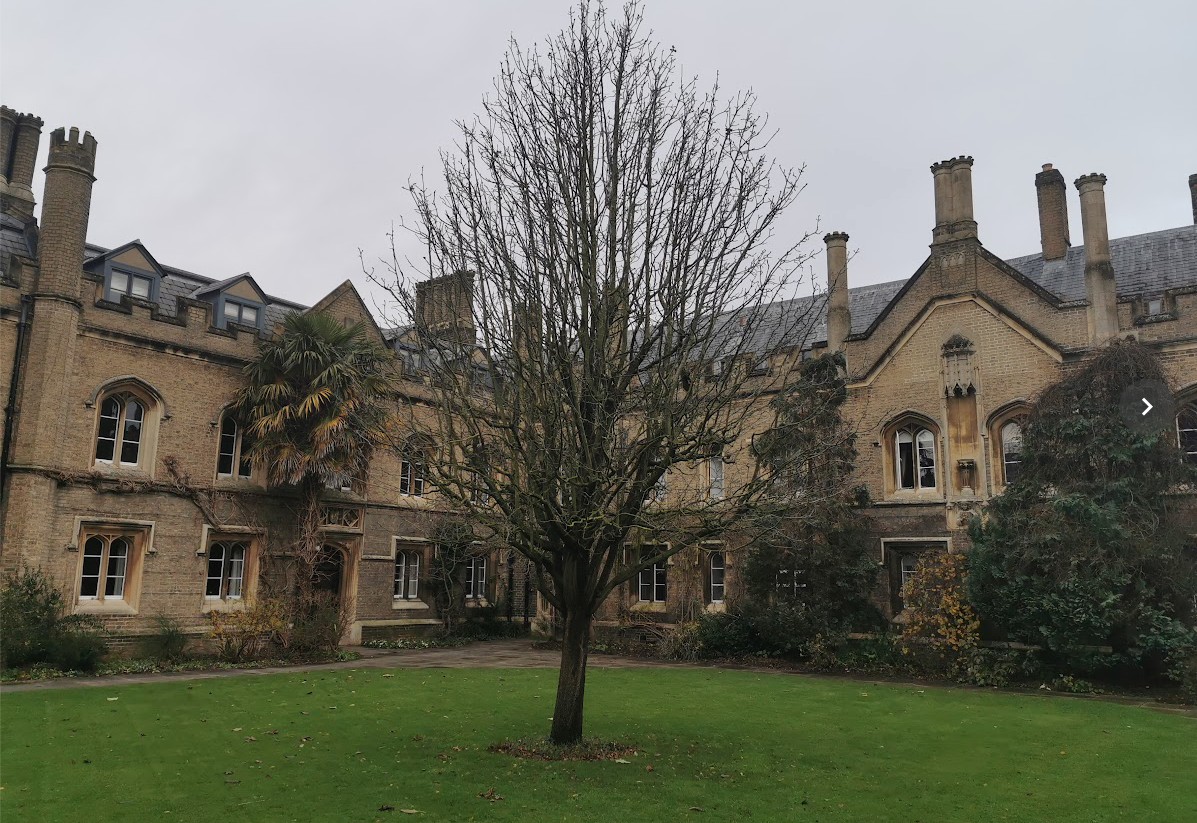
Peterhouse (RGL2023)
Projects
Contribute
Do you have any information about the people or places in this article? If so, then please let us know using the
Contact page or by emailing
capturingcambridge@
Licence
This work is licensed under
CC BY-NC-SA 4.0


 not including content on external links as indicated
by
not including content on external links as indicated
by .
.