Search by topic
- archaeology
- Building of Local Interest
- chapel
- charity
- church
- college servant
- crime
- dressmaker
- Great Eastern Railway
- Listed building
- Mapping Relief
- medieval
- oral history
- poverty
- Public House
- railway worker
- Roman
- scholar
- school
- Then and Now
- tudor
- women
- work
- world war one
- world war two
Search by text


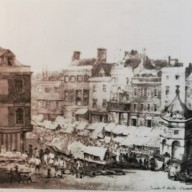
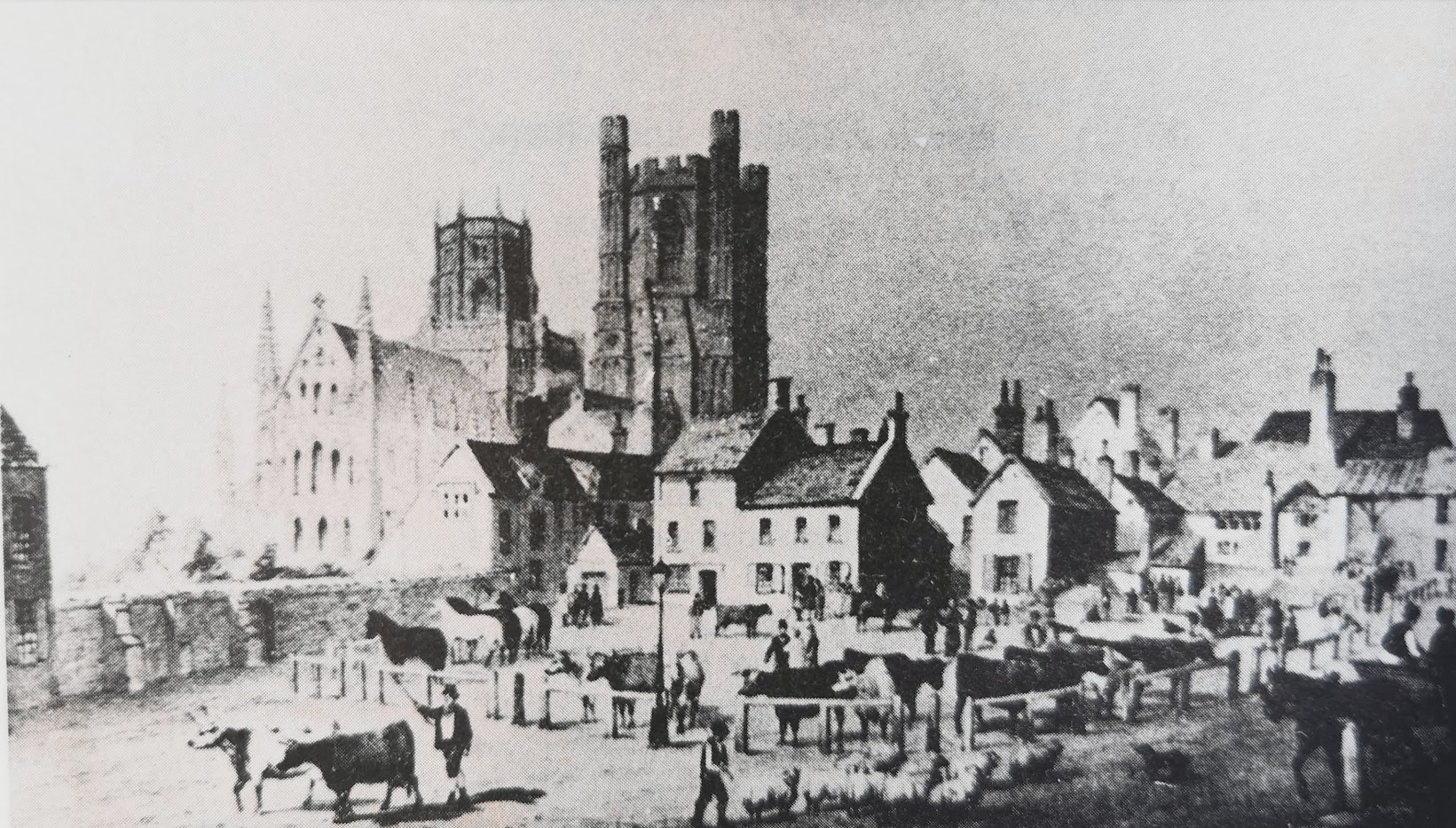 Ely Market, 1832
Trade, Shops and Markets
An overview of the history of trade, shops and markets in Cambridgeshire
Trade shaped the villages, market towns and rural communities of Cambridgeshire for centuries. Farmers, shopkeepers, carriers, innkeepers and market traders connected Fenland villages and agricultural settlements to larger commercial centres through roads, waterways and railways. Capturing Cambridge reveals how markets, pubs, shops and workshops formed the heart of everyday community life across both town and countryside.
1. Market Towns and Weekly Markets
Market towns acted as commercial centres for surrounding villages, drawing in farmers, labourers and traders from across rural Cambridgeshire. Weekly markets and annual fairs provided places to sell livestock, grain, dairy produce, tools and household goods. The market was also a social gathering place where news, politics and entertainment mixed with commerce.
Many smaller settlements depended heavily on nearby market towns such as Cambridge, St Ives, Wisbech and Ely. Streets around market places developed concentrations of inns, shops and workshops serving both local residents and visiting traders.
Linked entries:
2. Village Shops and Rural Commerce
Village shops were essential to everyday rural life. Small grocers, bakers, blacksmiths and general stores supplied communities where travel to larger towns was difficult or infrequent. Many combined several functions, acting as post offices, drapers, seed suppliers or meeting places. Shopkeepers often knew every family in the village and played an important role in local social life.
Census records show how rural trade frequently operated within family households, with women and children contributing to shop work alongside agricultural labour.
Linked entries:
3. Inns, Public Houses and Coaching Trade
Village inns and pubs were vital commercial centres in rural Cambridgeshire. Before the railway age they served travellers, carriers and drovers moving goods between villages and market towns. Many public houses hosted auctions, hiring fairs and business meetings as well as providing food and lodging.
In Fenland communities pubs often became centres of social identity and local memory, particularly where agricultural workers gathered after seasonal labour.
Linked entries:
- The Chequers and Jolly Millers, Cottenham
- Old Ferry Boat Inn, Holywell
- White Horse Inn, Cambridge
4. Fenland Waterways and Agricultural Trade
The waterways of the Fens were central to commerce for centuries. Barges carried grain, coal, timber and agricultural produce through lodes, rivers and drainage channels linking isolated communities to larger markets. Locks and sluices became important trading points where goods were loaded, unloaded and redistributed.
Even after the arrival of railways, many Fenland settlements continued to rely on water transport well into the nineteenth century.
Linked entries:
5. Rural Craftsmen and Skilled Trades
Village economies depended on skilled craftsmen including wheelwrights, blacksmiths, carpenters, saddlers and millers. These trades supported agricultural life while also connecting rural communities to wider commercial networks. Workshops were often attached to family homes and passed through generations.
Capturing Cambridge reveals how many villages supported surprisingly diverse local industries before increasing mechanisation and urbanisation reduced traditional rural employment.
Linked entries:
6. Railways and Rural Change
The arrival of railways transformed trade across rural Cambridgeshire. Agricultural produce could be transported more quickly to urban markets, while imported goods became easier to obtain in villages. Railway stations encouraged the growth of nearby shops, warehouses and commercial streets.
Some settlements prospered through improved connections, while others declined as traditional transport routes and local industries disappeared.
Linked entries:
7. Markets, Fairs and Seasonal Trade
Annual fairs and seasonal markets were major events in rural life. Hiring fairs brought together agricultural workers and employers, while livestock and produce markets reflected the rhythms of the farming year. Temporary stalls, entertainers and travelling traders created lively commercial gatherings across Cambridgeshire towns and villages.
These events often reinforced local identity and connected isolated rural communities to wider regional economies.
Linked entries:
8. Women in Rural Trade
Women played an important role in village commerce as shopkeepers, dressmakers, dairy sellers, lodging-house keepers and market traders. Census records across Cambridgeshire show women managing businesses independently or alongside farming and domestic work.
Widows frequently continued family businesses after the deaths of husbands, while daughters and female relatives contributed significantly to household economies.
Linked entries:
9. Mills, Granaries and Agricultural Processing
Rural trade depended heavily on the processing and storage of agricultural produce. Mills, granaries and maltings formed important centres of local employment and commerce. Grain moved from farms to mills and onwards to markets through interconnected transport networks of roads, waterways and railways.
These industries linked Fenland agriculture to national commercial systems while remaining deeply rooted in village landscapes.
Linked entries:
10. Rural Shops in the Twentieth Century
Twentieth-century rural trade changed dramatically as motor transport, supermarkets and urban expansion altered shopping habits. Many small village shops and traditional businesses disappeared, although some survived as important community centres. Oral history entries across Capturing Cambridge preserve memories of local grocers, bicycle repair shops, butchers and family-run stores that once formed part of everyday village life.
These stories reveal both the resilience and fragility of rural commercial communities.
Linked entries:
Projects
Contribute
Do you have any information about the people or places in this article? If so, then please let us know using the
Contact page or by emailing
capturingcambridge@
Licence
This work is licensed under
CC BY-NC-SA 4.0


 not including content on external links as indicated
by
not including content on external links as indicated
by .
.