Search by topic
- archaeology
- Building of Local Interest
- chapel
- charity
- church
- crime
- dressmaker
- Great Eastern Railway
- Listed building
- Mapping Relief
- medieval
- oral history
- poverty
- Public House
- railway worker
- Religious House
- Roman
- scholar
- school
- Then and Now
- tudor
- women
- work
- world war one
- world war two
Search by text


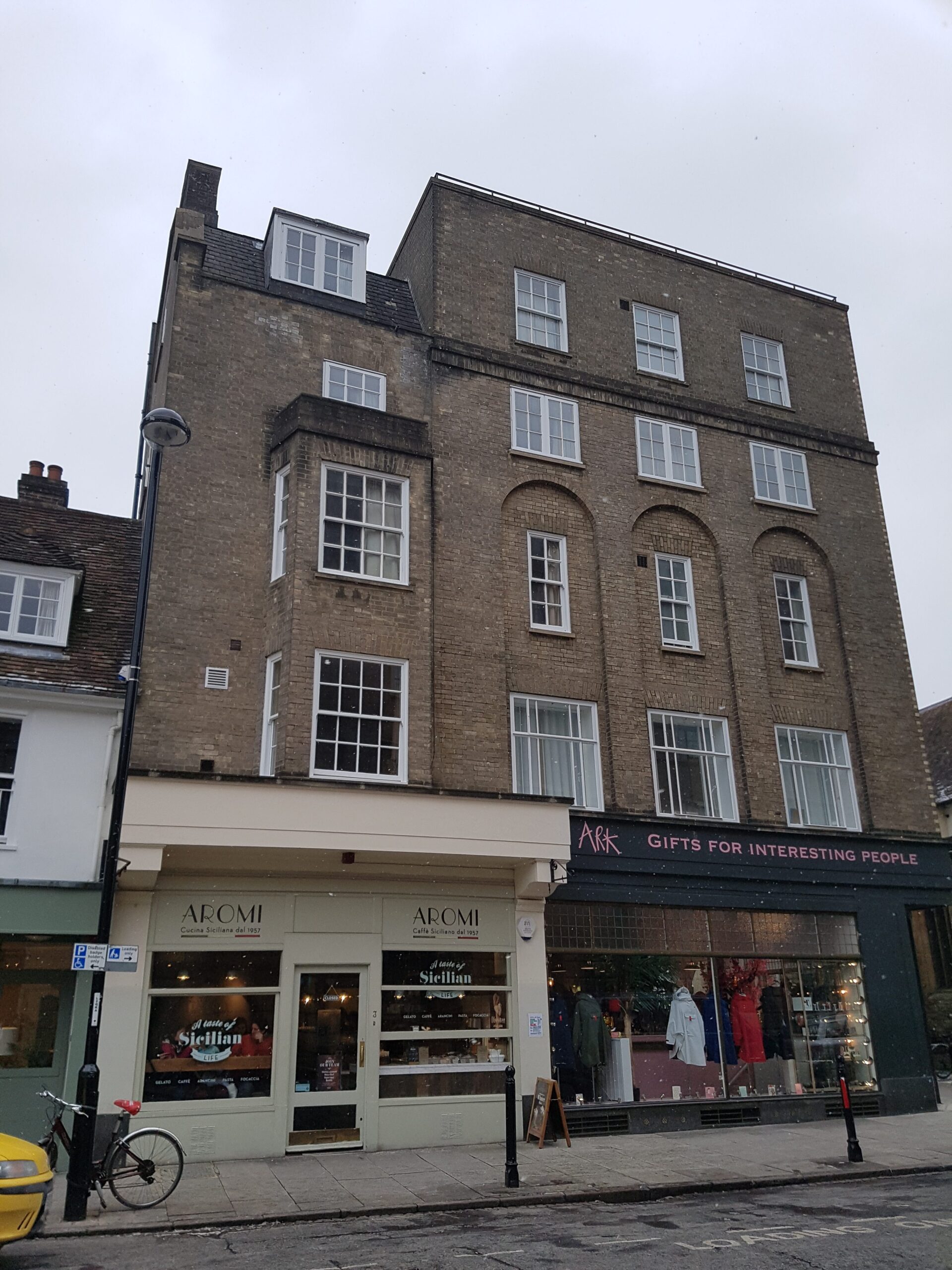
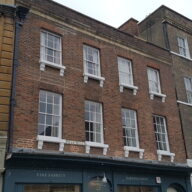
1 – 2 Peas Hill
History of 1 -2 Peas Hill
This has been identified as the site of Alderman Samuel Newton’s house. The following is taken from Wikisource:
Samuel Newton (1628–1718), notary public, born in 1628, was descended of a family who moved to Cambridge from Newcastle-on-Tyne in the sixteenth century, and was the second son of John Newton (d. 1635), ‘limner,’ of Cambridge, and of Anne, daughter of Mr. Hales, who was subsequently married to Joseph Jackson, minister of Woodnesborough, Kent.
Samuel Newton became a notary public, was made a free burgess of the corporation of Cambridge on 8 Jan. 1660–1, and treasurer of the town four years later. In 1667 he appears as one of the ‘24’ of the town of Cambridge, and in the following year was chosen alderman. In November 1669 he was proposed by the master, Dr. Pearson, and seniors of Trinity College for college auditor. He subsequently became registrar of Pembroke Hall, and on 23 March 1673, jointly with his cousin William Ellis, registrar of Trinity College. In 1671 he was elected mayor for the town of Cambridge. Charles II paid a first visit to the university during his mayoralty. In 1677 he was sworn a justice of the peace for the university and town. Ten years later, 16 Sept. 1687, James II addressed letters to the mayor and aldermen of Cambridge, requesting them to elect a certain Alderman Blackley mayor, and to dispense with all customary oaths except that as to the due execution of his office. On the corporation proving refractory, an order of the privy council, dated 8 April 1688, was sent down, removing the mayor, four other aldermen (among them being Newton), and twelve common councillors. Their places were filled by the king’s nominees. Six months later (17 Oct.) the corporation was restored to its original rights, and Newton and his colleagues resumed their offices. He died in his ninetieth year, and was buried at St. Edward’s Church on 25 Sept. 1718. Newton married Sarah, daughter of William Wildbore, son of Philip Wildbore, gentleman, of Cambridge. He had a son John, of Cambridge, surviving, and a daughter Mary, whose tomb stands very prominently in the churchyard attached to St. Benet’s Church. This tomb is adorned with the arms—two shin-bones in saltire—which are familiar as those of Sir Isaac Newton; nevertheless, there appears to have been no connection between the families.
Newton’s manuscript diary, ranging over the period from 1662 to 1717, and of great local and topographical interest, is preserved in the library of Downing College. It was extensively used by Charles Henry Cooper in his ‘Annals of Cambridge,’ and has recently (1890) been printed by the Cambridge Antiquarian Society, under the editorship of Mr. J. E. Foster, of Trinity College.
Evelyn Lord in her book, The Great Plague, uses Newton’s diary and his family as a source for her description of Cambridge during the plague of 1665-1666 (see pages 28ff). Samuel’s house may have had three storeys; it certainly had nine hearths. He became town treasurer in 1664 for which he had to put up a bond of £500. The house had a narrow frontage but broadened to the rear. The house was managed by Mrs Newton with the help of one maidservant hired by the year. Evelyn paints a detailed picture of the Newton family’s life over several pages.
1851
(1 Union Street)
R Oadams, widow, 49, box maker, b Burwell
(2 Peas Hill)
Frederick Hayles, 39, shoemaker employing 1 man, b Fordham
1861
(1 Peas Hill) Public House
Joseph Hunt, 45, harness maker and publican, b Haddenham
(2 Peas Hill)
Frederic Hayles, 49, shoemaker master employing 7 men 8 boys and 3 women
1913
(1) J P Young, draper & milliner
(2) W & R Fletcher, butchers, Joseph Probert manager
21/6/1916 Decorated. Lance Corporal W. Hassock,
London Rifles (who, previous to joining up was employed by Messrs. W and R. Fletcher, Ltd., Peas Hill) has been awarded the DCM. He was attached to a machine-gun section and continued to work
his gun when all his comrades had fallen. (Cam.News)
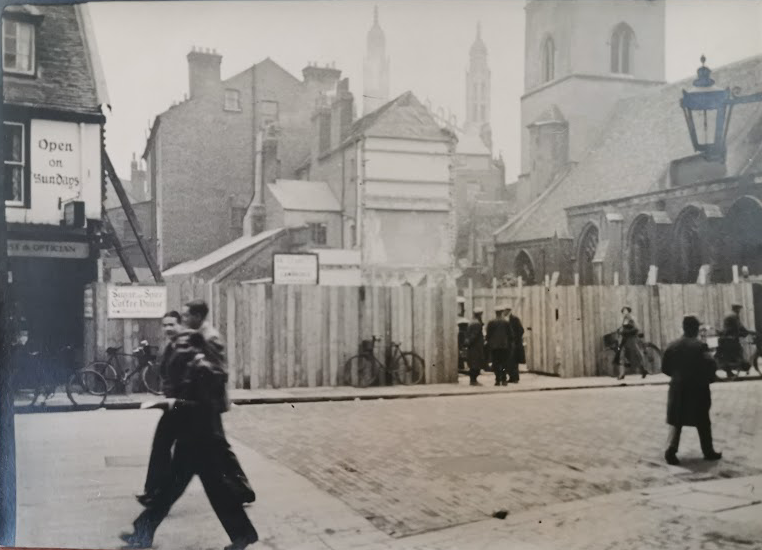
1 – 2 Peas Hill (MoC 77/62)
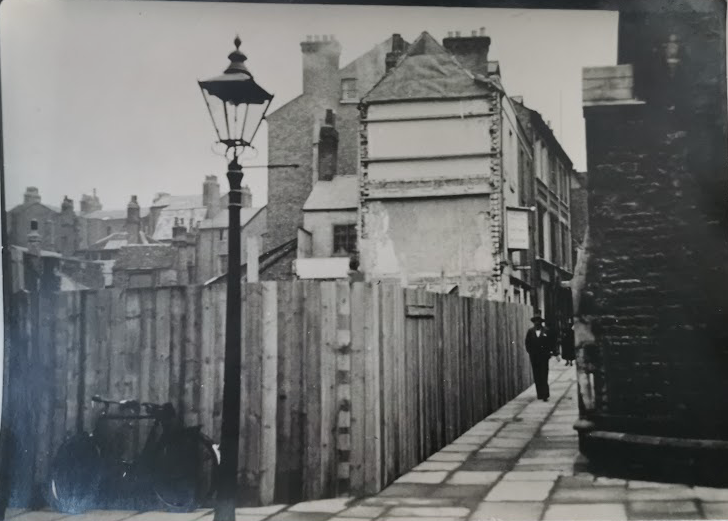
1 Peas Hill / St Edwards Passage (MoC79/62)
1962
(1-2) Automodels, model specialists
(2) G P Reece, radio engineers
1970
(1 – 2) University Audio, radio engineers
2018
Ark, gift shop
Projects
Contribute
Do you have any information about the people or places in this article? If so, then please let us know using the Contact page or by emailing capturingcambridge@
Licence
This work is licensed under CC BY-NC-SA 4.0