Search by topic
- archaeology
- Building of Local Interest
- chapel
- charity
- church
- crime
- dressmaker
- Great Eastern Railway
- Listed building
- Mapping Relief
- medieval
- oral history
- poverty
- Public House
- railway worker
- Religious House
- Roman
- scholar
- school
- Then and Now
- tudor
- women
- work
- world war one
- world war two
Search by text
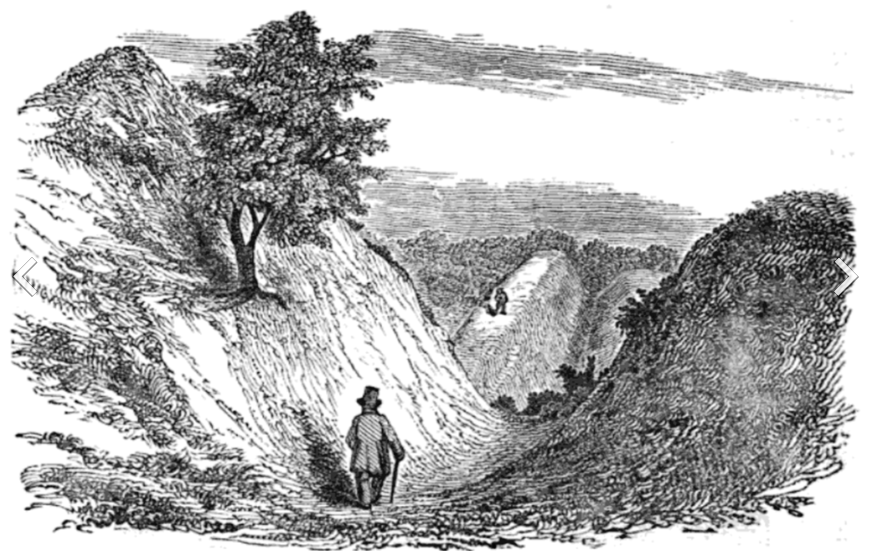 Devil's Dyke (1853) View towards Woodditton (Wikipedia)
Devil’s Dyke, Reach
History of Devil's Dyke
Scheduled Monument
https://en.wikipedia.org/wiki/Devil%27s_Dyke,_Cambridgeshire
In modern times the consensus is that this is a work of Anglo-Saxon origin. In the 19th century it was felt by some that it could be pre-Roman in origin.
Cyril Fox wrote in 1923 (Archaeology of the Cambridge Region): The dyke is aligned with remarkable exactness, no less than 5.5 miles being in the same straight line but each end is slightly deflected. This is undoubtedly due to the fact that from a point on the edge of the forest adjacent to Stetchworth House the 5.5 miles’ stretch was visible, and could thus be accurately plotted out; the terminations on the other hand were aligned by “rule of thumb” methods.
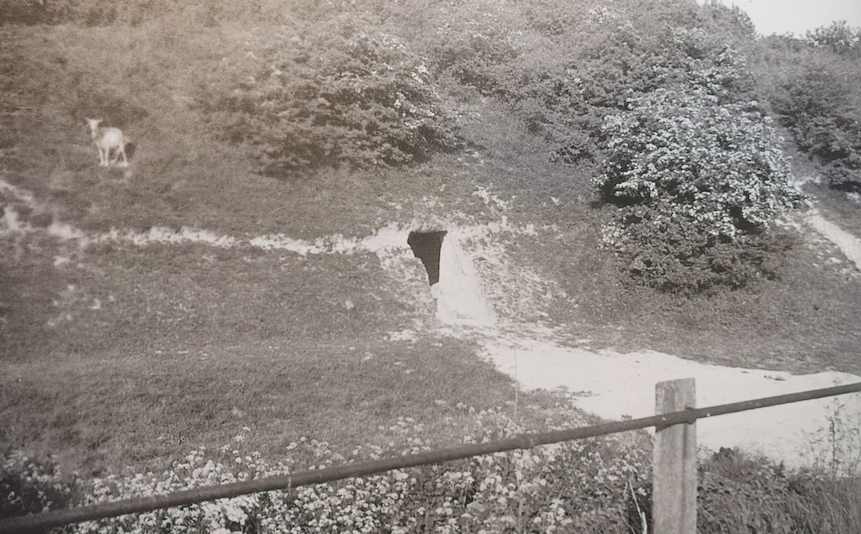
Devil’s Dyke May 1940 (photo M Brindley) (Cambridgeshire Collection)
In World War II an underground storage shelter was dug into the bank of the dyke. It was a Home Guard lookout point enabling them yo watch strategic railway lines and roads.
Projects
Contribute
Do you have any information about the people or places in this article? If so, then please let us know using the Contact page or by emailing capturingcambridge@
Licence
This work is licensed under CC BY-NC-SA 4.0