Search by topic
- archaeology
- Building of Local Interest
- chapel
- charity
- church
- crime
- dressmaker
- fire
- Great Eastern Railway
- Listed building
- Mapping Relief
- medieval
- oral history
- poverty
- Public House
- Religious House
- Roman
- scholar
- school
- Then and Now
- tudor
- women
- work
- world war one
- world war two
Search by text
Scotland Farm, Dry Drayton
History of Scotland Farm
Scotland Farm, although within Dry Drayton, is actually some distance to the south west and closer to the village of Hardwick.
This has always been one of the largest farms in the parish. At the beginning of the C19th the farm was largely arable. At the end of the C19th there was an expansion of dairy farming and model dairy premises were built in 1907. Two ponds by the main farmbhouse collected water which was then pumped uphill. twenty-two cottages were built to accommodate farmworkers.
One farmer was Terah Hooley, son of a twice bankrupt multi-millionaire entrepreneur, Ernest Hooley.
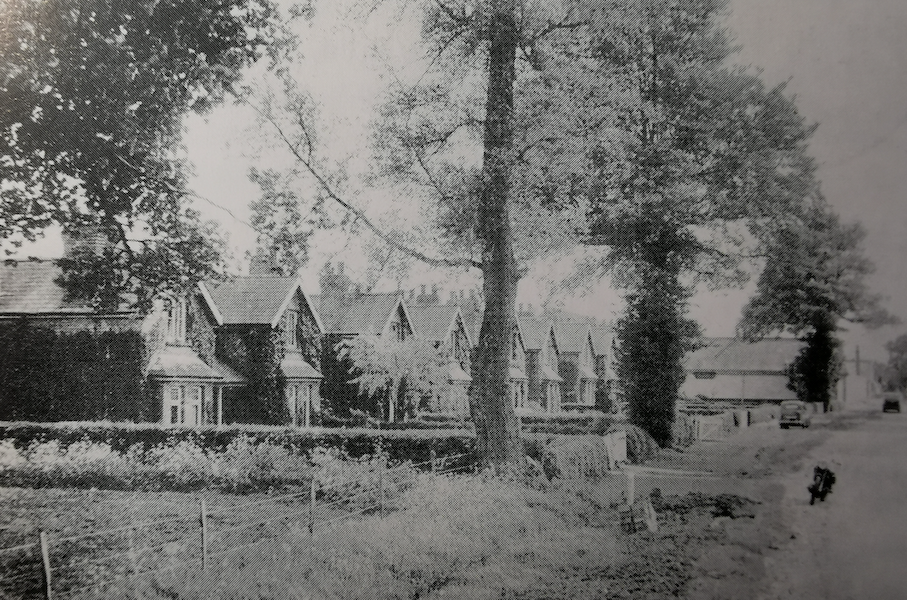
Workers’ cottages at Scotland Farm (from Dry Drayton Millennium History)
1911
John Thomas Jack, 47, farm foreman, b Papworth St Agnes
Mary Ann, 44, b Northants
Henry, 23, farm horse keeper, b Papworth St Agnes
Allen, 13, b Papworth St Agnes
Allen Jack joined up with the Cambridge Volunteer Battalion when he was only 16. He died on the first day of the Battle of the Somme, 1.7.1916.
The farm was bought by William Peck in 1948. Edinburgh Farm became part of Scotland farm and as the farmhouse and buildings were unused they were pulled down around 1950. The farm at the time was mixed with a dairy herd used for milking. In 1958 this was disbanded and a large flock of Suffolk sheep introduced. Then the farm switched to pig farming and by 1972 had become exclusively arable. (See p.76 Gallows Piece to Bee garden)
Peter Jeevar in Curiosities of Cambridgeshire mentions a grain store here mounted on saddle stones.
In 2007 and 2009 excavation was carried out by Albion Archaeology at this site.
https://archaeologydataservice.ac.uk/library/browse/details.xhtml?recordId=3200824
Activity here was dated to the turn of the first century AD.
Projects
Contribute
Do you have any information about the people or places in this article? If so, then please let us know using the Contact page or by emailing capturingcambridge@
Licence
This work is licensed under CC BY-NC-SA 4.0