Search by topic
- archaeology
- Building of Local Interest
- chapel
- charity
- church
- crime
- dressmaker
- fire
- Great Eastern Railway
- Listed building
- Mapping Relief
- medieval
- oral history
- poverty
- Public House
- Religious House
- Roman
- scholar
- school
- Then and Now
- tudor
- women
- work
- world war one
- world war two
Search by text
Church Street / Church End, Fenstanton
History of Church Street
In the 1851 census properties are listed along Church Lane, then Church End until the High Street. This suggests that Church End was renamed Church Street as shown on the 1900 OS map. The Mann house is likely to have been at the north end of Church End / Church Street near the Church.
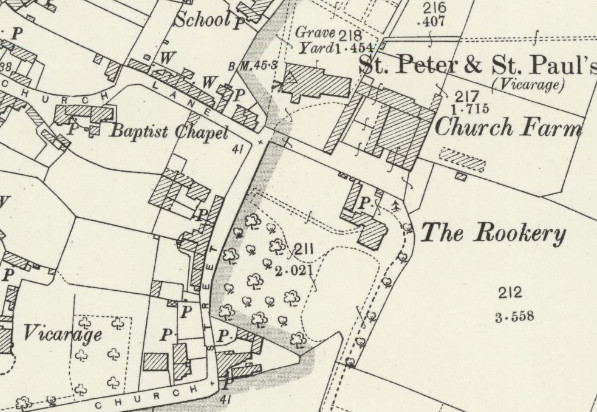
Fenstanton OS 1901
1851 Church End
Thomas Peters
John Mann, 54, farmer of 400 acres employing 18 labourers, b St Ives
Elizabeth, 52, b Beds
John, 27, b Lolworth
Caroline, 23, b Lolworth
Margaret, 19, b Lolworth
Walter, 11, b Fenstanton
Charlotte Hall, 59, annuitant, b Cambridge
Sarah Ireland, 20, servant, b Needingworth
Jane Carter, b 22, b Lolworth
Research by Rory Cunningham suggests that Charlotte Hall was a relative of the Mann family. In the 1841 census Charlotte was at 57 Jesus Lane, Cambridge. In the 1861 census she is living in Clifton, Bristol at the home of Charles Poulet Harris. She died in 1866.
Francis Margetts, 39, clerk curate of Fenstanton, b Hemingford Grey
Thomas Cresswell, 33, pig dealer and farmer of 33 acreas employing 1 man, b Fenstanton
James Allen, 36, ag lab., b Fenstanton
John Bonnet, 33, ag. lab., b Fenstanton
Susan Cresswell, 37, pauper, b Fenstanton
Susan Allen, 65, pauper glazier’s widow, b Hemingford Abbots
William Owen, 29, ag.lab., b Fenstanton
Thomas Crane, 36, baker employing 1 man, b Wisbech
Prior Phippers, 74, retired farmer, b Madingley
William Hard, 57, ag.lab., b Pidley
John Allen, 24, ag lab., b Fenstanton
Sarah Holmes, 32, ag lab. pauper, b Fenstanton
Projects
Contribute
Do you have any information about the people or places in this article? If so, then please let us know using the Contact page or by emailing capturingcambridge@
Licence
This work is licensed under CC BY-NC-SA 4.0