Search by topic
- archaeology
- Building of Local Interest
- chapel
- charity
- church
- college servant
- crime
- dressmaker
- Great Eastern Railway
- Listed building
- Mapping Relief
- medieval
- oral history
- poverty
- Public House
- railway worker
- Roman
- scholar
- school
- Then and Now
- tudor
- women
- work
- world war one
- world war two
Search by text


Poverty in Cambridgeshire
Institutional poverty in Cambridgeshire
Poverty and the Workhouses of Cambridgeshire
For centuries, poverty was one of the defining features of life in Cambridgeshire. Before the creation of the modern welfare state, illness, old age, disability, unemployment, crop failure or the death of a family’s main wage earner could quickly leave people dependent upon charity or parish support. Every community developed its own ways of helping those in need, ranging from medieval almshouses and church collections to parish relief, poorhouses and, eventually, workhouses.
The Elizabethan Poor Laws of 1598 and 1601 placed responsibility for relieving poverty on each parish. Overseers of the Poor collected local rates to provide food, clothing, fuel and small payments to those unable to support themselves. At first, most assistance was given in people’s own homes, but during the seventeenth and eighteenth centuries many parishes began establishing workhouses where the poor could live while undertaking productive work such as spinning, weaving, brewing or baking.
Workhouses were intended to reduce the cost of poor relief while encouraging industry and discouraging idleness. In practice, however, many soon discovered that relatively few able-bodied people entered them voluntarily. Instead, they became homes for the elderly, widows, orphans, the chronically sick and those with disabilities. Some institutions developed reputations for humane management and practical care, while others reflected the harsher belief that poverty resulted from moral failure and should be met with discipline as well as assistance.
Cambridgeshire never developed a single model of poor relief. Cambridge itself relied largely upon numerous parish workhouses alongside Hobson’s famous House of Correction, later known as the Spinning House. Elsewhere, towns such as Wisbech and Ely created substantial workhouses serving wider communities, while many villages maintained small poorhouses or continued to rely mainly on outdoor relief administered by the parish. Local traditions, charitable benefactions and the commitment of parish officers often proved as important as national legislation.
The Poor Law Amendment Act of 1834 transformed this landscape by replacing most parish workhouses with larger Union Workhouses serving groups of parishes. These imposing institutions dominated Victorian attitudes towards poverty for more than a century and remain among the most recognisable symbols of nineteenth-century social welfare.
The historian Michael J. Murphy, in Poverty in Cambridgeshire (Oleander Press, 1978), traces this longer history of poverty across the county, demonstrating that the Victorian workhouse was only the final stage in a much older and more varied tradition of parish responsibility, charitable relief and local welfare. His work reminds us that attitudes towards poverty have continually evolved, reflecting changing ideas about work, charity, responsibility and community.
Related Capturing Cambridge pages:
Hobson’s Workhouse (The Spinning House), Cambridge
Chesterton House of Correction
Great St Mary’s Parish Workhouse, Cambridge
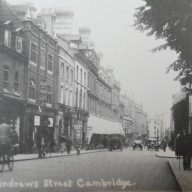
St Andrew the Great Parish Workhouse, Cambridge
Wisbech Workhouse
Ely Workhouse
Chatteris Workhouse
Linton Taske House
Whittlesford Guildhall Workhouse
Cottenham Poorhouse
Further reading
Michael J. Murphy, Poverty in Cambridgeshire. Cambridge: Oleander Press, 1978.
Projects
Contribute
Do you have any information about the people or places in this article? If so, then please let us know using the
Contact page or by emailing
capturingcambridge@
Licence
This work is licensed under
CC BY-NC-SA 4.0


 not including content on external links as indicated
by
not including content on external links as indicated
by .
.